Vanity, Mortality, and Choices

1 The words of the Preacher, the son of David, king in Jerusalem.

2 “Vanity[a] of vanities,” says the Preacher;
“Vanity of vanities, all is vanity.”

3 What profit has a man from all his labor
In which he toils under the sun?
4 One generation passes away, and another generation comes;
But the earth abides forever.
5 The sun also rises, and the sun goes down,
And hastens to the place where it arose.
6 The wind goes toward the south,
And turns around to the north;
The wind whirls about continually,
And comes again on its circuit.
7 All the rivers run into the sea,
Yet the sea is not full;
To the place from which the rivers come,
There they return again.
8 All things are full of labor;
Man cannot express it.
The eye is not satisfied with seeing,
Nor the ear filled with hearing.

9 That which has been is what will be,
That which is done is what will be done,
And there is nothing new under the sun.
10 Is there anything of which it may be said,
“See, this is new”?
It has already been in ancient times before us.
11 There is no remembrance of former things,
Nor will there be any remembrance of things that are to come
By those who will come after.

–Ecclesiastes, 1, 1-11, New King James Version

Some of the best conversations are those that never really end. They are conversations between friends that may take place in both the physical and the virtual, and may vary across the synchronous and the asynchronous. It’s a conversation about something shared that allows for multiple threads of thought. Sometimes one of these threads takes a startling turn.

“Vanity is an interesting companion to morality. ”

Indeed it does. On the other hand, my minor dyslexia has caused me to read this as “mortality” for two whole days. So that’s the way I have I have been thinking of this conversation. Vanity and mortality.

Contextually, I was thinking about mortality and a scene in fantasy novel where one of the antagonists admits that it was his vanity that got him in the end. More directly I was making a link between weight and typical aesthetics. There are some things I do strictly vanity’s sake, but to only a small degree, because too much could be risky or counter-productive.  My thoughts rambled further, thinking about a delicate balance between vanity and mortality, that we’ve upheld certain ideas of fitness and wellness that sometimes look like vanity, but really they are just personal pride in looking a certain way and achieving or constantly striving to achieve a peak level of fitness.

Back when Billy Crystal was on SNL doing an impression of Fernando Lamas, one of his catch phrases was, “It’s better to look good, than to feel good.” This is kind of the ultimate in the vanity of the aesthetic. Perhaps an example of the other end of the spectrum is the runner who really obsesses over running and does little else, while becoming so whittled down,  any standard sense of a traditional aesthetic has vanished. I’ve known a person like this and he was not healthy.

Sometime around 2004 or 2005 I was in Clearwater, FL for a meeting and I went out for a morning run. About three miles in, I ran into an old guy coming towards me. He asked how far I was running and if he could join me. Told him I had done three and planned another nine miles. He looked me up and down, “I’m impressed. You don’t look like quite that fit.” (I was weighing about 250 at the time and had done a couple of marathons, three successful ultras, and a couple of failed ultras.) I looked him up and down, “I’m impressed  that you’re out here running in flip-flops.”

“Oh yeah, they’re good enough and they only cost about a buck apiece.”

Right.

We ran and talked for a couple hours. He was certifiably nutty. Nice, but nutty. Retired and lived in a one room apartment and did very little but just run everyday, all day. He’d carry a spoon and a little bit of cash to buy ice cream along the way to eat while he ran. Sometimes he would just carry a bag of sugar. He claimed he usually ran a full 50K (about 31 miles) and never less than 16 miles each day.

Every day it was all he could do to just get out of bed, he said. It just hurt. Every part of him hurt. Especially his feet and legs. He’d wake up, struggle to a sitting position, sit until he felt he could stand, and then do it all again. He had no discernible fat on his body, nor teeth. He admitted sometimes to spending the winter up north with his family and trying to get “fat” and then return to Clearwater to run it off.

I have no idea how long someone can keep that up.  I don’t think he was as old as he looked, and he really did not look good to my eye. He looked like he was in the process of being consumed. Whatever level of fitness he might have once been trying to achieve he seemed to have taken it too far to a fairly dark place. You can take anything too far.

***

And conversations continue.

“The challenge with deciding to live, not just accepting the body’s deteriorating condition, is really about why.”

While we are young, we feel immortal. Even when someone in our age cohort dies it may shake us, but it seems like we don’t really start feeling mortal until age 30 or so. I remember when one of the guys in our Infantry company died. A popular guy, he took a fall off a cliff while rappelling one weekend. While the guys were pretty shaken, since beer and pot were involved, invincibility and immortality was back in less than a week.

By the time we comprehend and accept, or at least begin to accept, our mortality, our bodies have long since begun to deteriorate. One might stay fit and train at the highest levels, but the fact is the body is aging and wearing.  This is all in the early stages of deterioration for most people, it’s generally not even noticeable. It is the time of life where late night hours are spent in childcare or the endless work cycle of trying to get ahead. Things change though. Harry Chapin touched on this in the song, “There Was Only One Choice.”

When I started this song I was still thirty-three
The age that Mozart died and sweet Jesus was set free 
Keats and Shelley too soon finished, Charley Parker would be 
And I fantasized some tragedy’d be soon curtailing me 
Well just today I had my birthday — I made it thirty-four
Mere mortal, not immortal, not star-crossed anymore 
I’ve got this problem with my aging I no longer can ignore 
A tame and toothless tabby can’t produce a lion’s roar 
And I can’t help being frightened on these midnight afternoons


So we age. Our attitudes age along with our bodies. We begin to recognize the costs of choices we made in our youth and we likely become more cautious, more conservative in our choices. Less recklessness, greater thought for the future.

Because there is less of it, the future. Less of it for us as individuals. We know the future is not some far distant point in time. It keeps getting closer. A friend talks about how small children see time as taking so much longer – a year from now is just so very far away. For a five year-old, a year is 20% of the time they know. For a 50 year-old, it is only two percent. The days run out as we want to do more, to be more, to achieve more, because we finally feel like we know what we want to do, what we can do.

But we grow tired. We tend to be heavier. Our choices have begun to maximize comfort over fitness. We have perhaps actively chosen this, or just accepted the default. Either way, have we chosen to live, or to just continue? And why?

***

Back to the intersection of vanity and morality.

In Oscar Wilde’s, “The Picture of Dorian Gray” we get a morality lesson on vanity. The title character is so enamored of his  portrait and recognizes that every day he on he will be less beautiful than he appears in the portrait, that he offers to sell his soul if only the portrait would age instead of himself. It does not go well. That sort of vanity never does end well. The weakness in Dorian that expresses his willingness to sell his soul is the same weakness of character that leads one into all kinds of debauchery and unsavory activity, activities that affect both physical expression and the aesthetic appearance of the face. These qualities become apparent in the portrait as Dorian’s behavior and soul grow darker and more cruel.

Vanity, narcissism, too much of sense of self over others, are problems. When the inner dialogue is the only dialog that matters. When we never hear the words of others if they are anything short of praise for the self. This is not only bad, it is evil. It is a turning away from society, from community. We don’t exist alone.

***

How do we choose to live with the deterioration of our bodies?

Either following my diagnosis, or following surgery, in my researches, I read that events like heart attacks, brain tumors, cancer, can cause one to to feel that our body has betrayed us. That it has attacked us. This can be devastating to someone trying to find the energy and will do the work of recovery.

It seems to me, looking back, there was no defining moment in my case where I said was going to get through recovery. There were instead of thousands of little decisions to keep trying, to try just one more time, to take one more step, or to forgive myself one more time for not quite taking that next step. Eventually it became a habit, the same way I became obese, the same way I got older. I kept making certain decisions out of habit, a choice to keep to going. And then I made a choice to get healthy again, and this time I would do it right. I would avoid injury and real self-abuse. I would learn from the past about making thousands of little choices over and over again, including choices of self-forgiveness.

In fact, I made the choice to be much more forgiving to myself and stop with negative habits toward a poor sense of self. I accepted that failure in little things, was to be expected, and that success did not, does not require perfection, only commitment and practice.

In the end, there was really only one choice – to live each day, to be present each day that is left. But like the Preacher says, there is nothing new under the sun.

Sometimes Love is Lonely

“Love is hard.”

“Love *is* hard. And sometimes lonely.”

A snippet of conversation between two friends about marriage, caregiving, and family. Most everyone knows that love is hard. Not always, of course, but there are moments, days, and multiples of days in which love is very hard. The hardness generally comes from difference. All couples/families have them to some degree.

  • Difference in politics.
  • Difference in expectations.
  • Difference in desire.
  • Difference in ableness.
  • Difference in ability.
  • Difference in perception.
  • Difference in wellness.
  • Difference in strengths.
  • Difference in power/position.

And so on. There are no limits to the differences possible. Most of the time there is probably never an issue, but sometimes the differences bubble to the top and conflict evolves. If we don’t learn to handle conflict effectively it can get out of hand create more conflict.

There are times though that the differences seem almost insurmountable. Times where the gulf between two people just seems unimaginably large. This can easily happen in a caregiving-based relationship where there is great a differential in the partnership role. It can be lonely doing all the work that *should* be shared between two people (recognizing that in most households there is nothing close to an equal distribution of housework and child-rearing).

That’s one type of loneliness. Another form of loneliness is that of waiting as a part of caring. Waiting at a clinic, practicing patience, perhaps alone with your thoughts of hopes and fears for the future. Waiting as a parent for your child to return home late at night. Or more acutely, waiting by your child’s bedside for the fever to break, waiting for them to cry out. Waiting for a loved one in a hospital to draw a final breath, to say a final goodbye. Waiting for your partner to make the decision to live and be well. Love can be a very lonely vigil.

It’s fun to focus on the excitement, the joy, the goodness, of love. We talk about the hard work of love when we get frustrated if things go wrong or get icky, or we have to do the truly hard work of love. We rarely talk about how lonely love can be. Probably this is because the loneliness is only there when we are doing the hardest work of love – keeping a small light burning in a largely silent vigil.

From Agitation to Love

A friend shared this link with me today, “We can’t survive in a state of constant agitation.” This paragraph is particularly good:

“Yes, actions are important; they are absolutely essential, in fact. But I don’t believe we can survive for long in a state of constant agitation. Our bodies and hearts need rest to replenish stores of energy. This is something best done from a place of love.”

This is the core, I think, of self-care, acting out of love for yourself. Treating yourself as you would a loved one – with kindness, compassion, and honesty. I know this is sounds new-agey to some, and crunchy-granola to others, but ask yourself this: Why shouldn’t you treat yourself this way? If self-love really means treating yourself in this manner, and the reason for doing so is to improve your life, what exactly is the problem?

I never understood this previously. It never occurred to me to treat myself halfway well. That’s why anger became lifestyle and stress became habit. I went on day by day, functioning, sometimes well, but more often than not, it was just good enough. I also didn’t enjoy life the way I should have. I loved my family, I loved my job, but life, perhaps not so much.

As I’ve written before, breathing helps. Counting single breaths, finding the moment, and remaining there, makes a difference and leads to patience. Impatience is costly as it leaves one unsatisfied.  All of this is related to agitation and reversing it. Stress, anger, impatience, are just ways to become and remain agitated. Remove the sources of agitation, if you can, change the responses to stress, and living becomes a little easier. If you can’t remove the agitation, try to reduce the amount of time it crosses into your life.

I have had a number of friends and family members dealing with addiction over the years. Sometimes it was them, their spouse, or other family member. Regardless of who it was with the problem, one of the issues we faced is “dwelling.” In recovery from addiction there is challenge enough for the person with the addiction to deal with the yen, the desire, for the substance or behavior at the source of the problem. In recovery, and I have seen this also with PTSD,  dwelling on past behaviors and failures becomes an issue. I think though it is about more than forgiveness of self or others, that’s hard enough. It is instead about moving on and living in the current moment.

This is hard.

You can dwell on the past all you want, but it is the past. It’s over. The only way you can change it is to change the remembered narrative. You can rewrite your memory. Make yourself the hero, or at least remove the blame from yourself. Of course, doing so is contrary to your best interests. It is fundamentally dishonest with one’s self and that just creates more problems on down the road. Somehow, you simply have to find a way to move on, while maintaining an honest recollection that allows your continued growth and development.

So, I think once you have learned to accept yourself and your history, and learn to love yourself as you are – a flawed individual seeking personal growth and development, you can learn to take better care of yourself. Self-care is critical and when done well, makes all these other things easier. You know you are engaging in good self-care when breathing becomes an act of love instead of a mere act of survival.


Mythos, the West, and Manliness

This picture popped up in a discussion between my sister me (she’s the disheveled little girl causing trouble). But notice me. I’m ready for anything. There’s nothing I can’t handle.

medadanddaphne

After all, I’ve got my trusty six-shooter by my side.

Spending one’s boyhood in Chickasha, OK (the horse-trailer capital of the world and the birthplace of Cleavon Little (but I suspect more people know that I was born there than he)) made it next to impossible to know something about cowboys and to want to be one. It was also the time of the Lone Ranger, even if in re-runs, and the return to “those thrilling days of yesteryear.”

As a family picture, this is kind of oddity in that probably shortly after this, Daphne became the outgoing one, the focus of all attention. I think it must of have been not too long after this photo that things changed and she settled fully into her role as the middle child.

This picture bothers me. My eye continues to be drawn to the holster at my side. Even though it’s a toy, I feel look too comfortable with too much of a challenge in my eye. I don’t remember being a troublemaker at that age. I think that came much later. So I kind of hate the idea that I might be feeling empowered by having a gun at my side, even if it is a toy.

If I carry a gun today (which is rare, but I do deer hunt with a handgun occasionally), I feel weight. I feel the weight of responsibility in all its dimensions and risks. I feel far more responsibility than power. I also feel the actual weight. My choices in weapons lean towards the heavy and reliable. But heavy. I really find nothing empowering about a gun, knife, or other weapon. I find them burdensome, with the exception of a really good knife or Leatherman’s Tool in the great outdoors.

I’ve carried and used a lot of weapons. Everything from a pellet gun to a 90mm recoilless rifle with a lot of dangerous in between, so it’s not a question of lack of experience or knowledge. I have had some serious training, including sniper school at Ft. Campbell and I know how much fun it can be to just blow shit up with explosives. But I think I would tell little Tod, if I could, to find other toys. Not to ask for the Johnny Eagle M-14 and M-1911, both of which shot spring-loaded bullets.

On the other hand, I grew up having compulsion against serving in the Army and tackling whatever came my way, so it may not have been all that bad a thing to have all those toy guns. But Zach did not grow up with a toy guns, and instead had other toys that may have included cabbage patch dolls, but still he became a hunter. Peer experiences can be powerful.

I notice a lot of people carrying around town.

They don’t really seem to have the confidence of the little boy above.


Racing in the Streets

More than any place else I lived in growing up, I called Joplin, MO home. It was my Home of Record when I was in the Army. It was the place I went home to for the holidays and special events. It was the place I always returned to when life changed until after grad school.

Joplin is Midwestern town through and through. Coming of age there in the late 70s and early 80s cars, girls, and danger. Dragging Main Street was the thing to do on the Friday and Saturday nights. The endless cruising, talking car to car, stops in parking lots, the occasional fight, and the more frequent race off the change of the light.

I got a sixty-nine Chevy with a 396
Fuelie heads and a Hurst on the floor
She’s waiting tonight down in the parking lot
Outside the Seven-Eleven store
Me and my partner Sonny built her straight out of scratch
And he rides with me from town to town
We only run for the money, got no strings attached
We shut ’em up and then we shut ’em down

-Bruce Springsteen, “Racing in the Streets”

I kind of loved it all. Even though most weekends it was pathetically boring.

Except the racing.

Joplin is laid out overlapping the bulk of two Survey Townships. Two thirty-six square mile grids with main streets (including Main St.) spaced a mile apart and razor straight. Not flat, but not hilly enough to do much more than hide a waiting squad car. Officially, Main Street proper seems to be just under four miles. It’s not much, but it doesn’t need to be much with a dozen or so traffic lights interspersed and the only distance that matters is between two traffic lights.

I might have won a few races here and there. Now, I’m not admitting to have ever actually raced, because that would be wrong. Would have been wrong, and against my parents’ wishes and the way I was raised. And we know, a 1977 Ford Pinto was never expected to be fast.

Unless you knew it had a 2.8L six cylinder under the hood instead of a weak-ass four-banger.

I love cars when they work. I’ve learned to hate cars when they don’t. I tried being a mechanic. I replaced the warped aluminum four-cylinder of a Chevy Vega with an eight cylinder Chevy 350. That car was dangerously fast. Especially when the steering linkage failed.

***

Much of my life can be described as history of cars. Some good, some bad, some that I really, really, really should have stayed away from. There were one or two that seemed my heart and soul.

But I have no pictures of most. In some ways this is kind of strange, because for years I was trying to be a photographer. I never took pictures of my stuff or my life. I just took pictures of other people, other lives. This was brought home last Sunday when I received a Facebook friend request from someone I served with in the Army. We connected, exchanged a few messages, and I noticed he had pictures of those days.

It never occurred to me take pictures of my Army experience. Never. Admittedly, my life was pretty miserable because of the marriage I was in at that time so I am pretty sure I wasn’t thinking I would want to recall those days. There are pictures of my son from that time and a few family pictures and that’s about it.

***

“Racing the Streets” is one of my favorite Springsteen songs. I don’t actually make an effort to play it. It is one of those songs, like “The River”, that I think is best when it just comes on the radio and I say myself, “Ahhh, I really love this song.”

But now there’s wrinkles around my baby’s eyes
And she cries herself to sleep at night
When I come home the house is dark
She sighs, “baby did you make it all right, “
She sits on the porch of her daddy’s house
But all her pretty dreams are torn,
She stares off alone into the night
With the eyes of one who hates for just being born

-Bruce Springsteen, Racing in the Streets

But I remember us riding in my brother’s car 
Her body tan and wet down at the reservoir 
At night on them banks I’d lie awake 
And pull her close just to feel each breath she’d take 
Now those memories come back to haunt me 
they haunt me like a curse 
Is a dream a lie if it don’t come true 
Or is it something worse 
that sends me down to the river 
though I know the river is dry 

-Bruce Springsteen, “The River”

I remember these days of cars, of the Army, long ago. I don’t really recall what my dreams might have been, other than perhaps of glory and fortune. Clearly, those did not really come true, insofar as most people might measure these. But did the dreams die or did they evolve?  Were they every really there?

What I do know is that time rushes like a damn river. It passes by quickly and no matter what you do, you can’t step in the same piece of water twice. It is always moving, always different, never at rest. Time passes and the water moves on. It’s this moment that matters. What has been done can’t be undone, what has happened can’t be changed, and one can only seek redemption in the current moment..

****

A few months ago I wrote about the price of impatience. In my continued reading about mindfulness and trying to live in the moment, I ran across this passage from “Wherever You Go There You Are” by Jon Kabat-Zinn:

I see patience as one these fundamental ethical attitudes. If you cultivate patience, you can’t help but to cultivate mindfulness, and your meditation practice will gradually become richer and more mature. After all, if you really aren’t trying to go anywhere else in the moment, patience takes care of itself. It is remembering that things unfold in their own time. The seasons cannot be hurried. Spring comes, the grass grows by itself. Being in a hurry usually doesn’t help, and it can create a great deal of suffering, sometimes in us, sometimes in those who have to be around us.

Patience is an ever present alternative to the mind’s endemic restlessness and impatience. Scratch the surface of impatience and what you will find lying beneath it, subtly or not subtly, is anger. It’s the strong energy of not wanting things to be the way the are and blaming someone (often yourself) or something for it. This doesn’t mean you can’t hurry when you have to. It is possible even to hurry patiently, mindfully, moving fast because you have chosen to.

From the perspective of patience, things happen because other things happen. Nothing is separate and isolated. There is no absolute, end-of-the-line, the-buck-stops-here root cause.

And the river keeps rushing by. I read this and said, “Yep, just says it differently. The price of impatience is to be unsatisfied and anger is at the source.” These have been the big things I have tackled this year, with some success.

You make up your mind, you choose the chance you take 
You ride to where the highway ends and the desert breaks 
Out on to an open road you ride until the day 
You learn to sleep at night with the price you pay 

Now with their hands held high, they reached out for the open skies 
And in one last breath they built the roads they’d ride to their death 
Driving on through the night, unable to break away 
From the restless pull of the price you pay 

Oh, the price you pay, oh, the price you pay 
Now you can’t walk away from the price you pay 

-Bruce Springsteen, “The Price You Pay”

Patience.

Take a breath.

Count to one.

Exhale.

Repeat, as needed.

You are always in the moment of the current breath. Why count beyond? There is no need to race about, no need to just react. Breathe. Be. Patience.


How I spent my summer

So I looked at the scenery,
She read her magazine;
And the moon rose over an open field.
“Kathy, I’m lost”, I said,
Though I knew she was sleeping.
“I’m empty and aching and
I don’t know why.”Counting the cars
On the New Jersey Turnpike
They’ve all come
To look for America,
All come to look for America,
All come to look for America.

 -Simon and Garfunkel, “America.”  
 My wife and I spent three weeks on the road.   We drove a grand total of 5,024 miles to explore the Upper Midwest and the Northeast with what is billed as the “Coolest Camper Ever.” Now the thing is, this camper is really just superbly-designed tent-on-a-trailer. It is a very utilitarian camper, one that when compared to RVs and bigass trailers, is as Spartan as a Walmart tent. While the Sylvan Sport GO is great camper, it does not have all the creature comforts one is used to, especially after a number of years of recovering from multiple surgeries and learning to live with limited mobility. This was going to be a challenge for Melinda. While she was all in on it, I was of two minds knowing that a trip like this could build and strengthen a relationship or tear it apart.
Or just leave it as it is with deep new scars.
We survived. We emerged with a stronger relationship and a continuation of the rediscovery that began on the trip from Philadelphia to Joplin back in May. Recovery from multiple surgeries is challenging enough. When these surgeries leave one still disabled and in chronic pain, it is easy to shut down and to just quit. Melinda has been working hard for months to break out of that mode. What she accomplished on this trip by hanging in and dealing with pain and discomfort and camping is pretty damn impressive. When it hurts to walk all the damn time, the last thing one wants is have a fifty or hundred and fifty-yard walk to the washroom. She did it though
And we had a great time.
This trip started out with choosing between two conferences: One in Charleston, SC and the other in Minneapolis, MN. Summertime and the fact that Melinda needed Wisconsin, Michigan, and Rhode Island to complete her list of the lower 48 states she has visited, and I needed Michigan, Minneapolis as part of an epic road trip was the obvious choice. We did a trip like this in 2000 when our son was nine. That trip started in Oregon and created a funky loop passing through Crater Lake, Dinosaur National Monument, Santa Fe, Joplin, MO, the Field of Dreams, Rushmore. Crazy Horse, Devil’s Tower, Yellowstone, and Grand Coulee. That was a camping trip. With a monster tent that I hated setting up.
We did this summer’s trip in style. Just about as minimalist as a tent, but in style.
20170813_173950

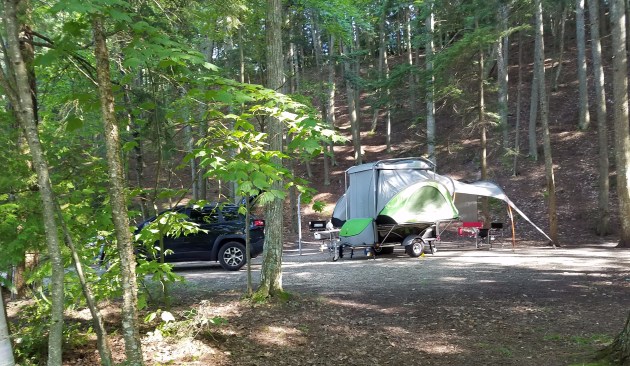
Our Sylvan Sport GO set up at Brevort Lake, MI.

The SylvanSport GO is the coolest camper ever. (It says so on it’s side.) At 840 lbs it is towable by just about any car. Further, it hardly impacts the fuel economy of our Cherokee. I can set it up completely by myself, without rushing, in 26 minutes, including the awning (which takes about 6 minutes of the 26). This thing is incredibly well-engineered and flexible. For someone like me who really values utilitarianism, this just about a dream come true.
We ended our first day of driving in Cleveland at the Rock and Roll Hall of Fame and Museum. That was fun and I could have spent a lot more time there. Especially since the museum pays homage to all the forms of music that influenced the development of rock and roll, like my hero, Pete Seeger.
20170805_185445

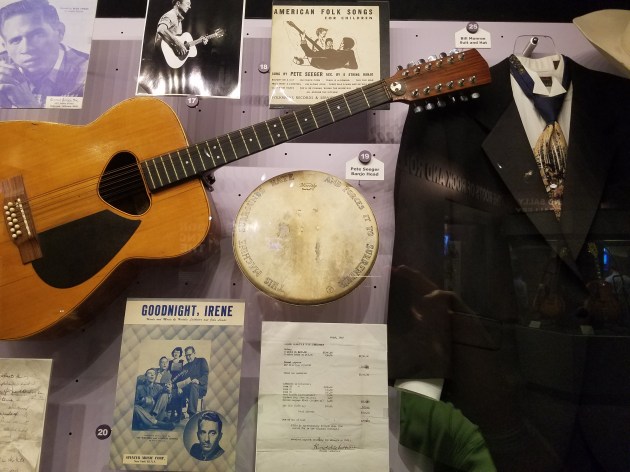
Pete Seeger display at the Rock and Roll Hall of Fame and Museum consisting of his banjo head with the stenciling “This machine surrounds hate and forces it to surrender.”

We made it Minneapolis and parked the trailer at an Extra Space Storage center north of the city. First month’s rent free, $25 dollar setup fee, canceled at the end of the week. Total cost for storage, $25 – far cheaper than parking the car in the city. Next time we might leave both vehicles in storage.
2017 Vacation

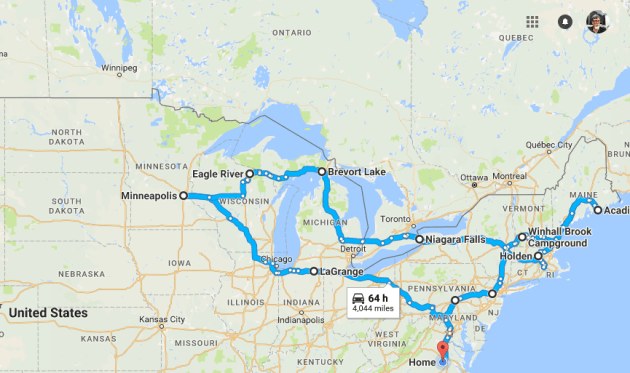
A Google Map image showing the route of our travels.

We left Minneapolis on a Friday for Eagle River, WI and a private campground. Along the way I saw a family of Sandhill Cranes in a field. I wish I had been able to get a picture because they were pretty special – I hadn’t anticipated them. Our next stop was Marquette, MI on the shores of Lake Superior and a very nice National Forest Service campground on Brevort Lake across the highway from Lake Michigan. The picture above of the camper is from that campground.
20170812_211603

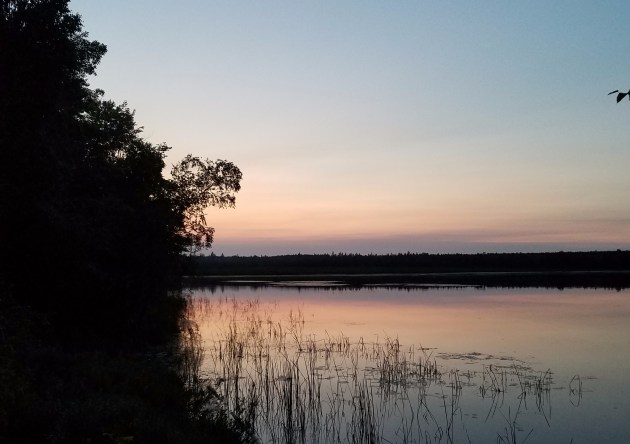
Sunset at Brevort Lake.

Because of a dropped cellphone and a kind soul, we spent a day returning the 150 miles to Marquette and back. This allowed us to experience pasties (pass-tees) and Michigan cheese curds and to explore a little more of shores of Lake Superior and Lake Michigan, both of which were pretty great.
20170813_144606

On the shores of Lake Superior with a bronze sasquatch staring at me and my cheese curds.

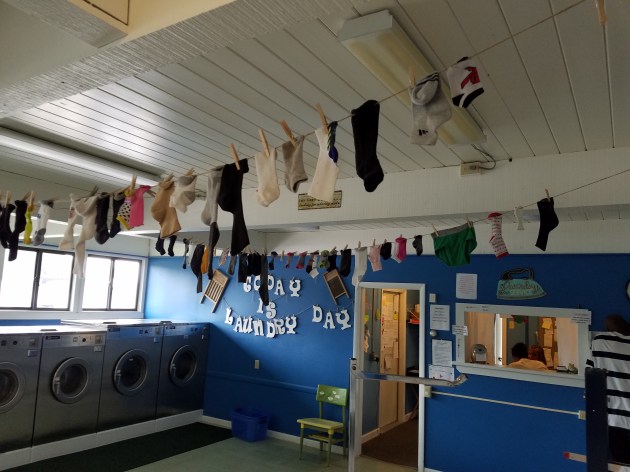
We left Brevort Lake and crossed the bridge between Lake Huron and Lake Michigan into Mackinaw City Where we found laundromat and pizza delivery. It was kind of like the island (peninsula, really) of Lost Socks.
20170814_125240

Lost socks hanging from clothes line of the ceiling of laundromat in Mackinaw City.

At this point in the trip, we started experiencing some anxiety. The lost cellphone, the changing of plans resulting in missing planned visits to a museum and Mackinac Island, and just the general anticipation of a rugged campsite without running water became too much. So we did a motel night to rest and regroup. I had anticipated this might be a necessity at least once, so it wasn’t a big deal. In fact, I really wasn’t sure how many consecutive nights camping we would make. Melinda hadn’t camped in years and life has changed quite a lot since the last time.
We finished the trek across Michigan and crossed the border into Ontario. I’m thinking about spending a summer in that part of the province. I want to make that same drive, about 15-20 minutes a day. Why? It seems that is how far apart the exits are that lead to at least one golf course. I figure this would give me a month of playing time, twice a day, without much stress. At least until I got close to Toronto and Niagara and all the crazy traffic.
The RV park in Niagara was multicultural. Definitely moreso than than the others we used.  There were also plenty of short-term campers in the section we were in as campers left daily and new ones arrived.
I saw Niagara Falls in 2001 when in Toronto for a conference. (That was the trip I took off driving without any documents about where I was going other than “Toronto.” Fortunately, I realized after just a  few hours on the road and was able to contact a colleague for the hotel name.) They haven’t changed much. Still an awful lot of water being pushed off of high cliffs and splashing against rocks and more water. Impressive and lovely but not really enough so to just hang around all day with thousands of goofy strangers. Melinda ended up feeling the same way, so we explored, had lunch and went to the casino. The casino was a bust – we had much better luck at Christmas Casino in Christmas, MI.
After Niagara we headed for Massachusetts to see our son and fiancee. This campground (private) presented a new set of challenges. In Wisconsin the walk to the washroom was short, level, and on soft ground. In Michigan the walk was quite a bit longer (150 yards all told) but still basically soft and flat. In Massachusetts it was a shorter walk, but up and down some steep little hills with a surface of broken asphalt and rock. This was a challenge for Melinda, day and night, but most especially at night. She handled it though. And so did I. I walked with her as much as four times a night, hand-in-hand. There is something special about being awakened from a sound sleep to take a walk in the middle of the night with your love. I don’t think I ever got irritated being awakened as I knew she wanted and needed me to help steady her and prevent her from going astray in the dark. (The latter can happen. It did. Just once.) I think this helped spur  the greater closeness we found together.
20170820_120640

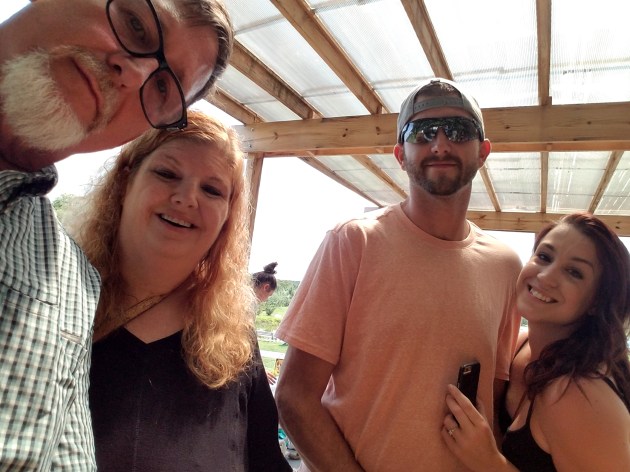
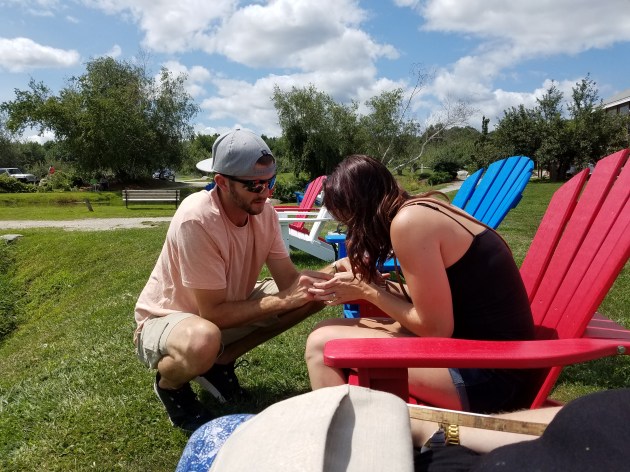
Us. Me, Melinda, Zach, and Kristen.

20170820_123006

Skill development. Learning to whistle or screech with a blade of grass.

Anyhow, we spent a delightful weekend with the young couple.
Time at a winery for a tasting, lunch, and then some very silly card games. Because of crowds and how the state shuts the park down at capacity, we were not able to get in and walk around Walden’s Pond, thus sparing friends and family a gratuitous post of Zach and me thorowing a Frisbee around. That was my biggest regret of the trip. We did at least see the pond from the road …not more than a stone’s thorow away.
We drove next to Acacia National Park in Maine. We noted the eclipse while stopping at a backroads grocery store, but we didn’t really pay it much mind. We were more concerned about lobster rolls, blueberries, and getting to the Schoodic Campground, which is on the mainland section of the park. It is a very sweet campground. Not as heavily trafficked as the island and thus much quieter and more sedate. It just takes longer to get to it as it about 40 miles from the park’s headquarters. It truly is lovely and the skies are dark. The first couple of nights there I just marveled at the stars and the Milky Way, the way I had on the Upper Peninsula. The third night, well, it was raining. There are some marvelous little hikes in the park.
20170822_165743

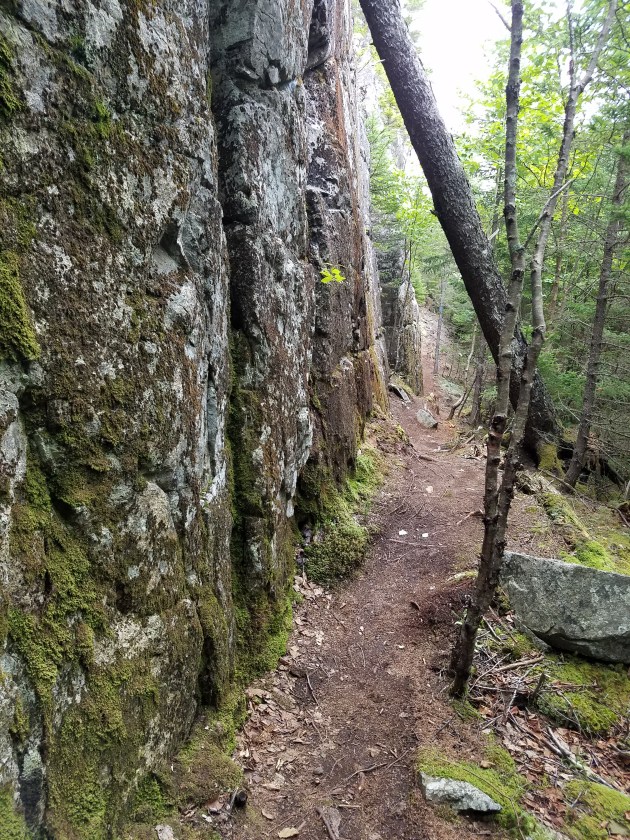
A rock wall along one trails at Acadia NP.

Our last night camping was spent at the Winhall Brook Forest Service campground about 30 miles north Brattleboro, VT. It was lovely and pleasant in the mountains along a trout stream, with great campsites and facilities.
But it was a long, slow slug getting home, mainly just trying to get across, and then out of, New Jersey and avoiding I-95 until the very end. We made it  home close to midnight in better shape than when we left. We were tired, but friends. We were also much closer than we have been in years as a couple. Yes, we have been close as a caregiver and patient, but that is a different and difficult relationship, one that we have been moving away from. For three weeks there was an enforced proximity of travel and with it a commitment to see the journey through that caused us both to be more willing to stop, take a breath, think, and then act or speak. It was helped by the fact that both of us have been working on mindfulness and meditative practice as part of our self-care.
All the work I have done on self-care was a big part of what made this trip a success. Taking time to find peace and inner calmness is one thing. Putting your body and mind in a state where those things can be achieved and appreciated is a whole other thing. Self-care is really a part of relationship care that we don’t talk about enough. It is much easier to be there for someone else when you have taken care of yourself.

life in road trips

Melinda and I just finished a three-week road trip  covering 5,024 miles. There will probably be a post about that trip, but I have been thinking about previous road trips. I have now visited all 49 continental United States and have done some extraordinary trips.

2017 Vacation

Summer 2017. First real vacation since 2017.


st pete round trip

AIR Forum 2003. Not an epic trip, but memorable.

San Antonio Trip

SREB Data Exchange , 2016.  The second of longer road trips with Melinda after her multiple surgeries. The first was a somewhat similar route to Austin, TX for Vertex.

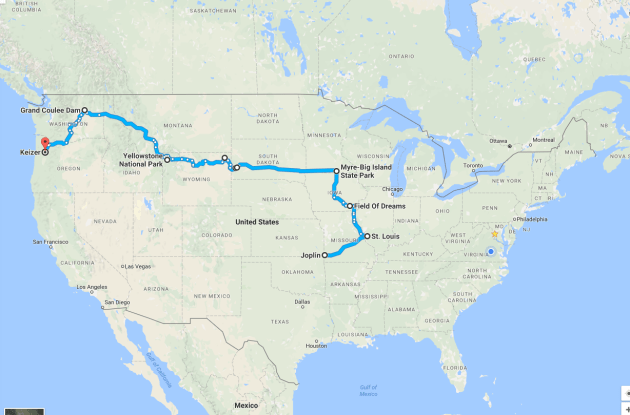
Leg 1 Keizer to Joplin

Leg 1 of a family road trip in the summer of 2000 that included a visitS to Crater Lake and Dinosaur National Monument.

Leg2 Joplin to Keizer

Leg 2 of the trip in 2000. Stops included the Field of Dreams, Rushmore, Crazy Horse, Devil’s Tower, Yellowstone, Grand Coulee Dam, and Multnomah Falls. Both halves of the trip were predominantly tent camping.

Ft Campbell to SeaTac

In 1983, my unit (B Company, 2nd Battalion, 502d Infantry) at Ft Campbell, KY rotated as a unit to assignment in at Ft Richardson, AK. We were all to meet at SeaTac to fly in together. We turned this into a rather crazy trip to see family and sights.

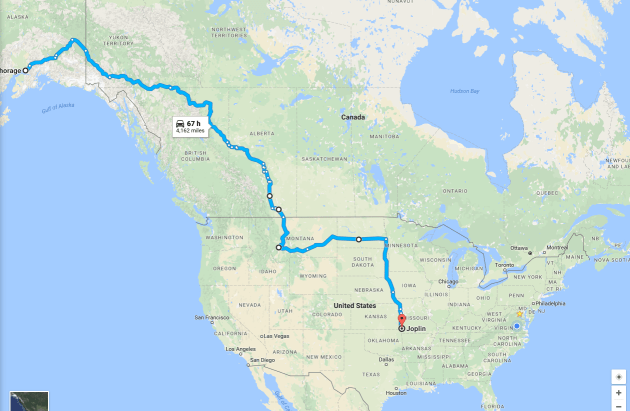
Anchorage to Joplin

In 1985, when I left active duty, we drove from Anchorage, AK to Joplin, MO.  Sections of the highways in Canada were still gravel. It was late March. The personal dynamics between my first and wife and myself were, shall we say, difficult. Very difficult. Much of the trip is a blur, enough so that I might wish to revisit the route.

There are other cross-country trips that could be included. The move from St. Louis to Oregon, with two small children, a U-Haul towing a truck and a separate car. Or the move from Oregon to Virginia in January 2001. Winter trips are often a much different sort of experience. Plus dozens of trips to Joplin, MO and/or Chickasha, OK to see family, from various points. Basically, just a lot more miles than I sometimes appreciate.

Bottom line is this. I love road trips.


A philosophy of counting and analytics

“It’sa dangerous business, Frodo, going out your door. You step onto the road, and if you don’t keep your feet, there’s no knowing where you might be swept off to.”


― J.R.R. TolkienThe Lord of the Rings
It is likewise a dangerous, or perilous might be a better word, business to begin to count things. Once you start counting, you never know where it will take you. What you do know, or at least what you should know, is that where it takes you is highly influenced by your assumptions in place when you began to count.

Counting is fundamentally an act of control. We seek to understand and thereby control our environment or our relationship to our environment. We seek to control things by counting in order to manage their exchange or monetizing the things being counted. We control people through counting in a number of ways, not the least of which is to define groups in and out of existence.

The notion of “information justice” captures this latter idea. Jeffrey Alan Johnson defines it thusly in an upcoming text:

“Information justice refers to the fundamental ethical judgment of social arrangements for the distribution of information and it’s effects on self-determination and human development. It is a broader subset of the notion of political justice, applied to questions of information and information technology.”
And so my challenge of how I think about and how i perform counting and analytics is this.

How do we count without doing harm, without taking away voice and recognition from minority groups, and how do we use analysis to improve outcomes without stealing it denying agency of those we claim to serve?

So, I have a few principles that I follow.

1) Counting must give safe voice to the voiceless. We can’t allow counting to become a tool of targeting subpopulations. We must think about the act and processes of counting to protect confidentiality as appropriate.

2) Counting and reporting should illuminate and guide decision-making in non-harmful ways. By this I mean that data and information displays should follow good practices of clarity and appropriateness of context and completeness. There should be clear statements of the limits of any measure. Average wages of graduates by itself has so much potential used by itself to be completely unrepresentative of 80% of people reported under such a measure. Distributions matter.

3) Analytic models that result in risk factors that include race/ethnicity or gender are indicators that you are measuring against the students or clients you wish you had, not those you have. We should delve more deeply into understanding the relationship between what we do and who we think we are serving.

4) Slick displays and data visualizations are too often like air brush paintings where the artist can’t draw. Slickness is often used to hide the lack of substance. Simplicity and basic displays are better for highlighting difference or the lack of distance.

5) There is often no other more powerful act than the act of definition. In the absence of definition, creating and publishing one is powerful, even without fanfare. A definition may seemingly lay dormant on a web page for years and then appear in law. It’s powerful and a tremendous responsibility.

I guess to sum up I would say this.

I count to give voice and support to those we serve, striving to do no harm, and to never restrict nor deny agency to those being counted. The analytics I perform are to improve systems’ and institutions’ understanding of self and to support individuals in finding the excellence in the lives they desire, within the domain of my work.

thoughts from a conference

I’ve been doing higher ed data and data policy for a long time now, almost three decades. I now have staff that are younger than the length of time I’ve been doing this stuff. It’s enough time to see that we continue to try and solve the same problems, just with different language and different metrics.

I think also not many of my fellow practitioners are thinking deeply about why we count. It’s easier to talk about what to count, how to count, but not why. There is a lack of fluency with the history of higher education and how it connects with American history. Also, it the nature of counting itself seems to be of non-interest. I draw blank stares when I talk about counting to one or counting as an act of control (although sometimes a light goes on here).

So now I am bringing the concept of “information justice” to the discussions. That seems to stir interest. It’s still the same conversation, just at a different level that seems more actionable since it provides a script, or at least the appearance of a script. But justice of any type is not something that should have to originate out of the idea of “doing justice.” Instead, it should originate from your thoughts about why and how you are doing something to ensure fairness and equity. Too often justice comes into play after the fact in order to clean up the messes that occur from sloppy thinking and acting.

Another thing that is clear to me is that I need to write up the philosophy that drives what I do (and what I don’t do). See, my thinking about analytics and data use has evolved tremendously over the years. I used to be a true believer about using neural networks and other precursors of predictive analytics, but now I have serious doubts. More and more I have become concerned about information justice, long before I knew there was such a term. I’ve generally thought about things in much simpler terms like “counting to one.”

Stay tuned. I will be writing a philosophy of counting while on vacation.


Talking with strangers

I. Am. Not. Good. With. Small. Talk.

I’ve said this before, I’m sure. I do the make the effort though. I will  talk with anyone, especially if there is a possibility of learning something useful.

There is also something about how I present to the world that attracts a more than generous share of persons with alternative experiences of the world I live in.

Tonight, west of Chicago in a service plaza, I encountered such people. They (an older, elderly couple) had pulled up nearby while Melinda and I were eating sandwiches constructed out of the back the car. They seemed very interested in us. Actually, it was our trailer. The old guy said he used to sell RVs and has never seen a camper like ours. Seemed to think it was something the Germans would build. (For the record, our SylvanSport Go is built in North Carolina.)  So, anyhow he wanted to know about the trailer.
After I gave him the rundown, he asked if I was salesman. Nope, just a traveler. Asked where we were going. I gave him few places. He had opinions. Not as strong as his opinions about Illinois and Chicago and why they were moving too much saner Florida on the Redneck Riviera but opinions. (Yes, I laughed openly at this.) Apparently every place he has lived has treated him badly.

In five or six minutes I learned more of his life history than he was ever going to learn of mine. I also learned I probably wasn’t going to learn anything really useful in this conversation. This caused me to immediately get bored with it all land just listen politely hoping that some of clown twenty years from now listens politely while I ramble on about the injustices of my life.

I’m sure I could do this better. But it seems like I would have to ask more questions. That would seem to indicate interest where I have none.

I guess I have to learn to be more interested in strangers.