Mixed Metaphors: Of Cowboys and Kings; and Tigers

TIGER, tiger, burning bright
In the forests of the night,
What immortal hand or eye
Could frame thy fearful symmetry?

In what distant deeps or skies 5
Burnt the fire of thine eyes?
On what wings dare he aspire?
What the hand dare seize the fire?

William Blake, “The Tiger”

A long damn time ago, there was a conversation between a girl and me. I can recall it like it  was just the other night. she was gloating that she had finally “caught” me. (Yes, there have been times I was hard to get.)

“I’ve got you, you’re mine!”

“Really? So, what’s your plan?”

“Plan? I don’t need a plan.”

“Are you sure about that? I know that if *I* were trying to catch a tiger, I’d have pretty darn good idea about what I was going to do with it. Would I let it go? Try to tame it? Or just kill it? Tigers are are unpredictable and dangerous. We don’t make good pets.”

“I’m going grab on to your ears, hold on,  and ride you for dear life.”

“Good luck with that. Please note that I didn’t compare you to a dog chasing a car….”

This conversation has been on mind lately. I have been chasing a specific tiger since 2002 and it looks like I am about to catch it. I am now questioning if I am going to be able to wrestle it into submission and tame it. It won’t be easy. I hope to hell I haven’t made a mistake.

Isn’t that the way it goes sometimes? You want something badly, work to get it, and when it comes to you…you become afraid that it is not quite what you dreamt. There is more work, more complexity, more of something needed.  In other words, you get what you want and so what comes next?

I got a small query for yooouu
What comes next?
You’ve been freed
Do you know how hard it is to lead?
You’re on your own
Awesome…wow
Do you have a clue what happens now?
Oceans rise
Empires fall
It’s much harder when it’s all your call

Lin-Manuel Miranda, “What Comes Next” from Hamilton.

So, you buckle up, and you go for it. Grab the tiger’s ears and hold on for dear life and ride him till he tires.

I’m not positive, but I *think* we are all watching someone in DC who caught a tiger, grabbed on, and then realized “What the fuck! This is not what I want.” Yep. Tigers are beautiful, powerful, and indolently dangerous. A careless swipe of the paw can drive a person to their knees, or worse. That same paw would certainly pulverize a semi-sentient Cheetoh.

I think the Cheetoh might know this.

Reminds me of another song. Sometimes, you just stumble upon someone or something that seems kind of cool. Intriguing and exciting, perhaps that takes your breath away. However, remember to breathe. Catch your breath. Think about the implications of what comes next. It’s not all skittles and beer.

‘Cause what’cha gonna do with a cowboy
When that old rooster crows at dawn
When he’s lyin’ there instead of getttin’ out of bed
And puttin’ on his boots and gettin’ gone
What you gonna do when he says honey
I’ve got half a mind to stay
What’cha gonna do with a cowboy
When he don’t saddle up and ride away

Chris LeDoux, “Whatcha Gonna Do with a Cowboy”

Of course, that’s my advice to others. I’m just going to go all in. “Damn the torpedoes, full speed ahead!” A life lived in fear is a life half-lived.

Birds

I call my parents twice a week, generally the same nights around the same time. On the last conversation, Dad brought up this story:

“I remember a little boy, about five or six, who was at the mall with his parents and younger sister. He said he was ‘going to look at the birds’ and we couldn’t find him for awhile. Eventually we figured out what he meant.”

I remember this well. What I don’t remember is where the youngest sister was. And she would have two or three at most. I think she might have been younger and that I was closer to four years old. What I do remember clearly, is that there was some kind of art show in the open spaces between shops. Paintings, drawings, and carvings, on peg boards. There was a section of carvings of birds. Right outside the store we were in.

That was not where I went. Those were not the birds I wanted to see.

I went to the pet shop to see the live birds.

I have not forgotten the look on my mother’s face as she was talking to a security guard or police officer as I walked up to her. So I learned to be a little more clear about where I am going when I go.

***

Our home in Chickasha was across an alley from the college where Dad professed. A former women’s college gone co-ed. In a small town, not far from the middle of nowhere, it was quite a place to be a child. Especially since one might possibly encounter both cowboys and Indians on a given day. Cleavon Little was born there a year or so before I was, but it took me 50 years to learn that. I know why it took so long, and it pisses me off.

I was a wandering child. No big surprise to any that have noticed how much I wander, r drive instead of fly. Walking and looking are just about my favorite things and they started early. As large as our backyard was, and I remember it seeming quite large, it was not big enough to contain me. The back gate in the cyclone fence was always inviting me to open it. And I did.

That corner of campus nearest the house was the emptiest, notable for the new alumni chapel, whose construction I watched when I could. The dorms and most of the academic buildings and student union were at the other end of campus. So, I always felt comfortable in this park-like space. One of the buildings, I don’t remember which, was attractive because of the flowerbeds in front that attracted ruby-throated hummingbirds. I was mesmerized by those lovely little birds. But I was also looking for scissor-tailed flycatchers and Mississippi kites. Just as I did when I was allowed to accompany my grandmother when she played golf at the country club.

One on of these days wandering around campus. I encountered an adult.She probably asked what I was doing and I proceeded to tell her with all the earnestness of a five-year-old. I made an impression that mattered. She was a biology professor, who happened teach ornithology and lead bird-watching expeditions. She contacted Dad, and then invited me to join the next field trip.

I don’t recall a lot of details about that trip. There was no parent with me to reinforce the memories through story-telling. I have flashes of memory of being somewhere in the wilds of Oklahoma, looking across a ravine through a telescope, a couple of young women making a fuss over me (I was realllly cute), and other images. It was quite a big deal for me at that age.

***

Around the same time, maybe the same summer, there was a big thunderstorm. My friend and I and were playing in the stream on campus, trying to build a dam near the remains of an Osage Orange tree that lightning had shattered in the storm. I remember scooping water out of the area we were trying to lay mud. I threw the water from the bucket and watched it hit the ground. There was unanticipated movement in the ground. A bird. A chimney swift with a broken wing was struggling against the drenching.

I scooped him up and ran home with it. Asked mom if I could keep it. We found a box. Put it in there with a little alabaster white ashtray filled with water. Mom gently pushed his head to the water and he drank. After, he looked up at us.

I have never forgotten those shiny black eyes, sooty-grey feathers, and a look easily believed to be gratitude.

It was dead the next morning though, and we had a little funeral. I always knew though that I tried to do the right thing, to give him or her a chance. But sometimes a chance is not enough.


Long May You Run


We’ve DCP_5926.JPGbeen through

some things together
With trunks of memories
still to comeDSCN0320.JPG
We found things to do
in stormy weather
Long may you run. 

-Neil Young, “Long May You Run”IMG_erl34z.jpg

Ahh Lucy, I am going to miss you. You were meant to be Zach’s dog, and you were. But I was the “responsible adult” who adopted you from the shelter in September, 2004. You may have been Zach’s dog, but you knew who the big dog in the house was – me. Every time I came near, you rolled over to expose your belly to me. But to Zach, you were ornery. The first couple of years you chewed up so much of his stuff, and only his stuff, he called you “Lucifer.”

We walked a lot of miles, you and me. How many times did we walk the 1.8 or 2.0 mile loop in the neighborhood at night? How many more miles did we walk the trails in Pocohontas State Park?  I will always remember that Sunday night we were finishing the four mile loop around dusk. Something spooked you.You kept trying to turn back…but back would only bring us to the same spot miles later in complete darkness. I had no choice but to pick your 70lbs up, hold you against my chest, and carry you the last half mile.

You were never so glad to be put back down on the ground than that time.

You had a food issues. Like the time you jumped and took pork chop out of Melinda’s hands as she was about to put in the pan. No food on the counter was safe from you. And this only got worse when Monty joined the family. His greater size and willing mischievousness made you a dangerous pair. That time I came home and found the two of you had raided the pantry and emptied box after box of pasta across the first floor. Or worse, when I came home and found you two on the couch and gnawing on an entire chicken that Monty had taken out of the pot on the stove when mom left on errand. Monty ran upstairs and left you holding the bird.

Monty has been gone four years now. And now you are gone. I will miss every greeting at the door when I came home. Every walk we took. Rest now. Your pain is at an end. You can chase and catch the squirrels with Monty, like you two did on that Christmas day long ago.  Be at peace my friend.


For you, in the land of hope and dreams 

I struggle with the idea of fighting to create a future I believe in. I know that not everyone shares the same ideas and values that I have. This is shown to me daily through each and every media platform. But some people do have at least an overlapping share of the same ideas and values. But they’re not all interested in doing the work and not all those that are have the same level of privilege that I have. So I often wonder how best to proceed.

For instance, despite the so- called “democratization” of the Internet where everybody that desires a platform has the ability to have one, some people have to work much harder to be heard. To often they have work harder,  write better, and justify the hell out of everything through research and citation.  I just get to write stuff and be heard, albeit by a small number of people.  But they are people who matter in that they also have privilege to use.

A lot of what I write here I view as nonsense or just outloud thinking of things that amuse me. At least of the things I dare mention out loud because someone is always looking to use something against someone. I have been writing a bit more beyond the trivial recently to document a journey that I am on and to perhaps inspire a few people in an era where inspiration seems necessary. Some of this are bits and pieces of a love letter to a country I took an oath to defend, and to certain ideas of equality and freedom in which I will always believe.

Princess cards she sends me with her regards
Barroom eyes shine vacancy, to see her you gotta look hard
Wounded deep in battle, I stand stuffed like some soldier undaunted
To her Cheshire smile, I’ll stand on file, she’s all I ever wanted
But you let your blue walls get in the way of these facts
Honey, get your carpetbaggers off my back
You wouldn’t even give me time to cover my tracks
You said, “Here’s your mirror and your ball and jacks”
But they’re not what I came for, and I’m sure you see that too

For You,” Bruce Springsteen

I know there are people that like the new direction we are headed. I don’t. I never will. The price of freedom is learning put up with people different than you and finding out they aren’t so different after all. When it works, it is not a bad system, and it is a glorious place. For a lot of people it hasn’t worked. Ever. Except maybe for lucky few individuals. Women, people of color,  Native Americans, the LGBTQ communities, and any group out of fashion in a given moment in history, have never been shown full equality. Those failures only make it worth saving, not blowing it up into a patriarchal white supremacist’s wet dream.

I’ve worked with a lot of people whose politics are polar opposite mine. But I’ve generally been able to believe they were good people trying to good work within a different framework of belief. Some of these people showing up in DC might as well be arriving from distant galaxy for all the commonality of belief in America we share. The oath I took as a soldier was to the Constitution, it still holds. As does my belief that we can never give up. I can never give up.

I will provide for you
And I’ll stand by your side
You’ll need a good companion
For this part of the ride
Leave behind your sorrows
Let this day be the last
Tomorrow there’ll be sunshine
And all this darkness past
Big wheels roll through fields
Where sunlight streams
Meet me in a land of hope and dreams

The Land of Hope and Dreams,” Bruce Springsteen

We simply can’t give up.

Rick Blaine: Don’t you sometimes wonder if it’s worth all this? I mean, what you’re fighting for.

Victor Lazlo: We might as well question why we breathe. If we stop breathing, we’ll die. If we stop fighting our enemies, the world will die.

Rick Blaine: What of it? Then it’ll be out of its misery.

Victor Lazlo:  You know how you sound, Monsieur Blaine? Like a man who’s trying to convince himself……of something he doesn’t believe in his heart. Each of us has a destiny. For good, or for evil.

-Casablanca, 1942.

Being Easy

I put a title here as a placeholder a few days ago. Unfortunately, I no longer have a clue what I was thinking about. No matter, since then, other thoughts have occurred. Many ideas tend to dangle about until they flower or are pruned, sometimes yanked out at the roots. But, I am sitting here tonight watching Robert Altman’s “Nashville” (1975) and wondering, if everything looked as ugly and homogenous in 1975, why in the hell would anyone want to go back to an even earlier in America?

Listening to Keith Carradine sing “I’m Easy” reminds me that I am anything but easy. I’m apparently “difficult,” “freakishly intense,” “complicated,” and a “royal pain in the ass.” I’ve been called other things, some of which have been much worse, but these have frequencies of recurrence where n>10. For the record, I am trying to change some of these things, but frankly, I think achieving “intense” is perhaps the best I can hope to do.

The idea of being relaxed all the time, and easy to be around seems appealing. I think. I just can’t really imagine that as me. There will always be something to do. Some task will always be calling a part of my attention. And there is just too much shit going on in the world for me to think about being relaxed.

It’s not my way to love you just when no one’s looking
It’s not my way to take your hand if I’m not sure
It’s not my way to let you see what’s going on inside of me
When it’s a love you won’t be needing you’re not free

Please stop pulling at my sleeve if you’re just playing
If you won’t take the things you make me wanna give
I never cared too much for games, and this one’s driving me insane
You’re not half as free to wonder as you claim

But I’m easy, yeah I’m easy
Give the word I’ll play your game
As though that’s how it ought to be
Because I’m easy

Fortunately, the song is about being relaxed at all, other than relaxing any tendencies to say no. Kind of like your local 7-11. Although it comes across in the scene brilliantly as little more than a brilliant act of seduction in which three women all think they are the inspiration, and target. Lily Tomlin is brilliant here as she just sits watches and listens to the song.

I like this song. I always have since I first heard it way back when. In 2017 it has a different meaning to me than in the 1970s. Back then, I never thought that an expression of vulnerability was a good thing.

Don’t do me favors, let me watch you from the distance
‘Cause when you’re near I find it hard to keep my head
When your eyes throw light at mine, it’s enough to change my mind
Make me leave my cautious words and ways behind

Vulnerability, openness, availability, these are not the natural characteristics of a freakishly intense caregiver with fascist tendencies. They are also damnably hard to learn, so it may take me awhile. Relaxing the tendencies and desire to control, is freeing, so I expect that to get easier over time. Vulnerability….uggh, that seems pretty scary.


Data, Caregiving, and the Ethical Control

This was in response to the tweet pushing Fascism and the Caregiver.

It makes sense, doesn’t it? Those of us with the responsibility of managing large quantities of the personal data of other people constantly think about control. We have legal and ethical requirements to control access, to establish and maintain limits, and use best practices (such least privilege access).  Whether we are talking about the Federal Education Rights and Privacy Act (FERPA),  Health Insurance Portability and Accountability Act (HIPAA), or any of the dozens of other federal and state privacy laws.

We also have the responsibility to encourage use of the data, but always appropriate use. Use that adds value to the lives/livelihoods of those we serve. Above all, use that does no harm, intentional or otherwise, to those whose data it is.

Last week, there was an essay at InsideHigherEd with the statement that “Big Data are ethically neutral.”

Data are never ethically neutral.  How can they be? Data create a definitional representation of the world and actions of individuals. The simple act of definition is fraught with ethical dilemma. I’ve written before about our decision not to collect student sex beyond men, women, unknown/unreported. There needs to be legitimate reason to go beyond this level of detail that outweighs the risk of collecting information about individuals that can be put to nefarious use.

As I write this  on the weekend of a badly written, ill-advised executive order, I know that a number of my colleagues around the state and nation are rethinking data collection elements, especially those about religion or nation of origin. There is an ethical choice about what to collect. For what reason would it be necessary to collect religious preference? I fully understand why the military does so as there are at least three reasons: 1) providing adequate numbers of chaplains with knowledge and training across faiths and denominations; 2) knowing the last rites needed by each service member; 3) knowing what symbols to use on a tombstone. These seem clear-cut to me. However, I can rarely understand why any other government agency or private business would need to collect this. More and more, I understand even less why someone would provide it. The fact is, today’s majority group is no more than tomorrow’s minority group.

There are also ethical choices at work in creating data definitions, specifically in the coding of categorical data or the scale of numeric data. Any choice of categories, any choice of words to describe the category,  have the power to determine how people think about the data, from collection through reporting. A simple example is the tired phrase “first-time freshman” which we (at work) have replaced with “First-Time in College” and “Freshman” with “First-year.” It’s long past time to move away from gendered terms. After all, our flagship university has been enrolling women since 1972.  (When pundits start talking about “colleges and universities being resistant to change” I start pointing out all the ways they have changed in just the last 50-odd years. It’s quite amazing.)

I have control issues, so let’s get back to talking about control.

I’m suspicious of anyone that tells me they are controlling me or my behavior for my own good. It is is usually for their good. On the other hand, one of the maxims I always taught my sons was , “Rules are your friends. If you’re going to break them, make sure you know what rules you are breaking, and why.” Anyhow, there are rules that make sense. Rules for public safety and responsible living within the social compact. Control, in and of itself, is not a bad thing. Controlling access to data as a privacy protection is not only reasonable and proper, it is an ethical and legal obligation.

But if data are locked away, without use, they should never been collected in the first place. There should be use. If data are collected to serve a purpose, let them serve that purpose. If they can be used to serve a greater purpose, that should be allowed as well…with proper controls. The hacker creed is that “Data want to be free.” Perhaps, but they at least want to be more free.

In other words, it is about balance. This is the mistake I made as my wife’s caregiver – I tried to exert too much control, for her own good, of course. And mine, it was just easier that way.

“Easier that way” should probably never be the justification for anything.

Fascism and the Caregiver

For a variety of reasons I’ve been thinking about control lately. One of the things I have learned from reviewing my role as a caregiver is the development of a tendency towards seeking greater and greater control. This occurs with the best of intentions, the well-being of my patient, but the comfort found in control is seductive. There never seems to be quite enough control to be truly comfortable.

For example. After my wife’s first foot surgery, which ultimately failed, she had a number of accidents while getting about in the  alleged care of others. She suffered not one, but two concussions, because of accidents with her knee scooter. Through recovery from her second foot reconstruction, for which she had to remain non-weightbearing on her right leg for 12 straight weeks, her left knee became less and less stable with an almost complete loss of cartilage. This led to the first knee replacement. And then the second. And then more than a year to complete her recovery. (Unfortunately, she still faces more surgeries as a result of her connective tissue disease.)

The natural response of a caregiver in this situation is to reduce risk. The easiest way to do this is to exert control. This is despite the fact that control is an illusion most of the time.

First, we start to identify the problem areas of potential injury. The easiest of these is space. We change the space as best we can. We did much of this through making the house universally accessible on the main floor, adding a stairlift, and widening doors upstairs. We also moved away from the temporary ramp we had built to a significant expanse dominating the front yard meeting the letter and full spirit of ADA guidelines.

Outside the home, we changed cars. Moved from two small SUVs too a much larger one for ease of access and the hauling of wheelchairs or rollerators of various types. I became her sole escort. Paying attention to path, guiding her, removing much of her decision-making. Slowing her down to control her speed, especially on descents.

All of this was appropriate. I would do the same things over again, but I would think about it differently. I would be cognizant of the control I was exerting, that I was trying to exert.

The problem is really that control is seductive. It makes your life easier to the point of saying, “No, let me do that for you,” as a form of control to avoid mess, frustration, or discomfort for the patient and yourself. For a long-term caregiver this is incredibly seductive. Especially if chronic pain and emotional outbursts are part of the situation. After a few months, or a year, it becomes easy to do anything just for the peace and quiet. One begins to exert control in unhealthy ways in order to control your own environment – to try and find an elusive peace and quiet.

Yeah, yeah, for those paying attention, this leads to a nasty codependent relationship. Which can be quite horrid. Because what happens, if the caregiver is effective in making life easier and minimizing pain and discomfort, the patient comes to really desire this. After all, that person is miserable to begin with and so this can deteriorate surprisingly quickly – without any real awareness that this is happening. The patient ends up wanting to be controlled, consenting to it, and this is bad for both parties. Ideally, the patient should always rebel against control, never consent easily. Healing will be quicker the more the patient does for themself.

In the end, it is all about control. Humans seem to naturally seek control over the environment and over each other. Always forgetting though that control is illusion. The climate can’t be controlled, there will always be a stronger storm. Far too many things are beyond our obvious control, but we act otherwise.

A few months ago, a retired physician euthanized his wife and then shot himself. She had terminal cancer, was nearing death, and he had been her sole caregiver for almost five years. This was just up the road from us. From all accounts he had given up hope after trying to do it all himself. Probably trying to control an uncontrollable situation.

When my wife and I talked about this, my response was, “Don’t worry. I would never do this. I would still want to play golf.”

This was not as reassuring a response as I thought it might be.

But see, behind it, there was a list. A list of all the things that need to be done to by the caregiver, to maintain control. Way down at the bottom of list, almost always at the bottom, are the self-care items. This is because the time it takes  to be a caregiver can easily drive out the time needed for self-care. Especially for hard-headed, counterdependent caregivers (like me). You strive to be super-competent at everything. And there is always something else to add to the list.

And this reminds me of a fight, way back in college, before marriage. (I think this the best line ever thrown at me during a fight or argument.)

“Goddammit, all you ever want to do is paint, eat, and fuck!”

“No, I want to read, too.”

See, it’s the list thing. There is always something to add to the list.

Learning to give up the act of seeking and exerting control as a caregiver is scary but it leads to healing. As my wife’s physical condition has improved, as she has been able to reduce the meds and is no longer on morphine, the inconvenience of using a ride service has become too much to bear. She wants to drive again. She wants her independence.

I was initially resistant. She does not have a good driving history. In one 10-day period, she damaged four cars in three events. The cost of insurance was nightmarish. And I have my own control issues. But. It is time. She’s an adult, with agency, and I want her to be fully and completely independent of me. I want to give up the role of caregiver. So instead of joining the women’s march on Saturday, we spent the morning at the DMV where she regained her independence and I gave up any control over where she is, where she goes.

It’s a good thing. It’s liberating. For both of us.

The fact remains, seeking control is seductive. Especially for those who desire power or desire sameness or the comfort of a well-ordered state. It is in our best to interests to rebel against being controlled, especially when it is for own good. We do not have to consent to be helpless, to be controlled. We can, and should, fight for our health. We can help others to fight for theirs.


We Shall Overcome Redux


I’ve mentioned this a couple of times before, but I am not satisfied I made my point.

“We shall overcome” is a love song masquerading as a protest song. Of course, it is a protest song. But it has origins before that as a hymn, or two, or perhaps more than two. While it is a protest song, it is pretty imprecise as a protest song. What exactly is it a protest against? Nothing, really. It is an anthem of unity to bring protesters together.

“We” as in “all of us gathered” and not the royal “We.” But those of us here, together, right now. We shall overcome.

But it is clearly not a love song as most people think of a love song. It certainly does seem to reflect any of the seven steps in writing a love song as described in this wikiHow article. When I hear this song, or when I sing it, I feel an act of defiance against the universe in the name of love. Whatever happens, I will stand by your side and we will overcome whatever we face.

Take a traditional wedding vow:

“To have and to hold, from this day forward, for better, for worse, for richer, for poorer, in sickness or in health, to love and to cherish ’till death do us part. And hereto I pledge you my faithfulness.”

Is this any different than saying “we shall overcome”?

Regardless of the difficulties we face – health, loss, challenge, and poverty – we shall overcome these things to love one another, to each meet the needs of the other.

It really sounds like a love song to me. The first stanza sets the stage – we shall overcome.

We shall overcome,
We shall overcome,
We shall overcome, some day.
Oh, deep in my heart,
I do believe
We shall overcome, some day.
Where we go, we go together. We are one.
We’ll walk hand in hand,
We’ll walk hand in hand, some day.
Oh, deep in my heart,
I do believe
We shall overcome, some day.
We will live in peace, together. The absent word “together” (implied by the “we”) tells us all we need to know – we are going to make our life together, and it will be one of peace.
We shall live in peace,
We shall live in peace, some day.
Oh, deep in my heart,
I do believe
We shall overcome, some day.
Whatever happens, we face it together and we are not afraid to do so.
We are not afraid,
We are not afraid,
We are not afraid, TODAY
Oh, deep in my heart,
I do believe
We shall overcome, some day.
Our love is in the world, and for the world. Together.
The whole wide world around
The whole wide world around some day
Oh, deep in my heart,
I do believe
We shall overcome, some day.
It is not just a love song between two people. It is just as easily something bigger. A love song for a community. A love song to the world. I will stand in defiance on behalf the world as an act of love. Because love is action every bit as much, and more, as hope is action.
There are probably billions of definitions and examples of what love is. Every day people enact love in small ways and big ways. For me, love is hope – action as an act of defiance. Defiance of a universe that barely acknowledges your existence. Defiance of loneliness. Defiance of all the things that prevent unity. Defiance of all things that cause sorrow.
“We shall overcome” is a statement of defiance, but all the rest of words are commitments of love as defiance.
We stand in defiance and we shall overcome, we stand united against all who would tear us apart. We two. We three. We, the many. We stand in defiance and love, and we shall overcome.

The Joads and the New Machine 

I saw this tweet.

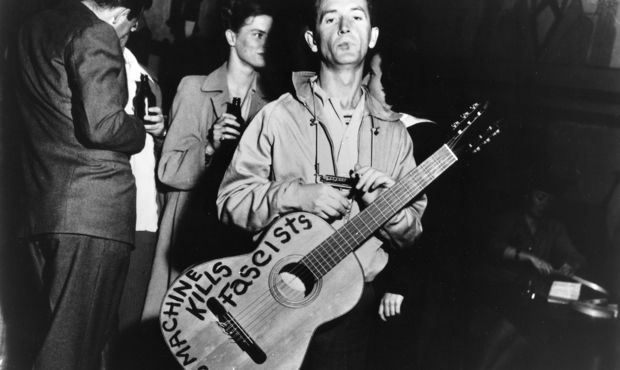
Of course I liked it and retweeted out immediately as it is in direct opposition of Woody Guthrie’s guitar:

and Pete Seeger’s banjo – “This machine surrounds hate and forces it to surrender.”

And later I saw this story in InsideHigherEd regarding the removal of a Leonard Peltier statue at (un)American University. I’d like to say I am always amazed at how quickly colleges and universities cave into pressure to take down works of art, but I’m not. Not ever. The balancing act of keeping stakeholders (donors, legislators, students, faculty, and staff – in that order). It’s a shame though, since art should often challenge us, as well as comfort us. Art is not just decoration.

When Garrison Keillor was feuding with Minnesota Governor, Jesse “The Body” Ventura, I remember him making the comment that artists and satirists always have the last word. Art does live on. It leaves traces that are readily found within every culture. The art of satire can be bitingly painful for the target. Which is why authoritarian types try to shut it down. The criticism offends their sensibilities. Mainly though, it offends their sense of power. It’s hard to feel omnipotent if people aren’t afraid to make fun of you.

This is why funding for the National Endowment for the Humanities and the National Endowment for the Arts is at risk. The budgetary impact is miniscule, but conservatives have been after these programs for years. Sometimes art can be offensive – both because it violates your senses or it makes you break through habits/barriers of thought. It’s ultimate sin is when it does both. Or when it mocks, satirizes, and parodies.

Art has the ability to unify, to create community. Some art forms are shared experiences, such as theater. Concerts and music shows are the same. Wherever a group of people come together for entertainment and art. Music is special, though, in it’s simple ability to create community.

Rise Up Singing is a song book used in community singalongs. It contains hundreds of folk songs, popular songs, children’s songs, protest songs, and work songs. All of which are easy to sing. More importantly, these songs are easy to sing together to build community. And despite the marvelous work that people like Laura Gogia (@GoogleGuacamole) are doing in #ConnectedLearning, there is still little as powerful as people in the same physical space, with voices raised in song, if you listen, you can hear the people sing. Perhaps Laura and her friends could make a #ConnectedSingaLong?

Remember the scene in “Casablanca”   where Victor Laszlo leads the patrons of the cafe in La Marseilles? The power of shutting down one song with another. Of course, such resistance is frowned upon. And yes, resistance can have its price. So does compliance. I don’t want to live in a world where compliance is celebrated over freedom. I guess those who want could all get together and be Comfortably Numb.

As for me, I’ll take my hoarse and coughy voice and sing. Starting with Your Flag Decal Won’t Get You Into Heaven and ending with The Ghost of Tom Joad with about a thousand songs in between. With all due respect, singing and singing loud is not going to end the war, at least not by itself. But it’s a start. Any form of resistance is a start. Not rolling over, refusing to normalize the abnormal, these are the beginnings of resistance.

Ya’ wanna sing with me?

Do you hear the people sing?
Singing the songs of angry men?
It is the music of the people
Who will not be slaves again!
When the beating of your heart
Echoes the beating of the drums
There is a life about to start
When tomorrow comes!

–Les Miserables, “Do you Hear The People Sing?”

But wait. This is not the right song. “Do you hear the people sing?” is right, but “singing the songs of angry men” is definitely not right. It’s the angry men that got elected, by many angry men that feel they got left behind. So, we need new voices, new songs.

A different gender.

A little bit obvious would be “Let It Go” from Frozen.

Let it go, let it go
Can’t hold it back anymore
Let it go, let it go
Turn away and slam the door
I don’t care
what they’re going to say
Let the storm rage on.
The cold never bothered me anyway
But my muse suggested something different. I’m not sure how it works as a marching song, but I suspect some talented people can figure it out. Let’s get Beyonce to lead us in Formation.
It’s a new world. A new style of protest and new voices are needed.

Tiny Acts of Defiance, and Hope

As a preteen, I grew up with an alcoholic stepfather. When he stopped drinking through AA, his meeting life life morphed into ours with Al-Anon and Alateen meetings. The one day-at-a-time message was pretty well hammered into me. Of course, at the same time, the TV show “One Day at a Time” was running and I had a major crush on Valerie Bertinelli. So, one day at a time became a lifestyle. (Which later became one datum at a time.) There were times in life when one day at a time was not strong enough and I had to just focus on just hour at a time.

As a follow-up to last night’s post on Hope, I want to say something about the little acts of defiance that can create hope.

Hope is action. Hope begins with defiance. Once you begin to defy that which threatens you or darkens your life, you can begin to find hope.

Start by getting up each day. The desire to hide in bed, to feel you can’t face the day, can be incredibly strong and seductive. Sitting up, putting your feet on the floor, and standing (or moving to your assistive device, defiance applies to everyone) can be the bravest act of defiance one can make.

Know what you believe in. Search, talk to people, learn, for God’s sake, read! So much has been written about freedom, courage, and hope, there is no reason not to be able find inspiration. Literature, music, performance arts, and fine arts can all inspire defiance and hope.

Push against the wind. Step sideways into it. Move into shelter. Or just stand against the wind and be a shelter for others. Just help someone.

‘Twas in another lifetime, one of toil and blood
When blackness was a virtue the road was full of mud
I came in from the wilderness, a creature void of form
Come in, she said
I’ll give ya shelter from the storm
And if I pass this way again, you can rest assured
I’ll always do my best for her, on that I give my word
In a world of steel-eyed death, and men who are fighting to be warm
Come in, she said
I’ll give ya shelter from the storm

-Bob Dylan, “Shelter from the Storm”

Do acts of sabotage. Toss your shoe into the machine. Do work that causes others to question what they think they know. Most of us have a greater ability to change the world than we realize. One small act of kindness, one small act of defiance, can set an avalanche of change in motion.

Save a book, or many. Save recordings and scripts. Ensure that the art of defiance and songs of freedom are always available.

Don’t be silent about injustice. More importantly, learn to recognize it. Once we begin to see injustice, we will get to the point where we can no longer be silent. It’s the ability to turn our heads, to ignore injustice, that permits silence. I once read an article on relationships that advised men to “learn to see the coffee cup.” In other words, clean up your own mess or just generally, by seeing what needs to be done and doing it. It’s a great start to saving a marriage for both parties. Or a country.

Be your own hero. Recognize that when you get up and do what needs to be done for the good, you are a hero. You are modeling for others the behavior we all need. You are letting others know that they are not alone.

You are my hero when you do these things.

Through the mad mystic hammering of the wild ripping hail
The sky cracked its poems in naked wonder
That the clinging of the church bells blew far into the breeze
Leaving only bells of lightning and its thunder
Striking for the gentle, striking for the kind
Striking for the guardians and protectors of the mind
An’ the poet and the painter far behind his rightful time
An’ we gazed upon the chimes of freedom flashing

-Bob Dylan, “Chimes of Freedom”