Free Parking and the Once and Future King

Sometimes, the higher education community amazes me. In a good way.

But not today.

This morning, as I occasionally do, only today was much later than usual, I sent out a list of articles for colleagues to at least be aware of. This snippet was part of that:

And…it is 10:35 am EDT and this article has received 36 comments already:

http://www.insidehighered.com/news/2014/07/23/rockstar-parking-heavily-subsidized-and-often-lucky-about-get-more-expensive-college

To this point, yesterday’s article on a more nuanced Bill Gates has received only 47 comments….. I am not sure I need say anything more about the values of the readers of InsideHigherEd

There was also a blog post from John Warner about a recommended reading list for Mr. Gates to become better informed about higher education.

It is now 9:48 pm and Warner’s post has received 18 comments, primarily reading suggestions. The parking article is now up to 73. This tells me that if Gates wants higher education to support the Common Core, all he has to do is buy parking spaces for every faculty, staff, and administrator. However, if  indeed the average cost of a parking space is $18,000, that is roughly $72B to cover four million college and university employees. I’m sure he could get a deal to buy existing spaces for a small fraction though.

I’m sure few people think that Gates care what us higher ed folk think about him and what he knows. I suspect though, that if enough people make a point of commenting on a regular basis, word will get to him.

So, I have a reading suggestion. I made it to Warner, but I don’t think he took me seriously. Few enough people do so. My suggestion is T.H. White’s, The Once and Future King.  It was my first reaction to Warner’s tweet for suggestions and 30 hours later I stand by it. To me the story has always been primarily the education of boy and king. Education is about observation, experience, gaining knowledge, and translating those things into understanding and the ability to improve one’s condition. With Merlin’s guidance, Arthur learns that Might does not make Right and that even as king, and to the end of life, Arthur was still learning.

“He would go to war, if King Uther declared one. Do you know that Homo sapiens is almost
the only animal which wages war?”

“Ants do.”

“Don’t say ‘Ants do’ in that sweeping way, dear boy. There are more than four thousand
different sorts of them, and from all those kinds I can only think of five which are belligerent.
There are the five ants, one termite that I know of, and Man.”

“But the packs of wolves from the Forest Sauvage attack our flocks of sheep every winter.”

“Wolves and sheep belong to different species, my friend. True warfare is what happens
between bands of the same species. Out of the hundreds of thousands of species, I can only
think of seven which are belligerent. Even Man has a few varieties like the Esquimaux and
the Gypsies and the Lapps and certain Nomads in Arabia, who do not do it, because they do
not claim boundaries. True warfare is rarer in Nature than cannibalism. Don’t you think that is
a little unfortunate?”

“Personally,” said the Wart, “I should have liked to go to war, if I could have been made a
knight. I should have liked the banners and the trumpets, the flashing armour and the glorious
charges. And oh, I should have liked to do great deeds, and be brave, and conquer my own
fears. Don’t you have courage in warfare, Badger, and endurance, and comrades whom you
love?”

The learned animal thought for a long time, gazing into the fire.

In the end, he seemed to change the subject.

“Which did you like best,” he asked, “the ants or the wild geese?”

****

Sisters, mothers, grandmothers: everything was rooted in the past! Actions of any sort in one
generation might have incalculable consequences in another, so that merely to sneeze was a
pebble thrown into a pond, whose circles might lap the furthest shores. It seemed as if the
only hope was not to act at all, to draw no swords for anything, to hold oneself still, like a
pebble not thrown. But that would be hateful.

What was Right, what was Wrong? What distinguished Doing from Not Doing? If I were to
have my time again, the old King thought, I would bury myself in a monastery, for fear of a
Doing which might lead to woe.

****

“Listen, then. Sit for a minute and I will tell you a story. I am a very old man, Tom, and you
are young. When you are old, you will be able to tell what I have told tonight, and I want you
to do that. Do you understand this want?”

“Yes, sir. I think so.”

“Put it like this. There was a king once, called King Arthur. That is me. When he came to the
throne of England, he found that all the kings and barons were fighting against each other like
madmen, and, as they could afford to fight in expensive suits of armour, there was practically
nothing which could stop them from doing what they pleased. They did a lot of bad things,
because they lived by force. Now this king had an idea, and the idea was that force ought to
be used, if it were used at all, on behalf of justice, not on its own account. Follow this, young
boy. He thought that if he could get his barons fighting for truth, and to help weak people,
and to redress wrongs, then their fighting might not be such a bad thing as once it used to be.
So he gathered together all the true and kindly people that he knew, and he dressed them in
armour, and he made them knights, and taught them his idea, and set them down, at a Round
Table. There were a hundred and fifty of them in the happy days, and King Arthur loved his
Table with all his heart. He was prouder of it than he was of his own dear wife, and for many
years his new knights went about killing ogres, and rescuing damsels and saving poor
prisoners, and trying to set the world to rights. That was the King’s idea.”

“I think it was a good idea, my lord.”

“It was, and it was not. God knows.”

“What happened to the King in the end?” asked the child, when the story seemed to have
dried up.

“For some reason, things went wrong. The Table split into factions, a bitter war began, and
all were killed.”

The boy interrupted confidently. “No,” he said, “not all. The King won. We shall win.”

Arthur smiled vaguely and shook bis head. He would have nothing but the truth.

****

Arthur learned too late the folly of easy answers. Chivalry, a common core of standards for behavior, was not enough, was never going to be enough. If White had written this today, perhaps the quest for the Grail would have been a quest for better standards. As for Arthur, if he had perhaps loved his people more than he loved his idea, things would have turned out okay in the end.

For me, I suspect I will never forget the badger’s question and the answer will always be “the wild geese.”

 

Feedback

A conversation started this morning with John Warner (@biblioracle) about remediation, learning, standards, and writing.

I keep thinking about this exchange, in part because my morning involved a heart-to-heart discussion with the oldest (12) grandelf about the necessity of learning to accept feedback and criticism as part of learning. And that this never really stops, or at least it shouldn’t.

I struggle with what I sometimes consider a lack of feedback (certain amount of insecurity revealed in that statement, I know). I don’t have a lot of people tell me “you really should do/say it this way” or “this should change” etc. I do get the occasional “you do good work” or referred to as the “data guru,” which are very much appreciated but don’t tell me much. I also don’t get much feedback on this or the other blog, but I get enough to keep on keeping on.

So, the feedback I rely on, work-wise, falls into four categories:

  1. My employment agreement gets renewed each year. I’m on an annual agreement and they don’t have to keep me around if I get too obnoxious, troublesome, or produce poor work. (This is really important to me – I like working.)
  2. People keep asking me to do stuff. There are some that are getting a bit carried away with this, but if they value my work enough to ask me to do it, that is valuable feedback.
  3. Institutional leaders use my work to support their arguments even when my work is not strictly flattering of their institution. (I am always watching for any citation of SCHEV Research data.)
  4. Legislators push bills that either require me(us) to do something, or that others use my(our) work.

Of course, I am looking what I have just written and thinking, “Didn’t this really start as a conversation about feedback in writing, you know, communication?”

Uhh, yes. But that is what I do. It just happens to be predominantly numerically-based. I’ve always thought of what I do as essentially an art form because of the Web. Until now, I don’t think I have really thought of it as primarily communication. (Sorry, Dad!) Many times over the last 23 years I have described institutional research as a process of teaching people to count to one. That is the foundational practice, but it certainly doesn’t end there because we have to communicate not only the meaning of one, but all the stories and meanings of the stories of every sum and difference of one. (If you have never seen it, The Story of 1 is a nice little documentary.)

So I am wondering how we teach young people what feedback is, how to recognize it, and how to respond to it. Probably need to teach the difference between good and bad feedback. We need to also model this behavior, because I don’t think everyone is.

About this whole “paying for college” thing

I keep trying to figure out this whole idea behind paying for college. I seem to be missing something.

Most everyone agrees that higher education is a private good. Most people, although not always the same people, agree that higher education is private good.

The first question is how much of either?

But does level matter? Yep, fewer states directly subsidize graduate and professional programs. Less financial aid is available to those students than a decade ago.

Despite the fact community colleges serve a greater number of students who are less than fully prepared for college, they typically receive a fraction of the support of four-year colleges. Fortunately, there are fewer frills (like full-time faculty) at community colleges, and despite lass financial support, they cost much less to the student. (Yes, the state spends less, but since the colleges are supported to a level that matches the needs of their students, attrition is high and completion is something other than timely, and so I would argue the cost is higher. Too many opportunity costs from subsidizing students with little hope of completing given the circumstances.)

So, if we just look at a traditional four-year student at a public institution, we see something like this:

One year of residential college: $24,000 (after a $7,000 subsidy from the state).

Four years, after increases, call it $100,000 for an on-time completion.

If the student came from a relatively poor family, the federal government might have kicked in as much as $21,000 and change. The state may have added $16-20,000, with another $12,000 from institutional aid (which if it does not come from a large endowment, it probably comes from tuition dollars of other students.) So, let’s call it a four-year net price of $50,000, roughly $12,500/year.)

That is $50,000 for the student and their family to cover. Since we assumed earlier the student got a full Pell grant, we probably should assume her family was unable to contribute anything and that the entire $50,000 is in loans.

So, the student borrows $50,000 for a solid degree in English with a 3.4% interest rate overall (which is probably lower than reality). But, she gets a job right after graduation at the median wage for English majors, about $32,000.

So, let’s make a whole host of assumptions.

She enrolls under Pay As You Earn (PAYE) right away.

PAYE remains unchanged structurally and legally for the next 25 years.

The poverty level for an individual grows about 2% annually over time. (Discretionary income under PAYE is household income – 150% of the poverty level for the household based on size.)

She stays single with no dependents.

She gets a good job at the median wage (in Virginia) for BA English majors at $32,000/year.

She stays at the medium wage which increases at 4% per year  (it was 6% for the median wage of English grads of 1992-93. I can tell you more about that next week.) but I don’t see that growth continuing, but it may.

She makes no payments the first year because her income the year she was in school was less than $20,000. Her payments the first year after are about $98. At the median wage for a in BA English in a single household, she just barely exceeds the first discretionary income cap to require payments.

If all goes well in that she has an unblemished employment history and no health problems, and makes only the minimum required payments, then it looks like she will have made just about $60,000 in total payments over 25 years. The remaining value of the loan will be about $34,000 and will be forgiven.

(This is far too much like General Physics 101 – assume five billiard balls on a frictionless surface with the cue ball traveling ……)

In any event, this looks like a relatively good deal for the student. She gets what is really a very low-cost loan with an effective interest rate for 25 years of three-quarters of a percent, I think.

In the end, the federal government writes off $34k in debt that was spent. (Doesn’t this become a back-end tax on everyone? That money is no longer available for other purposes.)

Meanwhile, we have built and maintained an entire servicing industry to manage this process…or expanded the IRS to handle it as some new legislative proposals suggest. I guess this is job creation and is thus a “good thing,” but I prefer more useful jobs.

Of course, if she had gone into engineering, enrolling in PAYE probably would have been unnecessary, and even if she had, unless she expanded her household significantly right away, she would likely have paid off all her debt well before the end of 25 years.

But I am using the non-gendered median wages. Oops. Women made less in both areas, and the annual growth rates for women were a bit less. But that’s based on graduates of 20 years ago, all that pay inequity stuff is resolved now, right?

Another oops…speaking of 20, PAYE actually has forgiveness after 20 years, not 25. IBR has forgiveness of the unpaid balance after 25 years.  So, really, she gets an even better by deal paying only $39,000 with forgiveness of $46,000.

I guess this why the GAO is planning a study on all this. It seems a pretty crazy way to run a railroad. It just seems to me it would be more cost-effective and less confusing to pay for everything upfront. In the end, there There Just Ain’t No Such Thing As A Free Lunch – we are going to pay the cost one way or another.

Students and families can only be expected to pay so much, no matter how of a private benefit higher education is. Other than the fact that 18-24 year-olds have no money, I don’t understand why families are expected to pay the college expenses of adult children. We don’t require that anywhere else. Unfortunately, we have always done it that way and we have created a marketplace where the targeted consumer is uniquely unable to afford the marketed service.

It also seems to me that this is a system designed to hide the true cost of higher education. Except that is cobbled together more than designed.

The example I used, approximates maybe 8% of borrowers in Virginia in terms of a debt being around $50k without getting into the extremes. It also represents the lower-income category net price of one of our small public colleges. However, as I have written before, if current trends continue, the class of students entering now may well have an average debt of $42-47K for those borrowers that graduate. That makes this discussion more applicable.

What am I missing? What have I got wrong? It looks to me like the states are ducking their responsibilities and spreading the cost around through federal tax base….which means we all pay in the end, what we would have paid in the first place, and probably quite a bit more. I think a more rational approach is probably in our best interests.

But that requires rationality, difficult conversations, making commitments, and living to those commitments.


What I said to the GAO

Should the Federal Government Rate Colleges (and Universities)?

President Obama, Secretary Duncan, Deputy Under-Secretary Studley, and others, have called “foul” on those of us opposing the proposed ratings system since it does not exist. Their position is that our response should be constructive and supportive until there is something to criticize.

They don’t understand why many of us, the data experts, are opposed.

It’s not that a ratings system can’t be developed. It can. At issue is the quality and appropriateness of the available data. The existing data are simply inadequate for the proposed task. IPEDS was not designed for this and organizations like US News & World Report have taken IPEDS as far as it can go and added additional data for their rankings. Also at issue is the appropriateness of the federal government providing an overall rating for an institution over aspects for which it has no authority.

I think it is fully a right course of action for the Department and Administration to rate colleges as to their performance with Title IV financial aid funding and required reporting. Ratings based on graduation rates, net price, and student outcomes of students with Title IV aid would be very useful and appropriate. Placing additional value factors in ratings relevant to compliance and accuracy of required reporting under Title IV would add meaning to a system designed to determine continued eligibility for Title IV programs.

After all, if continued eligibility and amount of available aid under Title IV are the ultimate goals, aren’t these the things to measure?

This is decidedly less politically exciting than saying Institution A has a higher overall rating than Institution B, but it makes a clear relationship between what is being measured and what matters. It also has the advantage of being able to use existing student-level data on Title IV recipients in the same manner as is being done for Gainful Employment. From where I sit, PIRS is simply Gainful Employment at an institution-level as opposed to program-level.

And that is appropriate.

Using ratings to develop performance expectations to participate in the federal largesse that is Title IV would be a good thing. Regional accreditation and state approval to operate is clearly no longer adequate for gate-keeping, if, indeed, it ever was.

The difficulty is determining what those expectations should be. It is quite reasonable to subdivide institutional sectors in some manner, calculate a graduation rate quartiles or quintiles for each group of students in Title IV programs and require institutions in the bottom to submit a five-year improvement plan with annual benchmarks. Any institution failing to meet annual benchmarks two years running could then be eliminated from Title IV. Using multiple measures of success, including wage outcomes from records matched to IRS or SSA, we can reduce any tendency towards lowering standards to survive.

In an ideal world, with quote complete end quote data, a ratings system would be focused on intra-institutional improvement. In fact, this is the language that Secretary Duncan is beginning to use, as he did in a recent interview:

“Are you increasing your six-year graduation rate, or are you not?” he said. “Are you taking more Pell Grant recipients [than you used to] or are you not?” Both of those metrics, if they were to end up as part of the rating system, would hold institutions responsible for improving their performance, not for meeting some minimum standard that would require the government to compare institutions that admit very different types of students.

The problem is that simple year-to-year improvement measures tend to not be very simple to implement. We have substantial experience with this in Virginia, especially this week, as we work through institutional review of performance measures in preparation for next week’s meeting of the State Council. On any measure, annual variance should be expected. This is especially true for measures that have multiple year horizons for evaluation. It is even truer when institutions are taking action to improve performance as sometimes such actions fail.

A better approach is focus on student sub-groups within an institution. For example, is there any reason to accept that Pell-eligible students should have a lower graduation rate than students from families with incomes greater than $150,000? We generally understand why that is currently the case, but there is no reason to accept that it must be so. I would argue, vociferously, that if the Department’s goal is to improve to access and success, that this is where the focus belongs. Rate colleges on their efforts and success at ensuring all students admitted to the same institution have the same, or very similar, opportunity for success. Provide additional levers to increase the access of certain students groups to college. To do this would require IPEDS Unit Record – a national student record system – perhaps as envisioned in the Wyden-Rubio bill, The Student Right-to-Know Before You Go Act.

This means over-turning the current ban on a student record system. It also means taking a step that brings USED into a place where most of the states are. From my perspective, it is hard to accept an overall rating system of my colleges from the federal government when I have far, far more data about those colleges and choose to not to rate them. Instead we focus on improvement through transparency and goal attainment.

I think few reasonable people will disagree with the idea of rating institutions on performance within the goals and participation agreement of Title IV. It is when the federal government chooses winners and losers beyond Title IV that disagreement settles in.

We will face disagreement over what standards to put in place, if we go down this path. That is part of the rough and tumble of policy, politics, and negotiated rulemaking. You know – the fun stuff.

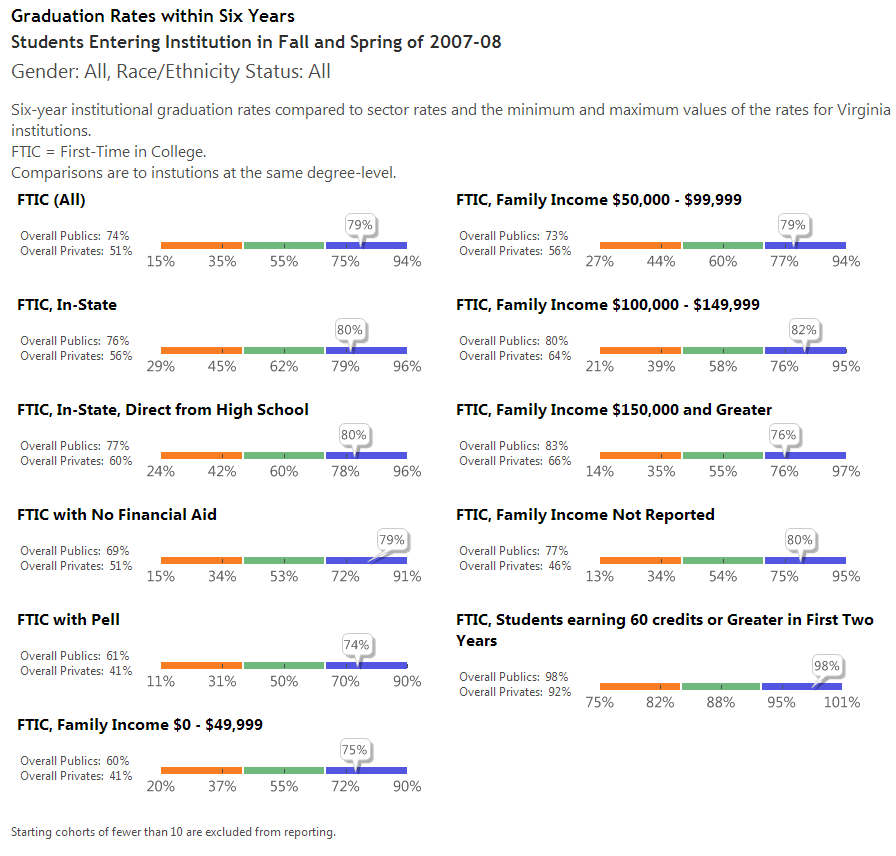
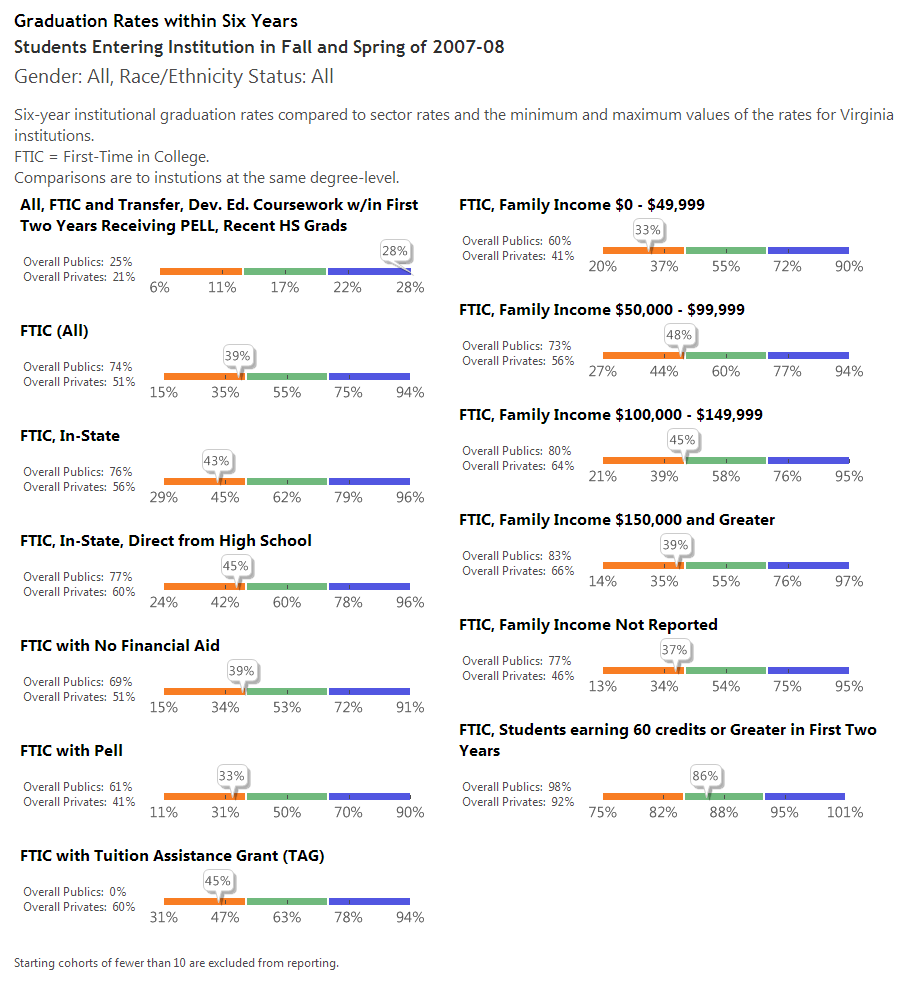
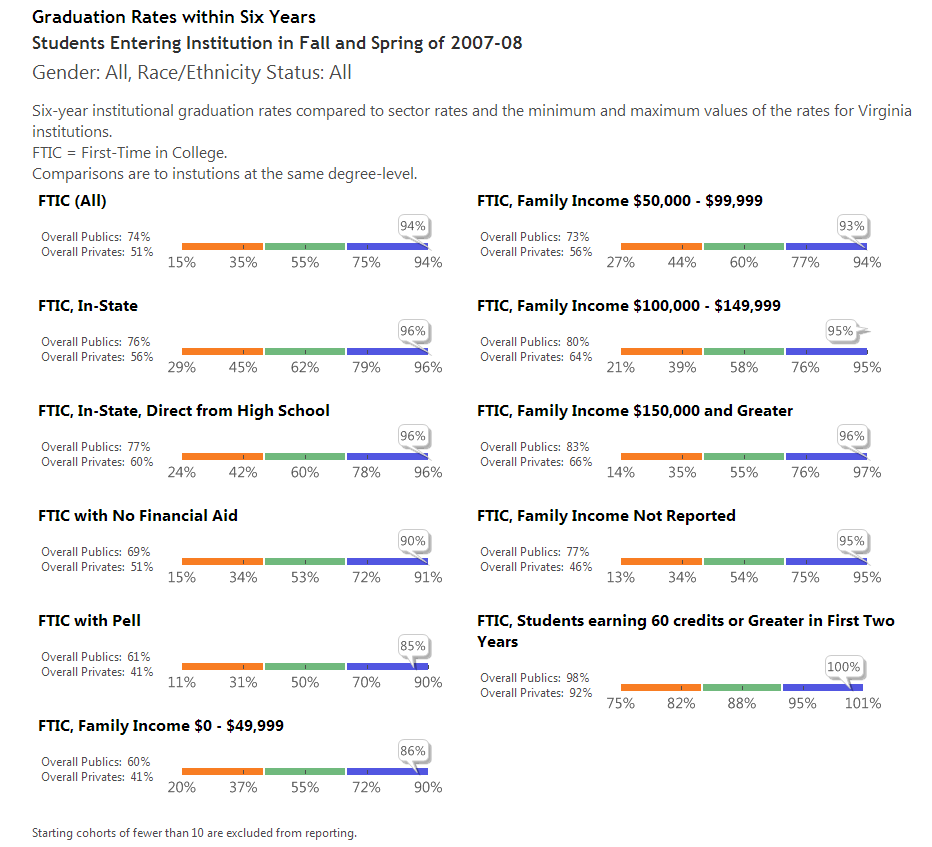
Let’s take a quick look at four very different institutions. These images come from our publicly available institution profiles at http://research.schev.edu/iprofile.asp


Germanna Community College does not have high graduation rates (note these are not IPEDS GRS rates as they include students starting in the spring as well as part-time students). All of these are toward the lower end of the range of Virginia public two-year colleges.  There are a range of differences among the subcohorts, particularly between students from the poorest and the wealthiest families.

gao1

Even at the highest performing institution on graduation rates, one of the highest in the nation, there is still a range of difference. A full 10 percentage point difference between the poorest and wealthiest students.

gao2-uva

In the last two decades, CNU has more than doubled its graduation rates through transforming the institution and its admission plans. The differences between subcohorts are much smaller, but this has come at a price of denying access to students that sought an open-enrollment institution.

gao3-cnu

Ferrum College has relatively low graduation rates and high cohort default rates. Using federal data, it does not look to be an effective institution. However, I will point out that it has the highest success rate with students requiring developmental coursework in the first two years. It apparently can serve some students well, and others better than other institutions.

gao4-fc

My point with these four examples is this. We need to drive improvements in student outcomes by focusing on differences within institutions, specifically subcohorts of students that are recipients of Title IV aid.


NPR once went beyond headlines

Yeah, this song is on my mind as I consider the silliness of belief and the cost of higher ed.

I’m an innocent victim of a blinded alley
And I’m tired of all these soldiers here
No one speaks English, and everything’s broken, and my Stacys are soaking wet
To go waltzing Mathilda, waltzing Mathilda,
You’ll go waltzing Mathilda with me

–Tom Traubert’s Blues, Tom Waits

In the article, How Private Colleges Are Like Cheap Sushi, Anya Kamenetz writes about how private colleges discount tuition, through institutional grants in the form of student aid. Using economic theory of anchors and signaling to explain this behavior, she points to private nonprofit colleges making these choices to compete in a crowded marketplace. Nowhere does she mention that public institutions engage in the same behavior, albeit to a lesser degree. At least with in-state students. More and more we see tuition discounting for out-of-state students using some of the dollars from the significantly higher tuition paid by non-residents.

Years ago, I was part of the Technical Review Panel that established the net price calculations for IPEDS. They were never targeted at just the privates. We spent more time talking about how these calculations would apply to public institutions than any other single topic at the meeting.

In failing to mention public institutions and the subsidies they receive, it is hard to take the article as little more than a puff piece. As I have argued before, when we look at actual spending for comparable institutions, much of the difference between public and private disappears. (By the way, many of the people who argue with me about this are the same that used to argue that all graduate programs were heavily subsidized by undergraduate programs – which is not really the case they realize now. Professional graduate programs are for-profit centers in public and private institutions.) Public institutions tend to rely more heavily on adjunct faculty…as long as they are in a geographic region where they are available.

I’m not interested in giving the private colleges a pass. I am interested though in seeing people recognize the that two sectors learn from each other and frequently borrow strategies. There is a lot of cross-pollination that takes place.

No institution has a right to survive. Especially not the those that are expensive and have low graduation rates with low measures of student success beyond completion. That should just as readily apply to institutions in all sectors. Survival is not a right.

Let’s also keep in mind that a primary culprit here is USED. Through the use and control of the Free Application for Federal Student Aid (FAFSA), the Department inserts itself into any discussion about price and cost through the resulting Estimated Family Contribution (EFC) – regardless of its accuracy. I have heard enough financial aid policy people, both in and out of the Department and the White House, refer to FAFSA as a “rationing tool” far more often than as an “accurate depiction of what a family can afford.”

Actually, I have never heard the latter.

We have a situation where a couple of generations of Americans were fortunate to have access to a free, or almost free, college graduation. This was possible because they were willfully ignorant of how tax dollars made this possible.

An awful lot of people went to college from groups that never had the opportunity previously. This was a good thing. Many students across all groups made good use of the experience. Many did not.

Now that the tax support for higher education has dramatically been reduced per student, college is seen to be much more expensive and not worth the cost – often based on the experiences and outcomes of those that did not make the best of their college experience.

I think the realities are this:

1) College (or any education) is never worth more or less what one puts into it. Yes, the credential has a value, but sooner or later, one can’t hide behind the credential and must demonstrate knowledge and ability to keep learning.

2) A large part of the costs of college have little to do with the specifics of education. Living expenses, for one, followed by athletics and building costs. Athletics is the only one that can possibly be eliminated and that seems unlikely.

3) Even if we trimmed, chopped, all the non-education costs, that would probably just allow a return to a more accurate cost of education. How? Colleges would stop relying so much on adjuncts. Adjuncts are nice additions to the faculty when they are local professionals with lots of experience to add value to a program. When they are used to provide a large portion of the education as contingent, part-time employees, it is just another form of an abusive system that does not serve the institution or its students well.

I realize nobody wants to pay anything for education. Unfortunately, that is just kind of stupid. Good education is always going to be fairly expensive because it involves lots of human interactions with humans with advanced education that was expensive to achieve. We can continue to work to find less expensive ways to deliver education content and to assess mastery, but engaging, coaching, and mentoring will probably not get cheaper. Unless it is something left in the hands of androids and robots, but then I start thinking about government or school contracts for these androids and it is doesn’t seem that will actually cost less.

We’ll be fighting over the cost of education, especially higher education, for decades, I expect. Until we reach the point where we recognize that we have reduced the costs and trimmed the unnecessary expenses to the point we can’t go any further, institutions will continue to be creative in pricing and aid strategies. Just as every other sector of the economy does.

I’ve rambled enough through this, and probably shouldn’t publish it, but what the hell. It is essentially an allergic reaction to something stupid.

And you can ask any sailor, and the keys from the jailor,
And the old men in wheelchairs know
And Mathilda’s the defendant, she killed about a hundred,
And she follows wherever you may go
Waltzing Mathilda, waltzing Mathilda,
You’ll go waltzing Mathilda with me

And it’s a battered old suitcase to a hotel someplace,
And a wound that will never heal
No prima donna, the perfume is on an

Old shirt that is stained with b lood and whiskey
And goodnight to the street sweepers, the night watchmen flame keepers
And goodnight to Mathilda, too

About the Undeclared Major as a Dead Horse

…I have not finished beating it.

Quick recap: FSA is requiring all Title IV awardees submitted by institutions to have a valid CIP Code (Classification of Instructional Programs), including students in undeclared or undecided status. Virginia institutions have been running into difficulty because they have reporting undeclared students to us for over 20 years using code 90.0000, which is, alas, a Virginia-specific code. It is thus not found in the official CIP 2010 tables and students submitted with these codes have been rejected. USED is advising institutions to use 24.0102 – General Studies.

Apart from my argument that students who are not, by definition, enrolled in a program and should not have a valid CIP code – unless it’s definition is undeclared. This is not the case of 24.0102. However,while  I grant the Illustrative Examples of “Undeclared” and “Undecided” might seem to make it a logical choice, I think a step was missed.

What step? How about checking to see if degrees are awarded under 24.0102? After all, a BA awarded in General Studies would seem to be a pretty declarative statement, wouldn’t it? Wouldn’t it also seem that someone had decided that was an appropriate major?

In 2012, there were 84,118 degrees at various levels awarded nationwide based on the IPEDS Completions report.

Oops.

In 1992, there were 24,357 degrees at various levels awarded with CIP 24.0102.

Oops. It is a growing problem.

In the grand scope of things, this is a relatively minor problem. Unfortunately it demonstrates how little thought is given to future data collections and future uses of data. Any analysis of these data will be inconclusive, misleading, or wrong, because researchers won’t be able to separate out students who were actually enrolled in a General Studies program v. those who were undeclared.

It would be so very easy to add 00.0000 or 99.9999 or some other code to the valid value table that is based on CIP Codes to avoid this problem. If the logic is that all degree-seeking (and thus potentially aid-eligible) students are enrolled in a program, this is just wrong. Some schools, including one of my previous employers, did not, possibly still does not, allow students to select a major until after the third semester. This allows them to experience more of the liberal arts and sciences before settling down to focus on just one.

I am curious to know if this was a conscious, intentional decision by the department, or a development choice by the contractor that was subsequently (and thoughtlessly) approved by the person running the contract.


Things that go Irk in both the day and night

Some things are just irksome. Tiny, piddly, little things. But they are often things that matter in a bigger way than is readily apparent.

I just finished posting on my work blog to provide guidance to institutions struggling with a very minor change in the data system USED uses to handle Title IV loan originations/disbursements. As of this spring, all students are required to have a valid CIP (Classification of Instructional Programs) Code for their program. Makes sense. However, what to do about students with an undeclared major? Certainly they should not be in a program, should they?

USED says yes. Further, they advise institutions to use 24.0102 General Studies (An undifferentiated program that includes instruction in the general arts, general science, or unstructured studies) because it comes equipped with Illustrative Examples of “Undeclared Major” and “Undecided.”

Fine. I have problems with the logic and whether or not this is accurate for all students to which the code might be applied, but okay, I can see how they got there.

However.

How will the Department differentiate these students who are undeclared from students who are in actual General Studies degree programs? Virginia has 23 such programs at public and nonprofit colleges.

Um, they won’t and they can’t.  (By the way, this conflict arises in Virginia, and apparently only in Virginia, in that we use 90.0000 to report undeclared students to us. Everyone keeps telling me that only Virginia institutions are having trouble with this.)

How good will the data be when some yahoo tries to build a Gainful Employment equivalent for all programs when the enrollment and default rates and who knows what other data all get confused for the actual programs and the undeclared students (who are not in a program, by definition).

At the base of the academic structure is the academic program. USED does not seem to understand to this. Nor do they appear to be thinking ahead about their Title IV data collection and how is might will be used.

Disappointing.


It doesn’t get much better

Yesterday, my son and I hauled the kayaks over to Kiptopeke State Park on Virginia’s Eastern Shore of the Chesapeake Bay. It is one of my favorite spots. Not because of the fishing – rarely have we done well – but just because it is a great little oasis. Just three miles from the tip of the peninsula, the park is located at the old ferry terminus that went across the mouth of the bay.

When we pulled in, the temperature was just about 80F with a north wind blowing at about 11 knots. We surveyed the conditions and crowd on the pier to see if folks were pulling fish up, and saw none. We decided not to head out to the grounded fleet of concrete ships right away with the chop and the wind after watching one kayaker working pretty hard to fish the shiDSCN0509ps. Instead, we launched and fished the shallower areas south of the pier where it was a bit calmer. This was about three hours before high tide.

Once we got into position, we were getting hits right away. Not much in the way of connections, until Zach landed a 20 inch flounder. But that remained the only fish for a while. There were enough hits though to keep things interesting. Both of us were working two rods – one with minnows, one with clam or shrimp. The latter options were generating the action.

We beached about an hour after high tide to stretch and fish from the sand. Sometimes we get a bit obsessive and will stay in the yaks for five or six hours without a break. Our record is seven. I was feeling the sun pretty well at this point and starting notice the stiffness in my shoulders that would be settling in later that night. The wind had remained pretty stiff and it was work maintaining position and despite that work, we were a good half-mile from the end of the pier.

We talked over our strategy and decided to check out the conditions around the ships, With luck, the might break a little of the wind.

DSCN0511We noticed about the half the way over the wind was slackening. This was great! We headed to the far north end of the concrete fleet dropped lines and started fishing, drifting up close to the hulls each ship. Zach pulled up a nice spot on the first cast. We spent the next couple of hours in near perfect conditions as the wind dropped completely. The bite was inconsistent, mainly a lot of oyster toads, including some that were quite large. Conditions had relaxed so much that I would occasionally look back and see Zach laying back and dozing, responding only to the occasional bite.  When we finished the northern group of ships, we drifted to the second group and fished until we realized the tide had fully turned and was now pulling us on to the ocean faster than the wind had. So, a few more casts.

Unfortunately I was rigged only for bottom fishing because I looked east toward the ramp, and I saw a heavy body, with a red-tinge, roll about 60 yards away. A big red drum had been cruising the area and that was the only look I got.

Overall, it was day that couldn’t really be improved. Sure, we could have caught more fish, but just getting out with my son was good enough. Easy drive over, relatively easy drive back. No problems, no issues. Just a great day. And the continuing of a “tradition” that started many years ago and continued through years of scouting – I drive back and he sleeps.
DSCN0524

It was also pleasant to be totally disconnected from the world outside of what I could see and here. Phone locked away in the car and spending thought capacity on what I was doing at the moment. Not worrying about higher education. Not worried about the current projects, or the next projects. Not worried about Twitter.

It was good. As good as good can be.

Duncan doesn’t understand the opposition to PIRS

Duncan doesn’t get it. Apparently the president does not get it either if this is all coming from the top.

Duncan did ask the ratings system’s many critics to reserve judgment until they actually knew what it would look like.

“This system that people are reacting against doesn’t exist yet,” he said. “Tell us what you like; help us do this.… Let’s not be against something that has not been born yet.”

Read more: http://www.insidehighered.com/news/2014/07/03/arne-duncan-talks-about-ratings-and-student-debt-expansive-interview#ixzz36VOw7Wlh 
Inside Higher Ed 

One of the many things that the Administration does not get, is that some of us are objecting to the ratings system because the currently available data are inadequate. Completely inadequate. Bloody embarrassingly inadequate. These data, for the most part, are the same data that brought us to the current state of affairs.

Asked by Leonhardt to respond to the criticism that the government can’t rate colleges intelligently and effectively, Duncan reiterated that department officials know they have a hard job ahead. “We’re going into this with a huge sense of humility,” he said, and recognize that “intellectually it is difficult.”

Bullshit. Humility is not based on ignoring the advice you receive and doing it anyway.

“I say to the Department this, “We need better data. Let me rephrase that. YOU need better data. This should be the Department’s first priority.”

-Tod Massa (me), PIRS Technical Symposium, Feb 6, 2014.

The Department called together 19 experts in this arena to advise on the proposal. Perhaps it was just a show to support the pretense of listening and engagement. That’s fine, we all do that (every time we nod when our spouse is talking to feign involvement, for example). However, since the lack of humility irritates me, I am choosing to assume they wanted advice, but are unwilling to accept it. (It is too much like a smug, snotty adolescent saying “Uh-huh, I know” when you are trying to convey important information to him. I already have one of those in the house and another enroute.) By the way, push-back from those you intend to rate does not prove the rightness of your cause.

At least the interview demonstrates that the talking points, and perhaps the structure of the ratings system itself, are changing.

“Are you increasing your six-year graduation rate, or are you not?” he said. “Are you taking more Pell Grant recipients [than you used to] or are you not?” Both of those metrics, if they were to end up as part of the rating system, would hold institutions responsible for improving their performance, not for meeting some minimum standard that would require the government to compare institutions that admit very different types of students.

This is a step in the right direction, perhaps the second best approach. Encouraging a constant cycle of improvement is a good thing. Perhaps they will look to states that have experience in accountability measures of this type, you know, like Virginia. One of the things we know on this topic, is that there are annual variations that are little more than statistical noise, especially with smaller institutions. When such accountability measures are first introduced, it takes a number of years before institutional policy and operational decisions catch up. Thus, improvement on all measures every year is unlikely – unless the measures are weak to begin with. Remember, the key decisions about the graduation rates of the entering cohort of 2014 have already been made – who, how much aid, the institutional budget, and the student support programs that will be in place. The decisions impacting the next available graduation rates of the 2008-09 have long been audited and stashed away in a dusty mausoleum.

Another issue that arises is “the pool of possibles.” Is it possible to expect every institution to increase its proportion of Pell-eligible students? Probably not, at least not after some critical point is achieved of overall enrollment is achieved, without dramatically expanding the definition of Pell-eligibilty. Over time a lot of students will wind up being shifted among institutions. Probably not before the next re-authorization of the Higher Ed Act, but I don’t know. It will depend on institutional reaction to the ratings and Congressional action to tie them to student financial aid. Anyhow, at some point one ends up creating a floor value to say, “If an institution is at or above this point, improvement on this measure is not required.”

When we start talking about improvement on multiple measures, we get this argument, “If we enroll more [under-represented students, students with Pell] our graduation rates will go down.” This is a complete and utter bullshit argument that I have heard over and over again. We go back to 2008 on this where I pushed the board to make graduation rates of Pell students compared to students without Pell, but other aid, compared to students without any aid, a performance measure.

There is absolutely no necessity for institutional graduation rates to decrease. “But Tod,” I heard, “we know students that are Pell-eligible are less academically qualified most of the time.” 

“What do you about that?”

“Well, nothing.”

“Therein lies the problem.”

That was a fun conference call. This experience, and more like it, are why I believe a ratings system is best built around comparisons of internal rates at the each institution. There is no legitimate, nor moral reason, why family income should be a primary predictor of student success in college. We know that disadvantaged students have different needs than wealthy students, so let’s meet those needs.

I am glad to see an evolution in thinking on the ratings system. As long as the Department plans to release a draft based on existing data this fall (which is a question-begging time frame to begin with – fall semester or seasonal fall? and I have seen both “in the fall” and “by fall” – implying before), I will continue to oppose and agitate against the current plan. I continue to be willing to help and engage with the Department, but my phone lines and multiple email accounts remain strangely silent.


The $8000 Bachelor Degree

We have finally cracked the code in Richmond for the sub-$10K BA.  Here is how we did it:

No administrative burden!

  1. Award is by a non-accredited institution, so no unnecessary burden in working with sister institutions who provide judgmental visitors that dis what we are doing.
  2. No Title IV federal financial aid. We don’t submit IPEDS or any other federal support.
  3. No buildings or expensive infrastructure to maintain.

No constant pursuit of an unattainable faculty salary goal.

  1. We’ve got NO faculty!
  2. We crowd-source instruction.

Here’s how it works:

  1. Every 16 Weeks we will give you a reading list.
  2. You buy the books and read them.
  3. You create a free WordPress blog.
  4. For each book, post an 8000-word essay about the contents, responding to the writing prompt, “How does this affect me and describe my position in a culturally diverse world where I will never know enough about what is going on to make a difference?”
  5. Readers from around the world will comment on your essays and you will be observed in your responses to their comments.
  6. We will repeat this sequence seven times for a total of eight semesters.
  7. At the end of semester 8 you will write and post a capstone project that responds to the prompt, “This is why I deserve this degree and now I have plan to change the world.”
  8. We will then provide you an .EPS file for you to manipulate and create your diploma.

You never have to send us a check. If you can borrow the books, or go the freaking library, you can do the degree for less.


WE ABSOLUTELY GUARANTEE YOU WILL RECEIVE THE EDUCATION YOU DESERVE!!!