Dashboards

I have owned a lot of cars. Too many, perhaps. Frequently I think back to that first car of mine: a bright yellow, 1977 Ford Pinto with a six cylinder engine. It was fast, light, and dangerous. Most of my cars and trucks since then have been improvements. (However, even with the Chevy 350 engine I put in a 74 Vega, it still needed more to be an improvement.)

Dashboards have changed a lot since 1977. There is almost no similarity between the dashboard of a ’77 Pinto and a 2015 Explorer. The basics are there – miles traveled, fuel and speed and a handful of idiot lights. A late-model car often has so much on the dash that one needs to spend a fair amount learning what’s there, what the options are, and what various icons and lights mean.

Last week a friend sent me this link The laws of shitty dashboards. There is a lot of truth here (however, more sensitive readers will need to work to overcome the overuse of the word shitty.) It has a lot of corollary to higher education dashboards as I’m pretty sure all higher ed dashboards are crap.

The dashboard on my Pinto told me how fast I was going and how much fuel I had. There were also a couple of small gauges for oil pressure and coolant temperature. If bad things happened to certain engine components, an idiot light would come on alerting the driver, “Hey, this is bad news!”

And the values changed on the gauges. Moment by moment.

And the information was useful. It was immediately actionable, if needed. Or I knew that immediate (at least very soon) action was needed.

In a new Explorer (or most other new cars), things aren’t much different. There is more information, such as average fuel economy, 4WD drive status (including amount of action directed to front and rear axles), navigational information, cell phone status, and sometimes much more. There are often choices in how to display the information.

In the end though, the key focus points are speed and fuel, followed closely by miles traveled (which is a function of speed, fuel, and time). These things still change moment by moment. The rest of the stuff is to help us feel in charge of the greater range of options available and ideally reduce the distractions faced by modern drivers and their toys.

The collection of dashboards I’ve seen for higher ed all seem to miss the point.

First, and this is my rule, “If the data only change once a year, it ain’t a dashboard cuz it ain’t got no dash.”

The speed of a properly functioning car can be changed immediately by application of accelerator or brake. Fuel can be added as needed (and stations are available).

Enrollment, for legitimate institutions at least, cannot be affected the same way. There are windows of time and action, and rules of process, as well as the influence of markets.

I sure as hell hope that degree output cannot be controlled like the speed of a car. If it can be, something is drastically wrong.

Law #6 from the article I linked to is applicable in a lot of ways.

Because it was useful in a PowerPoint doesn’t mean it’s useful on a dashboard.

Bingo! If a dashboard is somehow appropriate (and I am pretty sure a dashboard for state or national higher education issues never will be appropriate), there is probably little likelihood that if it is a good dashboard it will consist of charts from assorted PowerPoints.

There is an awful lot of literature on dashboards, decision support systems, executive information systems, scorecards, and the like. Before you build one, please RTFL – Read The Friendly Literature and always RFC – Read For Comprehension. There is already enough crap on the Web and enough bad decisions in higher ed. Let’s not add to it.


Accessibility and Marketplace Inadequacies

In May of 2014, my wife had reconstructive surgery on her right foot. The objective was to give her an arch and reduce her pain. Up to this point in life, she had a painful inverse arch that had worsened over time. Following surgery the plan was that she would be in a non-weight-bearing cast for six weeks, a walking cast for four weeks, and then a boot for another six weeks.

This requires change and adaptation. Especially in a two-story house. With the master bedroom upstairs and a houseful of people.

Prior to surgery, I built a temporary ramp on the side of the front porch. Why? Because non-weight-bearing means exactly that – she was not allowed to put any weight at all on that foot for six weeks. The most she was allowed to do was was use it for momentary balance. How did she get about? A knee walker, or kneelie as we call it, a rolling cart for her to rest her leg on.
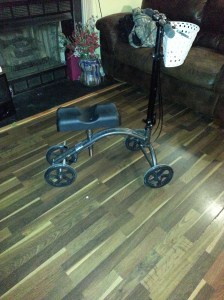
a picture of my wife's rolling knee walker.

My wife’s knee walker.

At first, this went fairly well. The ramp I built was steeper than ADA specifications, but we believed it would be fine for six weeks of the kneelie, and then another six to eight weeks of a walking cast and a boot.

Did I mention her other problems?

Her knees were almost, and now just about completely, without cartilage. Bad arthritis. Her left knee must support all efforts to sit or stand. Her right knee supports part of her weight on the kneelie. she has bad bunions, and a host of other problems. Most of which originate from a connective tissue disease, which we understand, based on DNA analysis, she is Case 0 and our son is Case 1. Yep, a new genetic disorder similar to Marfan Syndrome.

So, like I said, things started off well enough.

On June 24th, during my last presentation at the VLDS conference, she fell off the wheelchair ramp at the office of her neurologist. She wound up in the ER with a concussion. Save that the concussion wasn’t really diagnosed until weeks later after a second (or it might have been third) fall. The cause of the fall was a poorly maintained ramp with a crack in it. A crack which caught the wheel of the kneelie, twisted the steering, and cost her balance.

Wheelchair ramps, unsurprisingly, are constructed (and maintained) with foot traffic and wheelchairs in mind. Not so much for these new mobility devices. More on this later.

The concussion lead to balance problems and then more falls. At one point I decided our former daughter-in-law (who was living with us at the time with the two grandelves) would no longer drive and escort my wife to appointments. The falls never occurred in my presence. There were some near falls, but I

picture of our wheelchair ramp

Our new wheelchair ramp

was paying attention and caught her. Fortunately, I am big enough and strong enough to do so. This is why I have spent so much time taking her to appointments since July. In part, at least.

In part because about three weeks after she got her walking cast she started experiencing a lot of foot pain. It got worse when they put her in the boot. It was then we all noticed that things did not look right. Her arch had fallen back out. X-rays showed the surgery had failed. Other parts of the surgery had healed properly, but not the arch. The bones had not fused. We scheduled a second surgery in September to make a second attempt. In this case, the plan was that she would be non-weight-bearing for 12 weeks and we would use three hours daily of magnetic therapy (to encourage healing).

The downside to this is that she has gotten steadily weaker since May. She was not fit to begin with (and I should note May’s surgery was following arthroscopic surgery on her left knee in February, and she had not regained strength from that) and the lack of walking and other activities had a really negative effect on her. By mid-September the pain in her left knee was becoming unbearable. Her knee specialist suggested that she might have to resort to a wheelchair full-time for she was out of a cast again.

It was then we started thinking about access to the house again.

My wife is a big girl. That temporary ramp was going to give me a workout pushing her in a wheelchair. More importantly, and we learned this the hard way, the design of the porch is such that  is almost impossible, almost but not quite, to get her wheelchair in front of the door from the side. Further, there is very little margin of error to avoid rolling her down the front steps. So, we had a wheelchair ramp constructed the first week I was away for the executive institute. I designed its layout to minimize the incline and impact on curb appeal. It would have been possible to build it in such a way that there was no incline whatsoever, but that would have looked odd.

The new ramp makes a huge difference in accessibility to the house. So far we have used the wheelchair only one day. That was the day after we were rear-ended and she had gotten pretty stiff and sore. (By the way, we have moved the bedroom downstairs into what used to be the office. This may be the case for a couple of years as she faces having both knees and a hip replaced. And bunion surgery.)

Escorting her to all these appointments, some 15 or 20 hours each week, has taught me a lot about what accessibility really means. And it is not just clinics and hospitals, but also restaurants and hotels.

Like I said earlier, most accessibility adaptations are focused on wheelchairs. Wheelchairs have great big drive wheels and much smaller wheels for maneuvering and balance. They tend to much less effected by relatively small deformations and surface imperfections. This is especially true for powered wheelchairs.

However, with a greater range of technologies for mobility and surgical options that didn’t really exist before, combined with an aging population that wants to be out in the world, accessibility takes on new meaning. The 3/4 inch-wide, 8 inch diameter wheels found on these devices are more subject to getting caught or redirected than what is required in the minimal ADA-compliance standards.

Some of the things I have noticed:

  • Maintenance of ramps and transition points are critical. Much of this is not being done.
  • The pebbled/bubbled surfaces on outdoor ramp transition pads are not helpful for mobility devices.
  • Many doors, surprisingly in clinics and doctor offices are not really accessible. They are too heavy.
  • Examining rooms too often do not have chairs with arms. These are a necessity for people like my wife as she has to push up with her arms to get onto her one good foot, orthopedic centers tend to understand this, but even they don’t always carry the ideas through into the exam rooms.
  • Office staff apparently don’t always know what to do if a patient falls.
  • Deep pile carpeting can be make things much more difficult.
  • Hotels should be careful about advertising accessible rooms with a roll-in showers when they, in fact, have tubs.

Some offices are well-run business operations. Others are just lousy. This is true for both public/nonprofit clinics and for-profit clinics.  There seem to some themes about the problem areas, but I don’t really have enough observations to confident with being more specific. It is clear though that some places we simply have to plan on an 8am or 9am appointment going until almost noon.  Other offices are very well-run, never appear to be over-booked, and we know how long we expect each appointment to be. Certainly there is great diversity in patients and their issues, and if I understand that, I expect healthcare providers to be able to understand that and schedule accordingly. Don’t assume every patient is a five-minute visit if you can calculate an actual average of 18 minutes. I understand the need to maximize revenue and reduce costs, but I have heard enough patients at one facility complain about a 2.5 hour visit and process to get five minutes with the doctor to believe there is something untoward going on.

And here’s a pro-tip for a now former provider: It doesn’t make any sense whatsoever to deny that you called your patient and left a message when we have the recording and caller ID and a digital record. Either you are insane or stealing narcotics.

The most difficult part of getting my wife the care she needs is that we are dealing with a dozen specialists. All of whom suggest someone should be reviewing her meds and coordinating care. Unfortunately, they don’t who that person should be. It is beyond the skillset of her primary and they have no other recommendations and don’t volunteer. She is in process of being referred to Mayo Clinic for review and study of her connective tissue disorder. We hope they are able to offer a solution.

She makes my big-ass brain tumor look like a walk in the park. Almost.

We are six weeks through this recovery. With luck. She will be walking in a boot at Christmas.


Virginia Grown, Virginia Brewed

Picture of My brew-to and and brewing assistant (dog)

My brew-to and and brewing assistant

Today kicks off the first-ever homebrew competition restricted to ingredients grown in Virginia. The allowed ingredients are available from the Weekend Brewer in Chester, VA. This will be my first entry in a brewing competition.

Picture of the grain bed Inside the mash tun

Inside the mash tun

Picture of the brewing components.

Brewing apparatus: hot water tank, mash tun, brewing keggle. Pvc pipe delivering water to the hot water tank and to the wort chiller.

My recipe is this.

10lbs Virginia 2-row
1lb red wheat
1lb medium crystal/55L
60 min 2oz Va Cascade hops
30 min 1oz Va Cascade hops
15 min 1oz Va Willamette hops
5 min 1 oz Va Willamette hops

yeast 805 RVA Piedmont

I plan to ferment at 64F for two weeks

My brewing assistant was showing signs of being cold, so I laid her sleeping bag on top. (red and blue sleeping bag on top of dog).

My brewing assistant was showing signs of being cold, so I laid her sleeping bag on top.

It is one of my favorite type of fall days for being outside. Cool, occasional light rain from the deep gray skies, and trees still in fall transition. Its chilly, and I am not sure how long my furry companion will last out here. She is really an indoor dog. A 10 year-old rescue representing a kept promise to my son. She was four months old, give or take, when he brought her home from the shelter. Her arthritis bothers her and she is a bit lame in her back right leg. She is an absolute sweetheart though.

I love the renewed brew-to. Previously, the shelves and platforms were very minimal. These are more like counters. The height is right for a standard school if I wish to sit and type and just about high enough to stand and type. You may notice the mini-platforms that give about 4.5″ of additional height difference. These allow me shift things around and still use gravity to feed liquid from one place to another.

Ooops. I have screwed up. The instructions limit the IBUs (bitterness) to no more than 60, and I have hit 71. So, this batch will not going to the competition. Perhaps I will try again next weekend. Truth to tell, I didn’t really plan this recipe out, and a couple of things went wrong. It’s all good. I have four taps.

Picture of the batch inside the fermentation chamber

Inside the fermentation chamber


Reflections on leadership values

This week was the second and final week of the Virginia Executive Institute. The week was intense with dynamic speakers on ethics, conflict resolution, candor, state budgets, and individuals as historical actors. Graduation was held in the chamber of the Virginia House of Delegates – that was pretty cool.

The VEI staff have developed an interesting approach to leadership. They don’t tell you how to be leader, or attempt to mold Virginia state government executives into a single mold of leadership. Instead, they provide a selection of speakers with a differing perspectives that allow one to develop, or enhance, their own style of leading. I think it works.

For me though, it creates new thought collisions.

“It is by no means enough that an officer of the Navy should be a capable mariner. He must be that, of course, but also a great deal more. He should be as well a gentleman of liberal education, refined manners, punctilious courtesy, and the nicest sense of personal honor.
He should be the soul of tact, patience, justice, firmness, kindness, and charity. No meritorious act of a subordinate should escape his attention or be left to pass without its reward, even if the reward is only a word of approval.
Conversely, he should not be blind to a single fault in any subordinate, though at the same time, he should be quick and unfailing to distinguish error from malice, thoughtlessness from incompetency, and well meant shortcomings from heedless or stupid blunder. In one word, every commander should keep constantly before him the great truth, that to be well obeyed, he must be perfectly esteemed.”
–Compiled by Augustus C. Buell from letters written by John Paul Jones

This was read by one presenter. It seems to me that if John Paul Jones felt that officers of the US Navy should have a liberal education, one would think that would be desirable for all educated citizens.  Ahh, but I am not going to dwell on that issue. If folks aren’t going to be outraged or amused by my conjoining of a liberal education to the Second Amendment, it is clear that interest lacks.

I also made connections between some of the speakers and the not-quite-classic movie, “Circle of Iron,” also known as “The Silent Flute.” I like this movie, even as painful as it is to watch at times. David Carradine makes up for a lot of sins, but some scenes just don’t work quite the way they should. However, it does have some occasional good stuff, including an underlying theme about the value of a mentor (although others interpret this role as a spiritual guide, which has, to me, less difference than that between my black and slightly darker black turtlenecks).

And this brings to mind another collision. Some of the presentations, especially on conflict resolution, had very painful moments. Not because of the presenter, just the nature of wrestling with knowledge of my own inadequacies. Most of time, I am on good terms with these inadequacies – I don’t bother them and they don’t bother me. Sometimes self-knowledge and reflection just kind of suck.

When our speaker on individuals as historical actors brought up the history of the song, “We Shall Overcome,” I started thinking again about how I think of that as much less of a protest song than a love song. Try it some time. Sit and listen, and then sing it to your significant other, or a child, and see if it does not feel like a love song, or a song of love, if you prefer.

Anyhow, I came away from the week with more to think about and expansions to my reading list. As much as I would like to say that all I need to know about leadership I have learned from Tony Soprano, Frances Urqhart, and Frank Underwood, I suspect those who know me will disagree. Certainly now, I cannot stop with those three.


Liberal education-liberal arts are not in danger

Liberal education, the liberal arts, are the danger.

(In case you haven’t noticed, these posts originating on a late Friday night seem to get sillier.)

The wags and pundits calling for the elimination of the US Department of Education (USED)  on the grounds that “education” does not exist within the US Constitution are correct. Their ability to use Control-F and search for the word “education” is unimpeachable. But that is weak logic. Lots of things are not in the Constitution – highway(s), assault weapons, food, handguns, rifles, drugs,  cattle, dog(s), cat(s), abortion, hospital(s), identification, photo identification, trains, planes, and automobiles. The list goes on. I suspect there are few people who don’t have their own hobby-horse to ride about some federal law that they want, that they cherish, that is not actually mentioned in the Constitution.

But, so what?

This is what. Education is in the US Constitution. Specifically, the notion of a liberal education is in the Constitution. It is simply hidden.

As I wrote previously, the liberal arts, a liberal education, is for FREE people. It is just for people who are free, but for people who wish to be free, who strive to be free. Free from the shackles of ignorance, free from puppetry of the State. Free to make informed choices about their best interests.

Free to be free, to challenge government, to challenge the charismatic. Free to know when they are being led like lambs  to the slaughter.

(yeah, this is all over the top, but some of you just won’t pay attention otherwise)

The whole notion of the liberal arts, as a substantive part of a liberal education, is that these provide a basis of discernment to separate fact from fiction, lies from truth. There has always been far too much knowledge in the world to learn it all, but a solid liberal education provides the tools to study any part of it. The skills of critical thinking, problem-solving, literacy, numeracy, and reasoning, combined with knowledge across a range of disciplines is a threat to the power of any government, any tyrant.

Why else would China and other nations attempt to restrict Internet access, Twitter, or other tools for sharing information and knowledge?

Why else is espionage so important?

Why else deny Blacks access to the same education as Whites?

Because knowledge is power. The ability to act on that knowledge is more powerful still.

Education allows people to see, to know, that separate is never equal. Education allows people to work for change. And make it happen. Change through education has accomplished more absolute good than any weapon of death and destruction. Education that, if not grounded in liberal education, informed by liberal education, informed by the liberal arts. And shared through techniques and media developed, nurtured, expanded by the liberal arts.

The liberal arts are a weapon. I, we, are armed through the principles of a liberal education, based in the liberal arts and humanities. A right to which that shall not be infringed.

You can take my liberal arts degree when you can pry it from my cold, dead hands.

(You can’t. You can have the paper any time. You can erase my records. The education still remains. I thought would explain, just in case someone has missed the point so far. I realize I may have been very overly subtle.)

Through the mad mystic hammering of the wild ripping hail
The sky cracked its poems in naked wonder
That the clinging of the church bells blew far into the breeze
Leaving only bells of lightning and its thunder
Striking for the gentle, striking for the kind
Striking for the guardians and protectors of the mind
An’ the poet an the painter far behind his rightful time
An’ we gazed upon the chimes of freedom flashing.

–Chimes of Freedom, Bob Dylan

Defending the Liberal Arts

…don’t leave it to me.

I am the wrong person. I have a short temper and loud voice lacking gentleness, gentility, and any sense of gravitas. When someone questions the need for the liberal arts and their value, I have moved away from thinking about a defense to questioning their intelligence. After all, it is kind of like asking why we need the world to walk on.

Forget all the nonsense about life of the mind, and the exploration of life and history through the arts. It is all pointless. There is nothing more rewarding than working hard all day, with little reward, returning home to do chores, raise children, and collapse into bed. You just don’t need more than that. No song, let alone an entire musical or opera, will ever fix your broken heart. You just need to buy something. Chocolate. Beer. Something.

Buying heals all wounds.

Forget the fact that the act of barter, the most basic of “business” activities requires communication. As communication improves and barter becomes established trade, valuation becomes necessary. And then keeping track. So not only do we need math, we need writing.

But those are bad things. They are. Because writing and communication winds up leading to writing for the sake of writing, to record the stories, to create new stories. Workers don’t need that distraction. Workers need to focus. Workers need to work. Math for math’s sake leads to worse things. Digital things. Sudoku. HD TV, which then needs content and content providers.

From Wikipedia:

The liberal arts (Latin: artes liberales) are those subjects or skills that in classical antiquity were considered essential for a free person (Latin: liberal, “worthy of a free person”)[1] to know in order to take an active part in civic life, something that (for Ancient Greece) included participating in public debate, defending oneself in court, serving on juries, and most importantly, military service. Grammar, rhetoric, and logic were the core liberal arts, whilearithmetic, geometry, the theory of music, and astronomy also played a (somewhat lesser) part in education.[2]

And so here we have it.

The liberal arts, a liberal education, is for FREE people.

Freedom is more than nothing left to lose. Freedom is being able to recognize and know that not all chains are of iron. Indeed, not all chains are even made of metal. The heaviest chains are those forged of ignorance.

To know enough to be able to keep learning is powerful.

To those who argue that a “liberal arts degree” is not enough to be employable, well, yes, for many people that is true. It is just as true that being an expert in computer programming does not mean one will necessarily do something of value for society, economic or otherwise. Or even useful. Just because one path is valuable, it does mean that is valuable for all. It does not need to be the degree that is problem, at some point, the degree-holder has to take responsibility for recognizing the needs and desires of those doing the hiring.

But that doesn’t mean they should not be free.

Certainly the liberal arts should be part of the curriculum. That should never be a question. General education is founded in the liberal arts and sciences. For those that wish to explore writing more deeply, or theater, art, philosophy, or any other topic, there is no harm. Higher education is as much about creating, expanding, maintaining, and sharing knowledge as it is about producing graduates. That role is critical and it is through undergraduate education that individuals with an interest in greater depth of study are found to continue that development of knowledge.

As I have said before, outside the technical and professional fields, major is irrelevant. A college major is an artifact on which the skills of critical inquiry, analysis, problem-solving, and communication are brought to bear to exercise and further develop those skills. This is powerful stuff. It simply may not be what the market needs (or thinks it needs). Individuals, students, graduates, must move past the idea that degree completion is a laying on of hands certifying their wonderfulness as a ready-to-hire contributor. The world has become more complex, more demanding. And thus more will be required.

The liberal arts don’t need defending.

A society/nation/world that does not value the liberal arts is what needs defending. And there is no defense.

Making financial aid work again

There’s a kid out on my corner, hear him strumming like a fool
Shivering in his dungarees, but still he’s going to school
His cheeks are made of peach fuzz — his hopes may be the same
But he’s signed up as a soldier out to play the music game

There are fake patches on his jacket — he’s used bleach to fade his jeans
With a brand new stay pressed shirt — and some creased and wrinkled dreams
His face a blemish garden — but his eyes are virgin clear
His voice is Chicken Little’s — But he’s heir to Paul Revere

My last post inspired this:

So, yeah, the whole “add real financial aid” thing is really difficult. Sure, all we need is money to throw at the situation. But what will that really fix? It solves the immediate problems of access, but we are in this for the long haul. Leastways, I am. I would like to see things change for the better before I retire. Besides, this is still along the lines of reinventing college, an effort that would not be accomplished overnight.

So, if we think about this as an effort for the long haul, what is the problem we are trying to solve?

Create/Increase affordable access to an undergraduate education seems like a reasonable place to start. Of course, then we get hung up on the word “affordable.” Let me tell you, it is tough word, a hard word, to discuss in policy circles. Lots of the folks that are “in charge” or think that they are, have a definition when challenged. Usually it is pretty supportive of the status quo. After all, if college is currently unaffordable, then why does (has) enrollment keep (kept) increasing? Apparently debt it is not a problem. (Not for those already done with a much smaller far behind them and long paid off.)

Could be that students are scared of being poor and the higher ed industry has been pushing the increased earnings over a lifetime associated with a degree compared to some college or no college. Of course, institutions tend to be comfortable selling this aspect of college, right up to the point that we (I) start measuring it rigorously.

So here’s a new definition:

No student shall have to borrow money to cover any part of the total Cost of Attendance beyond the Estimated Family Contribution.

And he’s got Guthrie running in his bones
He’s the hobo kid who’s left his home
And his Beatles records and the Rolling Stones
This boy is staying acoustic

There’s Seeger singing in his heart
He hopes his songs will somehow start
To heal the cracks that split apart
America gone plastic

Think about it. Why on the green earth should a student with EFC=$0 have to borrow $12,000 per year? (Approximate net price of some fine under-supported public colleges for students from families with incomes of less than $30,000/year.) If students with a positive EFC choose to borrow, that is their free choice (although it may in truth be necessity in some families). This strikes me as a measurable and workable definition of affordable.

Unfortunately, it has some near-fatal flaws. First, it requires that the federal need formula be accurate and meaningful since it defines the EFC. Talk to lots of financial aid officials, including those within and without USED, and formerly of the White House, and they will admit that the FAFSA has become a rationing tool. The validity of the EFC should not be accepted without a box of pickling salt. Second, because it is based on Cost of Attendance, we would need some validity checks for institutional estimates of textbooks, travel and incidentals, and off-campus living costs. Braden Hosch from Connecticut demonstrated the issues with these estimates at the PIRS Technical Symposium last February.

And now there’s Dylan dripping from his mouth
He’s hitching himself way down south
To learn a little black and blues
From old street men who paid their dues

‘Cause they knew they had nothing to lose
They knew it
So they just got to it
With cracked old Gibsons and red clay shoes

Playing 1-4-5 chords like good news
And cursed with skin that calls for blood
They put their face and feet in mud
But oh they learned the music from way down there

The real ones learn it somewhere
Strum your guitar — sing it kid
Just write about your feelings — not the things you never did
Inexperience — it once had cursed me

But this is the truth of policy. Policy relies on imperfect measures and the art of the possible. Policy is also built on a foundation of shifting sand because devotees of today’s policy are subject to the hurricane winds of tomorrow’s needs, and tomorrow’s big ideas. So it seems to me we need to agree first on what affordable means.

Assuming we all agree that we are trying to make postsecondary education available to all who wish it, and not just those we think are worthy. Getting consensus on even just that might be challenge.

When the hurricane is coming on it’s not enough to flee
It’s not enough to be in love — we hide behind that word
It’s not enough to be alive when your future’s been deferred
What I’ve run through my body, what I’ve run through my mind

My breath’s the only rhythm — and the tempo is my time
My enemy is hopelessness — my ally honest doubt
The answer is a question that I never will find out
Is music propaganda — should I boogie, Rock and Roll

Or just an early warning system hitched up to my soul
Am I observer or participant or huckster of belief
Making too much of a life so mercifully brief?
So I stride down sunny streets and the band plays back my song

They’re applauding at my shadow long after I am gone
Should I hold this wistful notion that the journey is worthwhile
Or tiptoe cross the chasm with a song and a smile
Well I got up this morning — I don’t need to know no more

I am willing to push policy based on the definition above, as I think it is a good starting place. It is pretty easy to measure. Also, I’ve got data! Data that show that students with larger amounts of loans to meet their COA have lower graduation rates (http://research.schev.edu/?xhF1 – ignore 2009-09 as those are five-year gradrates as six-year rates are just now ready to be updated).

It’s not a fix, but a place to start.

It evaporated nightmares that had boiled the night before
With every new day’s dawning my kid climbs in my bed
And tells the cynics of the board room your language is dead
And as I wander with my music through the jungles of despair

My kid will learn guitar and find his street corner somewhere
There he’ll make the silence listen to the dream behind the voice
And show his minstrel Hamlet daddy that there only was one choice
Strum your guitar — sing it kid

-Harry Chapin, There was only one choice.

Reinventing College

I had planned to write something somewhat subterraneanly witty, inspired while sitting in medical waiting rooms and doing a mashup of Oliver!, Animal House, and something about strings. Sadly, that will have to wait.

Instead, I was presented with this tweet in my timeline.

https://twitter.com/DyingSparrows/status/520340069450657793

Instant karmic clickbait to me. No way I could resist.

Nutshelling his (Adam J. Copeland) excellent post into the five bullet points reads thus.

1. Allow no high school credits to transfer.
2. No graduating college early.
3. No declaring one’s major until the spring one’s sophomore year.
4. Offer no more than 10 majors total.
5. Do away with minors.

From my minimalist perspective and a desire to keep things somewhat simple and deep, these are great ideas. I’ve never been a particular fan of AP credits, although my experience includes “credit-in-escrow” which simply means that the summer between my junior and senior I spent the mornings on the campus of MSSC (now MSSU) in BIOL-101.

Graduating college in less than four years is rarely ever much of an issue. Very few students do so in Virginia. (You want proof? I’ve got data right here – http://research.schev.edu/?xJBL .)

As for not declaring one’s major until fourth semester, I’m all for it. This was the policy at Willamette University when I was there in the 90s. The last time we checked, 35% of undergraduate majors changed majors between fall and spring of their sophomore at Virginia public four-year institutions (excluding undeclared majors). There shouldn’t need to be any rush. Of course, the US Department of Education (USED) (PLEASE NOTE THIS – USDOE is the Department of ENERGY) does not seem to understand this as they are insisting (although it may be an unintended design flaw by the contractor who built the financial aid processing system) that undeclared majors be reported as Liberal Arts majors. Most majors are absolutely irrelevant to career choices. The concept of the major field of study is really to provide a focal point on which to apply and sharpen the skills of critical thinking, problem-solving, literacy, numeracy, and reasoning learned in general ed.

This bit about offering no more than 10 majors and eliminating minors. Hmmm. Yes, a large part of my legislature might jump at that idea. Here’s the rub though. If you think legislators are going to fund faculty in the remaining discipline areas at the graduate level, with low class loads, I suspect you are sadly mistaken. Further, graduate programs tend toward wanting applicants with a matching undergraduate programs.

But the larger problem is this.

To have a well-rounded general ed program, we need a variety of faculty representing various disciplines. What I have noticed about faculty throughout my career and as a faculty brat, is that as much as they work alone (or at least take credit alone) they really prefer to travel in packs. (Although herd is really more appropriate most of the time. Until they smell blood. Or grant money.) One PhD in sociology is going to waste away until another is found. They will soon want a third. Before long you have a department offering a major and multiple subspecialities, each representing their pet interests. Art faculty are the worst as they can convert just about any wannabe artist with an advanced degree into an art faculty member. Late 20th century art using junk and found objects is ample proof of this. (I got bit by junk art angel once upon a time in Alton, Illinois – I still have the scar.)

More seriously, building a solid academic program around a liberal education ideal, tends to require more diversity in faculty than allows an easy limit to a small number of majors. After all, any number selected is pretty much arbitrary in the absence of research on the topic. Faculty will push for more majors. So will administrators. Sometimes students will do so. So the number grows.

We also have an obligation to ensure that the knowledge continues to be shared, developed, and renewed in all disciplines. Colleges and universities are not just about educating the current flock of excellent and semi-excellent sheep.

The big question is this. Are their schools out there now that match this idea? Are there any that wish to do so?


Associations and love songs

I saw the best minds of my generation destroyed by madness,
starving hysterical naked,
dragging themselves through the negro streets at dawn looking
for an angry fix,
angelheaded hipsters burning for the ancient heavenly
connection to the starry dynamo in the machinery of night,
who poverty and tatters and hollow-eyed and high sat up smoking
in the supernatural darkness of cold-water flats floating
across the tops of cities contemplating jazz,
who bared their brains to Heaven under the El and saw
Mohammedan angels staggering on tenement roofs
illuminated,

Howl, Allen Ginsberg

Will my son say he saw the best minds of his generation destroyed by xBox, chatteringly nervous thumbs, of players with heads bowed by student debt, dragging themselves down poxed highways across rotting bridges, keeping faith with their IBR, as Pabst-drinking hipsters dance like maggots in rotting meat, and music oozes tonelessly with only the beat of a warped tire at 25 mph?

Probably not. My son likely does not know the best minds of his generation.

Have you ever watched a music video on YouTube and scanned the list of “related” videos on the right? Do you ever question the algorithms that defines related? Why does “Our Lips are Sealed” by The Go-Go’s show up with Siouxsie and the Banshees  covering The Beatles “Dear Prudence?” Wouldn’t a better option be “We Got the Beat?”

This post is a self-revelatory piece of nonsense for those that can follow the train. But not this train.

And the gold rolled through his veins
Like a thousand railroad trains,
And eased his mind in the hours that he chose,
While the kids ran around wearin’ other peoples’ clothes

Sam Stone, John Prine

Once the Research blog goes out on a Friday night, if I have nothing specific to say and do, my mind wonders as the discipline of the week is relaxed.

Unfortunately, while I would like this to mean I am not currently thinking about higher education, I really kind of am. I wonder about the relationships in the data over the past week, the things I saw, the things I didn’t. I worry constantly about unintended bias in our work. The same thing happens when I hike in the summer. If I go a day or two without seeing a snake, I start to worry that I am not paying enough attention. It simply is not enough to trust that I always I see what I am looking at.

We skipped the light fandango
Turned cartwheels cross the floor
I was feeling kinda seasick
But the crowd called out for more
The room was humming harder
As the ceiling flew away
When we called out for another drink
The waiter brought a tray

And so it was that later
As the miller told his tale
That her face, at first just ghostly,
Turned a whiter shade of pale

A Whiter Shade of Pale, Procol Harum

Christopher Newfield, a professor in the English Department at the University of California, Santa Barbara, has written a fairly stunning review of both Academically Adrift and Aspiring Adults Adrift. Rather than challenge the data or findings, he challenges their facile interpretation. This is one of my favorite things I read this week. It is second only to tweets about me (good ones) and articles where I am quoted. It is really easy to challenge research data. I think it is less easy to challenge the interpretation while offering a good-faith alternative.

Aphorisms and advice

At first, my idea was to create a page of Aphorisms by Tod. After brief moments of thought I realized that such a thing already existed.

This blog.

In a text conversation with one of my sisters, I offered the following. It is better to have a pattern of self-deception than not believe in yourself at all. For some reason she objected to what I think is very sound advice. However, she can’t help herself, she will come back for more whether she objects to it or not. This is something not many people willingly do. A lot of folks tend to think less is more than they can handle.

While I don’t seek people out to offer my advice (if they are not smart enough to ask, they are probably not smart enough to benefit), tonight I feel compelled to offer advice to a small group of people in need of listening.

Read.

In fact, read this.

Particular attention should be focused on standard 7.2.1:

While final authority for an institution is vested in the governing board and defined by the institution’s official documents, each school shall articulate a structure and process of governance that appropriately reflects the collegial nature of theological education. The governance process should identify the school’s constituencies and public, recognize the multiple lines of accountability, and balance competing accountabilities in a manner shaped by the institution’s charter, purpose, and particular theological and denominational commitments.

Whatever is happening at General Theological Seminary, it seems from a distance that all parties involved have forgotten that by seeking and receiving accreditation, they are responsible for these standards. Not just the board, not just administration, not just the faculty. All are responsible. (I don’t have any interest in this situation other than it was brought to my attention by tweeps who pointed to my earlier post on accreditation.)

It is embarrassing to higher ed that a group of people who can fit easily into a decent-sized conference room, or a McDonald’s dining room, can’t find a way to talk things out. Certainly things get touchy, and nightmarish presidents are less than a dime a dozen, but nightmarish faculty are just as readily available. I know from experience that struggles of faith and church governance can be painful and nasty. However, this is a struggle that also directly affects students and their ability to access federal student loans. Of course some would say, in that case, losing accreditation would be a good thing – make the students take private loans. This leads to a line of thought that some will find unpleasant.

I know that churches tend not to pay well. I know that PCUSA synods and presbyteries have to set minimum pay standards to enforce fairness. I also know divinity grads with tens of thousands of dollars in student loans will qualify for one of the income-based repayment options and will likely never pay back the full amounts of their loans. Especially if they have families. (Total Cost of Attendance at GTS is about $44K for nine months an M.Div appears to be a 3 year program.)

This scuffle will draw attention to this issue and perhaps cause people in Washington, DC to consider added HEA amendments that may ripple across higher ed. It probably won’t. This will be just another story in a year full of stories, but the possibility exists.

I note though, that the striking faculty, those that institution leadership and board members insist have “resigned” are still listed on the web page as faculty of the institution. I guess that is preferable than listing only the remaining two.

(for those that would rather read the script)

Brian: Are you the Judean People’s Front?
Reg: Fuck off!
Brian: What?
Reg: Judean People’s Front! We’re The People’s Front of
Judea! Judean People’s Front, God!
Rogers: Blighters…
Brian: Can I…join your group?
Reg: No, piss off!
Brian: I didn’t want to sell this stufff, it’s only a job! I
hate the Romans as much as anybody!
All in PFJ except Brian: Ssch! Ssch! Ssch! Ssch! Ssch!
Brian: Oh.
Judith: Are you sure?
Brian: Oh, dead sure. I hate the Romans already.
Reg: Listen! If you wanted to join the PFJ, you’d have to
have really hate the Romans.
Brian: I do!
Reg: Oh, yeah, how much?
Brian: A lot!
Reg: Right, you’re in. Listen, the only people we hate more
than the Romans, are the fucking Judean People’s Front.
All in PFJ except Brian: Yeah!
Judith: Splitters!
Rogers: And the Judean Popular People’s Front!
All in PFJ except Brian: Yeah! Splitters!
Loretta: And the People’s Front of Judea!
All in PFJ except Brian: Yeah! Splitters!
Reg: What?
Loretta: The People’s Front of Judea. Splitters!
Reg: We are the People’s Front of Judea!
Loretta: Oh. I thought we were the Popular Front.
Reg: People’s Front! God…
Rogers: Whatever happened to the Popular Front, Reg?
Reg: He’s over there.
All in PFJ except Brian: Splitter!


Of course, it could be that this is not really the story the matters. This may just be a symptom.