Burning Bridges

I guess I am tired and feeling cranky. Thursday’s InsideHigherEd story from Michael Stratford, U.S. Keeps Scrutiny of Risky Colleges Secret convinces me that USED cares very little about its credibility. Apparently the Department is afraid to release the names of over 500 institutions under funding restrictions and enhanced scrutiny.

But the department has refused to provide the names of those colleges because of the “competitive injury” it may cause them.

Really.

And what the hell will happen to institutions receiving the lowest PIRS ratings? Seriously, this makes no sense. Unless they are designing the ratings to give specific institutions the lowest ratings. This would mean they are targeting a specific group of institutions and that the game is rigged. Or that a different group of inmates is in charge of each of these projects. The Department really needs to think about consistency in its behavior and make an appeal to the President to back off PIRS or ask the Wizard of Oz for a backbone and courage. Yeah, I am probably reducing or eliminating the number of invitations I will receive from the Department in the future with this comment, but I am just so disappointed in this kind of inconsistency.

Of course, I am still waiting for Ted Mtichell or someone else from the Department to call me about using state data, but apparently that’s not going to happen. Perhaps because I suggested that our timeline probably would not be as quick as theirs. I’m not sure why that would matter since they haven’t hit any of their promised deadlines yet. (I often have that problem as well, and that is the nice thing about self-imposed deadlines – you can move them at will.)

Published on the same day, also at InsideHigherEd, is this story covering the release of a report from the National Student Clearinghouse showing that nearly half of the graduates with four-year degrees had experiences in community colleges. In fact, 65% of had three or more semesters of enrollment at a community college. Matt Reed writes about this pointing to the disconnect between thjhese data, the IPEDS GRS, and what typically is defined as success or failure for community colleges. Reed makes the further connection between community college transfer to four-year institution and student debt. What he leaves out is the connection to PIRS.

Yes, everything comes back to PIRS.

If PIRS happens and Congress somehow embraces it, it will drive federal data collections and definition of metrics for years to come. For good or ill, the concept paper from Senate HELP Committee suggests how things might be throttled back, but Congress has never been shy about adding things it wants to College Navigator.

Ham on rye, Don’t hold the Mayo

We, my wife and I, spent last week in Jacksonville, FL at the Mayo Clinic. I was simply driver and escort. This was her week of attention and an attempt to find answers.

Mayo is an interesting experience. Once they agree to see you and work out the doctors you need to see, and the initial tests you need, they tell you when to show up and how to send your records to them. They also recommend you hand-carry them if things are not scheduled well in advance. Then they send you an itinerary.

When you arrive at the information stand just before registration and check-in, the volunteers print a fresh itinerary for your use. After check-in, you’re off to the first stop on your itinerary. I don’t know how it works with other patients, but in our case our first stop was with a specialist that might be the most knowledgeable of the core of my wife’s least-easily identified issues. We spent almost 90 minutes with this doctor while she took a full history, made an examination, talked about possibilities, ordered tests, and made referrals to other doctors.

She also explained how the system worked and how to make best advantage of our time there.

After the consultation was completed, we returned to the waiting and were asked to standby for a new itinerary. Twenty minutes later we were provided one that included a lab appointment, appointments for that week, and appointments several weeks out. We were then told that some consultations had to be handled in a specific order, which ones were, and then how to talk with schedulers about trying to find openings for the week we were there as well as how to request standby appointments.

Each floor is essentially its own practice and has its own specific rules about standby appointments and scheduling. While this lack of uniformity is frustrating on the surface, I think it makes sense. The amount of time these doctors spend with patients is quite impressive and they do seem much more interested in identifying and solving problems than rushing patients through assembly-line medicine.

Tuesday morning, following an orthopedic consult that brought a great deal of needed clarity, we began a day of sitting patiently in hopes of a consult with a specialist in physical medicine and rehabilitation. By mid-afternoon we learned that the doctor had promised to see us. Just before five we were called and guided to an examination room. For more than an hour my wife was able to tell her story to someone who not only seemed to care, but who believed the reality of her pain and could explain its foundations. This doctor, as they all ended up being, was extraordinarily helpful and exemplified what I think we all wish our doctors to be.

By week’s end we had consulted with eight doctors, visited the lab three times, had three sets of x-rays, one abdominal CT scan, and an ultrasound. Along the way we had access to an online portal that allowed immediate access to her Mayo records, including her doctor’s notes – often the same day of the visit. The Mayo Clinic runs a good operation.

We came away without all the answers we wanted, but we now have greater clarity about what to pursue. Importantly, we also know some things not to do. Previously planned surgeries are now completely off the table. While these surgeries had been suggested to help her, we now know they are ill-advised for someone with her issues. So, something less to worry about over the next couple of years. All of this made the trip worthwhile.

I suppose I should make some comparison to higher education, but I am not sure I can. Colleges, four-year colleges especially those that are predominantly majority-serving, do their best  to admit people who need the least help and are most likely of success. Mayo, and other specialty clinics, do a lot of the opposite. Guess which job is tougher? Certainly there are parallels to minority-serving institutions and community colleges, but I am not sure these institutions are intentional about seeking the most challenging, the most interesting cases. They simply do not turn their backs on them if they do show up.

We still have a long way to go. Of what we have learned, some has been a relief, more is quite scary. I wish I could take this burden from her and carry it myself. It may be though that she is stronger than I as she has been carrying this burden from birth and it has simply gotten worse. My wife has been quite amazing.

“We Shall Overcome” is a protest song. It is, as I have said before, also a love song. It declaration of strength and a commitment to shared strength. It’s a song of love. It’s a protest against injustice and badness.

We shall overcome, we shall overcome,
We shall overcome someday;
Oh, deep in my heart, I do believe,
We shall overcome someday.

We’ll walk hand in hand, we’ll walk hand in hand,
We’ll walk hand in hand someday;
Oh, deep in my heart, I do believe,
We’ll walk hand in hand someday.

We are not afraid, we are not afraid,
We are not afraid today;
Oh, deep in my heart, I do believe,
We are not afraid today.


Two Ratings – Why Not Five?

USED has announced that it is considering two ratings systems for PIRS. One using raw data for consumers for consumers, one using input-adjusted metrics for accountability (access to Title IV student financial aid).

Why not five?

Why not ratings based on wealth-adjusted metrics?

Why not ratings of public institutions based on levels of state-support adjusted measures?

Why not adjustments based on the proximity of Starbuck’s (since that was apparently a factor in Sweet Briar’s closing)?

Clearly I can go on (and on) because once you go down this path there are dozens of legitimate arguments to make. A good ratings “system” would allow different ratings to be created based on the user’s preferences or needs. But to say we will have two ratings will create confusion – especially if the Department is not COMPLETELY transparent in its methodologies and the results of each are markedly different.

I imagine a dining room table conversation where a parent says, “Gee, the this college is rated a poor performer by the consumer rating, but a high performer to be eligible for Pell grants  and loans, so it must be doing something right, even if almost no one seems to graduate in six years.”

Yep. That will be helpful.

A Wall

This is a wall.

It is a very nice wall. image

It is slightly abused and dirty at the moment from kid grime and drywall dust and chunks.

But that is not the problem. The problem is that it hides a Very Bad Thing. What is it that it hides? Why, two runs of very crappy pipe. The water lines for the upstairs bathrooms run down the inside of this wall.

But you would never know this unless you happened upon some accurate blueprints somewhere. Even if you knew the pipes were there, you wouldn’t know they were crappy without evidence of failure elsewhere.

It looks harmless, does it not? More than that, it looks to be doing its job holding up the ceiling and keeping the door to closet separate from the door to the bathroom. What more could you really want?

You don’t know what’s going on until you open things up occasionally and take a look.

Or something bad happens.

Like the plumbing breaks and you find out the pipe is crap.

Or you learn you have a brain tumor and you feel that you have an invader in your head or body is attacking itself.

I suspect the students, staff, and faculty of Sweet Briar understand this feeling. It’s something that could have been solved with transparency and openness. The decision and announcement still would have been painful, but probably not as painful.

Surprises like this just suck.

When the plumber gave us a rough estimate of replumbing the entire house, he said, “A lot of times I give that figure and come back and find a for-sale sign. Some people just don’t want to pay for a new plumbing.” Unfortunately, I am going to have to guess that rarely, if ever, do potential buyers get told of major plumbing needs. After all, it is all behind a wall or ceiling and it might just be okay. I just could not do that to someone. It’s wrong on so many levels.

Anyhow, I feel that if you can’t trust a wall, you can you trust?

Hiding behind the sheetrock


image

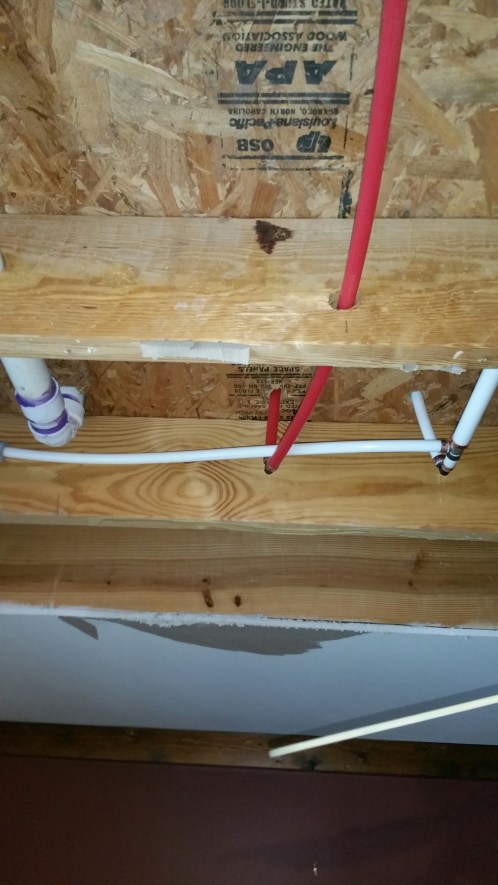
A few weeks ago, without effort, I broke an upstairs bathroom water line and flooded the house about midnight. When I explained the situation to the plumber at 1:00 am and $165/hour, I am sure he thought I was crazy and hiding the fact that I had done something completely idiotic. Seriously, the pipe just snapped inside the wall while just moving stuff around inside the vanity.

About an hour later, my wife and I are downstairs and she is watching me mop up the living room and pick up the sections of sheetrock that had fallen. (The largest piece falling my head is what actually woke her.) The plumber was upstairs capping the lines in the vanity and we both saw a section of pipe just fall to the floor. The plumber came downstairs holding the hot water valve in his hand.

“I’ve never seen that happen before. I grabbed the valve to cut it off and it just snapped.”

And it happened several more times.

So, while much of the ceiling is missing, we’ve had the plumber back of couple times to completely re-plumb the upstairs bathrooms. (Ultimately we will have all the water lines replaced this year.) He brought an assistant with him this week so the job wimageould go a bit faster. I asked him if the situation had been explained to him. “Sure, I’ve just never heard of that happening before.”
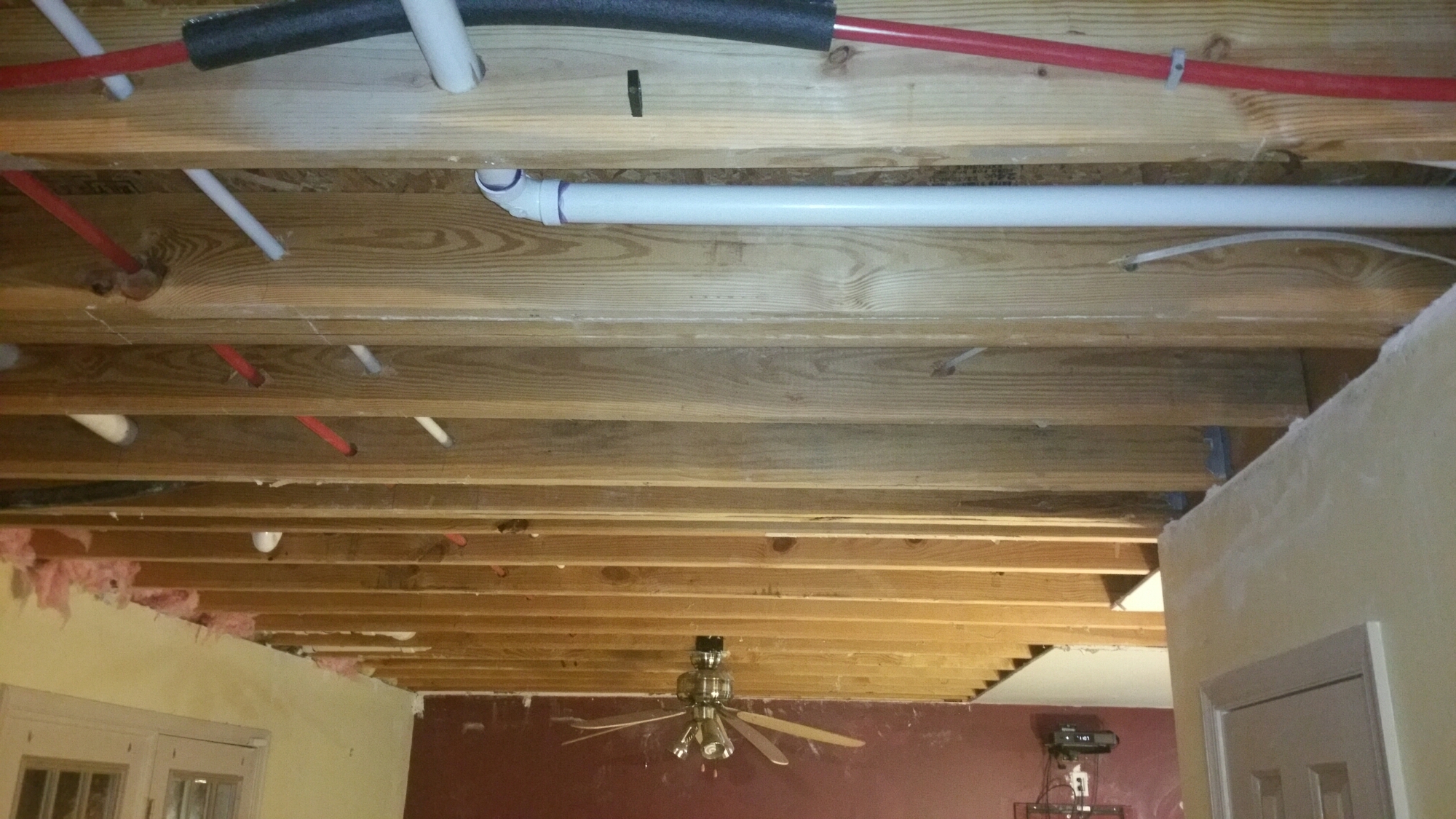

A little while later I got to watch as it happened to him.

“You thought I was crazy, didn’t you?”

So, these pipes have me freaked out a bit. They will all be replaced. It has also been pointed out that these same pipes have been connected directly to the water heater, instead of to 18-24″ of copper piping between the CPVC and the water heater.This a code violation that never should have been passed.

What’s behind the sheetrock is something we rarely see. In fact, when we buy a house, or choose a college, we do it largely on faith in the processes and adopted standards. We assume that any relatively new house (and ours was built in 1999) is built to the established building codes. We also assume (hope) that quality materials were used and used correctly.

Right now, that seems like an awful lot of (misplaced) faith.

For the record, I can do a lot of things. I started looking at the water lines thinking, “you know, I could replace those myself.” But, I’ve read enough posts on the plumbers’ fora to understand that “it takes more than a can of glue and a buttload of CPVC to be a plumber.” It does indeed, and I am okay with that. I would rather appreciate the fact the someone else has taken the time to master plumbing skills than to attempt to so myself.  I look at the new lines thinking, “It is a shame to have cover this up. It’s doubly a shame that no one else will appreciate this to the degree that I do.”


image


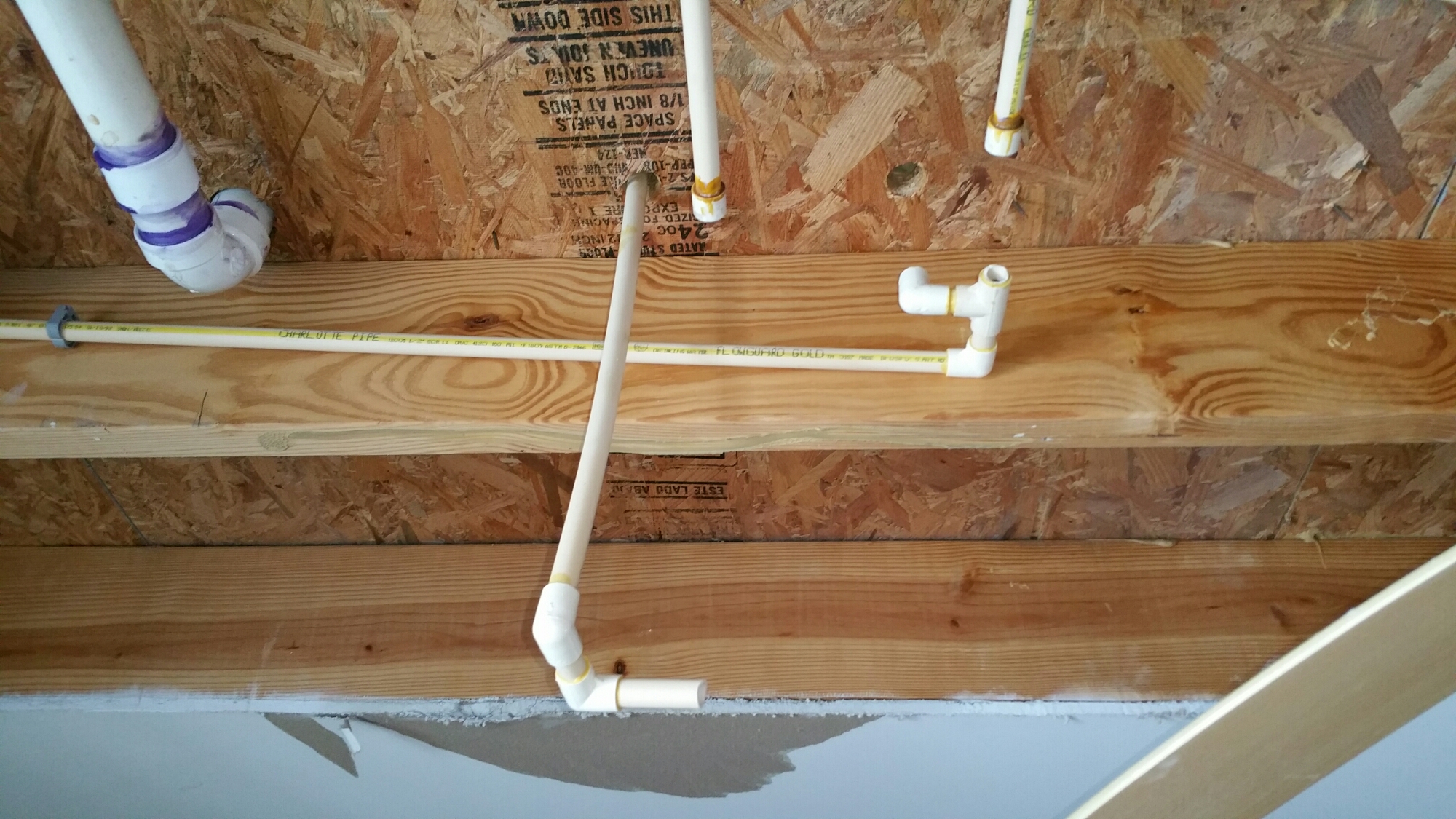
This below is what crap pipe looks like. Manufactured in January 1999, Flowguard by Charlotte Pipe. Maybe it was a bad manufacturing run, maybe it was mishandled by the original plumber, maybe the glue was flawed, or maybe it had spent too much time in sunlight. Maybe if Charlotte Pipe had at least acknowledge receipt of my email, i would not show the details. But this is the beauty of the open Internet. Someone may see this and tell me of a related case. Or maybe the manufacture will find this and respond. Google Flowguard CPVC and browse the results. Opinions on Flowguard are all over the map.

imageI saw this evening on Twitter that there is a bill, or at least a proposal, to allow states to create their own USED-recognized accrediting body. Historically that topic has come up in Virginia from time to time. It is an interesting idea, but not one I am interested in pursuing. While I could create a hell of an accreditation function with our data resources, it still would not tell us what is behind the sheetrock. I suppose we could peak under the sinks and grab the valves and give them a good shake, from time-to-time, but we have been here 10 years and nothing like this has happened before.

In the end, I don’t really have a good answers beyond trusting the process and knowing that sometimes things break and require fixing. All the metrics in the world won’t show me what’s behind the wall.


image

image

image

You can do everything well and still fail

Subtitle: Some of you are focusing on the wrong things.

Subtitle: Life isn’t fair.

The board of Sweet Briar College announced today that it would cease operations with the end of the semester. It seems that they are taking a principled stand to go out on their own terms, with adequate resources to properly teach out the term and close down decently and in order. It is striking that SBC has a $94 million endowment, but over half of that is restricted in its use, significantly reducing the ability of the college to use endowment returns to fundoperations.

Sweet Briar is a fine institution that really does seem to do most everything well. Young women generally seem to thrive there, especially those that stay. Retention into the second year is not the greatest, but those that make it into the second year are pretty much going to graduate. From what I have observed the last 14 years from a distance, and on campus, it is a pretty special place.

The policy wonks have been excitedly discussing the increased applications and the declining yield rates.  The fact is that few young women seem to be really interested in attending a single-gender institution sitting on a mountain ridge an hour or four away from excitement and activity. I suspect there are far more than the approximately 200 that have enrolled each year, but finding them is not easy. As for the increased applications, those are easy enough to come by with a little work and little more mailing. A difference in 400 applications really is not that big deal to achieve with the available tools and consultants. It is much, much harder to increase the number of quality applications – applications from students really interested in what Sweet Briar offers, at a price that the students and the college can both afford.

The fact the entering students of 2013-14 had an 84% acceptance rate (Admissions tab) is pretty strong evidence that increasing applications alone may change very little.

A critical problem to my mind is the getting students in the door is only one part of the problem. A 63% graduation rate  is respectable rate, but for a small college with lots of one-on-one experience with faculty, I suspect most people believe it should be much higher. If not, what is the value of the small college experience? Again, as I said earlier, the “problem” (if it is a problem and not a feature of college) is in the first year retention. The entering class of 2008 had a 75% retention rate (148 students) into the second year. Six years later, 124 of those had graduated from Sweet Briar, or about 84 percent. A handful of others graduated from elsewhere in the Commonwealth. By prowling these data one can get a sense as to where some of the struggles are. It is a simple fact that any institution that struggles to constantly replace students that don’t persist to completion faces an uphill struggle for its existence.

But the fact remains that Sweet Briar is gem tucked away in the mountains. A gem like BridgewaterFerrum, Hollins, Lynchburg, Roanoke, and a host of other small, liberal arts colleges, that deserves more attention for all that it does well. Unfortunately the world is changing and it has never been fair.

I worry that we don’t wish to pay the costs to keep such experiences available. That we refuse to acknowledge that some things are not only somewhat expensive, they are also worth every penny.

On the other hand I admit to shopping at Walmart and Amazon. Not because of the price, but because of convenience. They are open when I have time. (But, if it is a stop on the way during “normal hours”  to just about anywhere else, I will avoid Walmart like the plague if I can get in and out quicker.) Small mom & pop stores are rarely open when I have time to shop. If I have to leave work early or go in late, the cost and inconvenience of the shopping trip has generally increased more than I wish to consider.

And this is the conundrum of the small rural college.

So, I’m supposed to take you seriously?

Yes, this is pure snark. It’s been building and I am tired.

Maybe it is just my experience, but I don’t assume we all see the same things.

Sometime in 1986-87, give or take a semester, one of my art classes went to Wildcat Glades to draw and paint. The instructor set to work right away with paper and oil pastel to recreate the waterfall. His colors were surprisingly way off for his normal style. In fact, when this was mentioned, he questioned the commenter, quite doubtfully. After all, it looked normal to him.

Until he removed his sunglasses.

“Oh wow! I never really thought about the way these filter color, nor have I worn them for color work before.”

Kind of an important lesson for all of us.

A couple years later, when I was at the The University Museum at SIUE, we were talking about the design of the new art building under construction. Tremendous amounts of glass blocks were to be used to give it a light and airy feel with a very contemporary design. And a tremendous amount of greenish light. The administration and architects seemed uninterested in listening to the experts who tried to explain that this might not be a good thing. It was finished after I left, so I hope it all worked out (I think they did use a different glass block). [These were the same people planning a gallery with lights at 24ft height, but only noted storage for a 12ft rolling ladder. We joked that the plan was to hire at least 12ft tall grad assistant each year.]

The lesson is that we need to be careful of being overly confident in what we (think we) see. Or measure.

If you assume that we all see the same thing the same way, you are probably wrong.

When I was a cocky, snarky, difficult to get along with art student, I would insist that I only saw six colors.  I don’t really recall what they were, it was just an annoying way to justify my choices in palette and design. It was also a way I chose to think about things because it had become clear that not many people saw things the way I did. (I’m not saying my was better. It was simply right.) Talking with other artists, I learned about their conceits and world views that informed how they saw things.

We all understood that light has different colors and it was fairly easy to change how someone perceived art by changing the qualities of the light on the art.

So before you damage a relationship by insisting something is one thing while someone else insists the opposite, maybe you should consider the lighting.

And just to be clear, this post is not about #TheDress. It is about #PIRS. And any other attempt  of rating, ranking, or measurement.

Staying (Aging) in Place

So. We have decided to stay. We have begun the house modifications, albeit a little sooner than anticipated. A week ago we had a pipe break in an upstairs bathroom. Just hours after a new accessible shower was installed. The pipe didn’t freeze, it just broke, snapped, while I was moving stuff in the vanity. Later that night, it did the same thing to the plumber as he was working. Fortunately the water was off when it happened to him. Another snapped a week later when bumped by a contractor laying a new a floor in the adjacent bathroom. (I think this is bad pipe.)

So, the CPVC in the house has me a bit freaked out and we have started having it replaced. Especially with a big section of living room ceiling missing, it is a lot more cost effective to do that now.

As we consider choices for replacing the living room floor (half of which has been torn out) we have to think about choices that will handle a wheelchair, if needed, without damage. This takes laminates out, and probably all of the snap and click floating floors. This leaves vinyl, tile, and hardwood (glued or nailed). If I could find our existing tile it would probably be an easy decision to use tile, but alas it is no longer made. Bamboo is probably the winner.

Meanwhile, the upstairs bathrooms have much wider doors. Wide enough to get a walker through. We are still considering quotes on the chair lift and thinking about geometry and cost. It is not a big house, although now somewhat bigger than we need, and areas like the entryway are small and the footprint of a chair lift has to be carefully considered to avoid obstructing wheelchair access.

The big project will be to slightly enlarge the small downstairs bathroom and make it wheelchair accessible. We have a plan and it is reasonable in cost and approach. We are also considering other modifications to the kitchen to help ensure she is able to easily self-manage when I am not around.

Throughout all of this I have begun to learn about the concepts of “aging in place” and “visitability.”  We also think a lot about furniture layout and how traditional homebuilding practices do not enhance accessibility.

I also learned that Virginia offers up to a $5,000 for permanent visitability adaptations for new construction and modifications to existing structures. It is the “Livable Home Tax Credit.”

I think this will all work out. I hope.

an adjunct prayer

It was four in the morning at a Motel 6 in the wilderness of the not-quite midwest. I was half-naked on my knees, holding a large chocolate bunny and nibbling at its ears. The wind was howling, at least I thought it was. In any event, my ears were full of a roaring sound I tried to ignore. I could see the snow swirling through the space between the drapes.  The college I taught my Tuesday morning class had already closed for tomorrow, but my evening class was 73 miles away and I wasn’t sure what the storm would do there, or if I could get there in time.

Living on the road my friend
Was gonna keep you free and clean
Now you wear your skin like iron
Your breath’s as hard as kerosene
You weren’t your mama’s only boy
But her favorite one it seems
She began to cry when you said goodbye
And sank into your dreams

My girlfriend and I taught at two campuses in common. She has a pretty good gig in that she teaches six days week at two colleges and brings down nearly twenty-thousand dollars for the semester with less than 300 miles driving. I don’t do that well. I drive over twice that distance for six courses that don’t pay as well.

All the federales say
They could have had him any day
They only let him hang around
Out of kindness I suppose

If not for income-based repayment, we would not be able to make it all. Between the two of us, we are on the hook for $290,000 in student loans. Thank God they are federal loans or else we would really be in a shitload of trouble.

The poets tell how Pancho fell
Lefty’s livin’ in a cheap hotel
The desert’s quiet and Cleveland’s cold
So the story ends we’re told
Pancho needs your prayers it’s true,
But save a few for Lefty too
He just did what he had to do
Now he’s growing old

A few gray federales say
They could have had him any day
They only let him go so wrong
Out of kindness I suppose

We talk about running away to somewhere warm. Out of reach of Sallie Mae and FedLoans. Save for the lack of water and a Whole Foods store, the Chihuahuan desert seems a good choice. Except while we have fluency in French, German, and Romansh, Spanish escapes us. Still, it is tempting.

Tonight we rock, Tonight we roll
We’ll rob the Juarez liquor store for the Reposado Gold
And if we drink ourselves to death, ain’t that the cowboy way to go?

Tonight we ride, tonight we ride
Tonight we fly, we’re headin’ west
Toward the mountains and the ocean where the eagle makes his nest
If our bones bleach on the desert, we’ll consider we are blessed
Tonight we ride, Tonight we ride

Tonight though I kneel, head bowed to circumstance, lost in communion with my chocolate Jesus that happens to be shaped like a bunny.

When the weather gets rough
And it’s whiskey in the shade
It’s best to wrap your savior
Up in cellophane
He flows like the big muddy
But that’s okay
Pour him over ice cream
For a nice parfait

Well it’s got to be a chocolate Jesus
Good enough for me
Got to be a chocolate Jesus
Good enough for me

Lyric credits to:
Pancho and Lefty by Townes Van Zandt.

Tonight we Ride by Tom Russell

Chocolate Jesus by Tom Waits

Feb 13, 2025 – Government Will Change How it Rates Colleges

The federal government on Thursday announced that it was changing the way it measures colleges, essentially adjusting the curve that it uses to rate institutions to make it more difficult for them to earn coveted four- and five-star government ratings.

Under the changes, scores are likely to fall for many institutions, federal officials said, although they did not provide specific numbers. Institutions will see a preview of their new scores on Friday, but the information will not be made public until Feb. 20.

“In effect, this raises the standard for colleges to achieve a high rating,” said Thomas Hamm, the director of the survey and certification group at the Commission of Education Economics within the Executive Office of the President, which oversees the ratings system.

Colleges are scored on a scale of one to five stars on College Compare, the widely used federal website that has become the gold standard for evaluating the nation’s more than 15,000 colleges even as it has been criticized for relying on self-reported, unverified data, that is limited in scope and function.

In August, The New York Times reported that the rating system relied so heavily on unverified information that even institutions with a documented history of quality problems were earning top ratings. Two of the three major criteria used to rate facilities — graduation rates and student input quality measures statistics — were reported by the institutions and not audited by the federal government.

In October, the federal government announced that it would start requiring colleges to report their staffing levels quarterly — using an electronic system that can be verified with payroll data. They will also report their enrollments weekly by the individual student to be verified against the National Student Loan and Tuition Tax Credit Data System. This allows to begin a nationwide auditing program aimed at checking whether an institution’s quality statistics were accurate.

The changes announced on Thursday were part of a further effort, officials said, to rebalance the ratings by raising the bar for colleges to achieve a high score in the quality measures area, which is based on information collected about every student. Colleges can increase their overall rating if they earn five stars in this area. The number of colleges with five stars in quality measures has increased significantly since the beginning of the program, to 89 percent in 2024 from 62 percent in 2015.

Representatives for colleges said on Thursday that they worried the changes could send the wrong message to consumers. “We are concerned the public won’t know what to make of these new rankings,” said Mark Parkinson, the president and chief executive of the Association of Private Sector Colleges and Universities, which represents for-profit colleges. “If colleges across the country start losing their star ratings overnight, it sends a signal to families and students that quality is on the decline when in fact it has improved in a meaningful way.”

But officials said that the changes would be explained on the consumer website, and that the public would be cautioned against drawing conclusions about a institution whose ratings recently declined. Still, Mr. Hamilton said scores would not decline across the board.“Some colleges, even when we raised the bar, continued to perform at a level much higher than the norm,” he said in a conference call Thursday with college operators. “We want to still recognize them in the five-star category.”
The updated ratings will also take into account, for the first time, a college’s use of antipsychotic drugs, which are often given inappropriately to elderly administrators with dementia.

–Thanks to John Nugent for the link to the original article and the inspiration.