yes, data can lie

20170417_145314

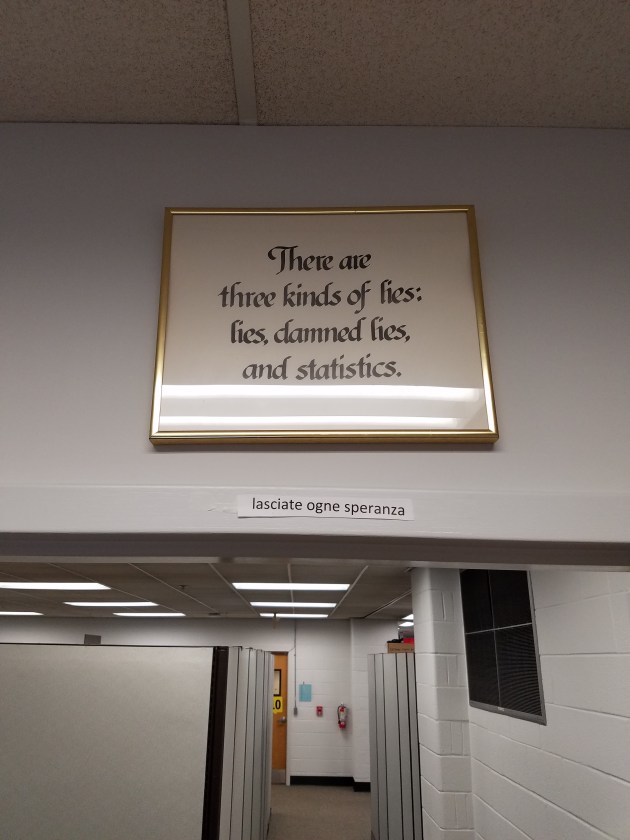
My office doorway, leading out into policy analytics lab environment. This was a gift from one of my former vice presidents when he left to become a college president.

A couple hours after I published i have questions, my brilliant friend Tressie tweeted:

https://twitter.com/tressiemcphd/status/853607774370004992

The Digital Goofball, I mean, Guru, above is wrong. Data do lie on occasion. They can lie for a whole bunch of reasons, from the simple to the complex. The lies can begin at point of collection and continue on through aggregation and analysis.

Another brilliant friend, Laura, published a new blog post on the same day that begins with a story of a failure in medical screening.  The nurse’s failure in this account suggests that her lack of questioning is her normal behavior, or hints at assumptions she makes about patients. Whatever the case, the collected data are suspect.

Data collection is an expensive process to do well. Putting aside Big Data, which generally captures data that are a byproduct of transactions, good data collection requires careful thought and planning. I wrote about counting to one almost two years ago and point to it again because it is the basis of what I do and think about. Understanding what you are counting, and why. What I didn’t discuss, and it is implied in friend Jeff’s (also brilliant) essay that is linked within that post, is choosing what not to count. Or who not to count. Every choice in collection defines the truth and reality of what the data can represent as information.

Once we move beyond collection into shaping we encounter the same choices. We shape (most people call it “transform” but I like to shape the data) into forms that fit our understanding and the understanding we wish to share with others. Data are like Play-Doh and can take all sorts of shapes and dimensions. It can be worked and reworked for endless variety. But, it can only stretch so far before it breaks and becomes separate pieces. This is what happens with data when you stretch the definition and structure too far, original meaning is lost and the provenance is broken. Small pieces can be lost during this shaping, or blended with other “colors” creating something new, but increasingly more abstract than the original data.

There’s a key word: “provenance.” Familiar from my art history/museum studies days. Relevant today as “data provenance” for both the ownership and meaning of the data all along the way. While one may be able to demonstrate a chain of ownership and handling of data, at some point it is possible to have shaped the data into something that violates the provenance, intentionally or not. Developing checkpoints along the way of shaping and transformation is needed to reliably maintain original meaning or at least the path to original meaning.

As data are aggregated, as the counting begins, the lies can take on new dimensions of possibility. This wonderful essay by Dana Boyd covers a number of examples. At the close of our first panel presentation at the Governor’s Data Analytic Summit that I mentioned here ,each of us were asked who the ultimate beneficiary of our work would be. We all gave the same answer, but I was naturally bit blunt about it, “Clearly the citizens of Virginia. If not, we are doing it wrong, and that’s all that really matters.” Later in the day I raised the need I felt – that every session should have some discussion about the ethics of data use and analytics. There was much less response to that than I had hoped for.

Data can be made to lie. They can also just be wrong. Errors do occur, and hopefully they can be corrected before damage is done. The data can also be right, but misused, misunderstood, and misinterpreted. For example, attributing an outcome to say, skin color, instead of attributing to differences in treatment because of skin color, is more than likely in most cases a complete misunderstanding of the data. Or a determined willingness to see an interpretation that fits your desired model, something along the lines of confirmation bias but with clear intentionality.

One has to know the distance between zero and one and what that distance measures and accept that distance in order to have an honest conversation about data. The fact that I am inspired/driven to write this post should be an indicator that I feel strongly about this topic. “Data don’t lie” is right up there with “the check is in the mail” and “don’t you trust me baby? of course I love you.” It is a crock of shit to say in an all encompassing way “data don’t lie.” Some of us work damned hard trying to ensure our data don’t unintentionally mislead. We spend hours wrangling with people about nuance, not just nuance of definition, but the nuances of calculation, why one way is more accurate than another. And why it takes longer to do it right.

Even when the data are pure as the driven snow, the provenance is impeccable, and the interpretation admirably circumspect, there is still room for doubt. What was left out? What assumptions were not valid? What don’t we know about what we don’t know?

In other words, we should be cautious with even truthful data. It is never, in my experience, “the whole truth and nothing but the truth” as there are always unknowns.


i have questions

I spent the beginning of the week at the Governor’s Data Analytics Summit. Talk about some serious geekdom. And generally overly serious people. Governor McAuliffe was an exception, his speech was jovial and positive as usual, celebrating things in the Commonwealth and his accomplishments. But it was all seriously geeky.

And it happened again. The conversation that I find amusing. I go to events like this or hackathons and datathons and talk about what we do. I talk about our data, our longitudinal data systems (yes, plural – the agency’s and the collaborative system), and our data products. When I mention the wage & debt reports or the cohort lifecycle modeling, I often get this: “Wow, you must have one hell of a data scientist!”

“Thanks. I am pretty good at what I do, I’ve been doing it a long time.”

They look at my name tag again for a title again, or just say, “Oh.” Then we talk languages and tools and they learn that I am just not with it. My tools are old school. “Data Scientists” have proliferated at these events. Some are young and possibly credentialed as such, others are old, like older than me, and I find they haven’t picked up any new credentials. Nope, they have just retitled, re-branded, what they are. As far as I can tell, they just change tools occasionally to use the new, “cool” languages, or just new modules for old school software.

So, no, I don’t think of myself as a “data scientist.”

I’m not sure what I am. My title at work is “policy analytics director.” This gets at some of what I do. It’s also new, an improvement over “policy research and data warehousing director” for both brevity and accuracy, but I doubt it will be included most one-on-one introductions, unless I use it.

Recently I ran into a local college president. He introduced me to his son as “a numbers guy.” This is marginally better than “data guy”, a term I despise, (and yes, I know thatvirginiadataguy.net points to this site as sometimes you have to give in to the nightmare). “Data guy” is just so very one-dimensional. My life is not data. My identity is not data. But to a lot of people, that is probably all they see. Certainly, Virginia’s college presidents almost only see me talking about data – or rather what they think is data. I see it as something at a higher level than that, but I guess the difference between data and information and knowledge depends on where you stand. Or whether or not your thinking incorporates an understanding of the levels of abstraction that exist between a number and the people it represents. Where does data stop and information begin?

Data, for me, is the lowest level of observation, categorization, and measurement of phenomena. To address me as a data guy suggests that I am not worthy of the higher thought-levels in which you engage.

“Guru” is another nickname that just drives me crazy. It implies that there is some level of mysticism to what I do, at least in the way I suspect they mean it. There is no mysticism in this work, just hard work, a willingness to fail regularly, and an ability to learn from all that failure. Basically the same as in any profession. I’m not really a “data analyst” but it is a part of what I do. I can spend hours on occasion listening to the data and occasionally saying, “So what do you think about that?” Yeah, kind of the Carl Rogers of data science. (Would that work on a business card?) Or data psycho-analyst? Or psycho-data analyst others might suggest?

So what am I?

I am more than my job, that’s for sure.  If I am only a data guy, let me point out that I am generally the first person to make an argument for the liberal arts and humanities and their necessity for inclusion. I think about data and information in terms of policy objectives and people, it is more than just numbers. I also think about data in terms of the level of abstraction it represents, the distance from the measurement to the people, policies, transactions, or things measured.

I also see data everywhere. Everything is data. Every observation can be reduced to something identifiable as data or a collection of data. It’s frustrating, and sometimes damaging, because I notice things like timestamps on messages and will try to reconcile those with comments within a conversation, ie. reconciling data with storytelling. This can be unsettling to others but it is not intentional, it is just a byproduct of seeing and incorporating data. Because everything is data and it is all collectable. Especially stories. Stories are both data and a form of data collection and data sharing. They are also more than that as they are also informational and can convey knowledge and wisdom. That, I think is really cool.

Reviewing this last bit, I can almost believe that I am a data guy. But storyteller works too. I think storyteller is better, and more accurate. It won’t work on a business card for a state agency, but I could introduce myself that way. It makes sense to me, but it does it make sense to others?

Some years ago, in a context I don’t remember, I was part of an exercise about “Who are you?” The crux of this event was that most will identify themselves in terms of their job when any individual is generally so much more than that. The problem is that for some group of people that each of us knows, that is really all we are. That is my complaint. How do I, how do we, change that so we are seen as more than our jobs?

There was another aspect to the conversation above. The college president chuckled and said, “Tod always says what’s on his mind.”

I groaned, “Okay, what did I say this time?”

“Nothing, nothing it all. It’s just that you’ll have us all in a room, we’ll all be thinking the same thing, but you are the only one who will say it.”

Fair enough. I have little to lose by being straightforward, clear, honest, or just stating what sounds to be opinion but is more often my interpretation of what I see in the data. I also disagree that all are thinking the same thing as I know at least some are still struggling to catch up.

So, who am I? Is it what I do for work? Is that really a problem when it seems from my perspective that I do for work flows naturally from how I see the world and interact with it? Why do I object to certain phrases so viscerally when I can see their rightness, especially in the full definitions or synonymous meanings of words like guru?

I’m probably antagonistic by nature (full stop, maybe?) to the idea of being defined or described by two simple words. Might was well just call me a number. 219 works. I answered to that in both basic training and Air Assault school. Maybe this is my ongoing reaction to current sensibilities of reducing everything to a handful of numbers, a handful of words (bullets on a slide), key performance indicators. We’re carrying this too far, losing any sense of nuance or complexity, losing any sense that the data represent real people and their movement through life.

It reminds me of the racist, dehumanizing language used in the military to describe the opposing forces. Sure, it is shorthand, but my dehumanizing, by making them other, it reduced the psychological impact of killing and maiming. It makes it easier. The more we reduce measurement and description, the easier it becomes to forget the people that are the basis and the whole point of measurement. That’s my problem.


Lost stories of a lost world

I know only only a few songs by the Moody Blues.  I had one album on cassette way back when, but I don’t even remember which it was. On  the way home tonight, I heard “Lost in a Lost World” and it struck a chord. I’m always impressed at the timelessness of some song lyrics.

I woke today, I was crying
Lost in a lost world
So many people are dying
Lost in a lost world
Some of them are living an illusion
Bounded by the darkness of their minds
In their eyes, it’s nation against nation against nation
With racial pride
Sounds…
Thinking only of themselves
They shun the light

Of course, I’m a sucker for a good story, whether the ending is happy or sad, that mirrors how I feel.  So story songs are my favorite. I’m an unabashed fan of Harry Chapin’s music. Certainly Taxi is in my top 10, but A Better Place to Be is probably my favorite and the one I am likely to sing to someone at bedtime – that is if John Prine’s Sam Stone was not enough to put a child to sleep. Zach is probably fortunate that he grew up before I discovered Tom Waits and did not sing Tom Traubert’s Blues, A Christmas Card from a Hooker in Minneapolis (I actually knew a call girl in my time at SIUE – she was my girlfriend’s roommate and had spent the summer working in a brothel in Nevada – but that’s another story), and I Hope I don’t Fall in Love with You. Then again, these songs might have softened his temper a bit and are perhaps a bit cheerier than Puff the Magic Dragon and some of the folk songs I sang to him.

Back when I was involved in the scout troop, storytelling was a key ritual. It built and reinforced community.  Friday and Saturday nights of our monthly campouts found the adults sitting around a fire telling and retelling the troop’s stories. For newcomers it often seemed off-putting at first since most of the stories were about boys that aged out already. But these stories were the core history of the troop. It was a small, but truly boy-led troop. The adults were there primarily for oversight and instruction. And to keep things from getting too out of hand. With this model, there was lots of room for stories to develop since there was very little, “No, don’t do that.” Zach created quite a few stories for the troop.

Saturday night campfires involved mandatory skits. It was more than entertainment, it was about encouraging creativity and performance for peers. A lot of the skits were rehashed versions of skits from Scouting or Boy’s Life magazines . Occasionally they were new. For a couple of years, Zach and one or two others would steal ideas from “Whose Line is it Anyway” and do improv like “Scenes from a Hat” where they would draw random slips of papers with scenes to act out. It ranged from groans to laughter. Adults had to had participate as well. But, other than Scout Vespers there was almost never any singing around the fire. Occasionally one of the assistant scoutmasters would sing ballad of the “Uneasy Rider” to which I would respond with the “Talking Ben Tre” blues and thus kill any further song. Apparently, anti-war songs weren’t the right tone.

It was all about the stories though.

Storytelling with data is much of what I do. However, it tends towards the implicit more than the explicit. When I was in the MFA program, one of my colleagues at the museum was fond of criticizing my paintings as he felt the stories were too obvious.  “Tod, my problem with your work is it that it is story-based and the stories are too obvious. Good art is always implicit, never explicit, as David says,” (our boss). “I think if you want to paint butts, then just paint butts, no stories.” First, he may have thought the stories were obvious, but he never quite got the stories right , he just saw a story. And two, he was the one that did nothing but paint butts. That was his thing.

The difference between implicit and explicit art or storytelling, is interesting. The explicit leaves little for the audience’s imagination to do.  Perhaps. I think it depends on how much they are engaged in the story. A two-dimensional painting or drawing can only do so much of the work. A video or movie can do much more, but still can’t do everything. And a story read or recited leaves as much to the imagination as the storyteller chooses. Implicit art simply leaves out detail allowing the audience to make more choices and assumptions, even as far as what the basic point of the piece is. To my mind, it can be somewhat lazy, if it is not somehow clear that the work is only about the aesthetic.

Transcending the discussion between implicit and explicit is Picasso’s “Guernica” painted in reaction to the use of town (of the same name) for bombing practice by the Nazis. The nearly monochromatic approach to color, Cubist style, and general abstraction take this painting far from the explicit save for a clear depiction of death and woe.  At the other end of the spectrum is John Singer Sargent’s “Dr. Pozzi Comes Home.” On the surface, this is simply a beautiful full-length portrait of an apparently beautiful man. It is pretty explicit on that level. On the other hand, there is seriously implied humor in the painting on multiple levels – especially with knowledge of about eight or ten words of the backstory. Both paintings tell stories and are deserving of hours of study and appreciation.

I used to try to write enrollment reports and a couple of special region reports that were storytelling about the data leading to an inevitable conclusion based on the presented data. It didn’t work. Every report or whitepaper had to have an executive summary that told the answer, and that’s where ninety percent of readers stopped. Also, agency heads in the past really wanted to impose an authoritative voice that was generally dry and matter-of-fact. My response was to reduce my writing to the bare minimum, and provide more and more data on the website making it a Pandora’s Box of higher ed stories. The stories are there, you just have to pick one to follow and know that the ending may not always be happy.

In participating on a forum for people with acoustic neuromas and associated brain tumors (like mine) I have experienced first-hand the power of individual stories when shared in such a forum. The sharing of a common struggle with a new member who is equal measures of terrified and curious lead to a reduction in fear from the comfort of knowing that others have been down a similar path and have had successful outcomes. Knowing further of the challenges and the less successful outcomes creates likely boundaries that reduce the fear of the unknown. My own story tends to scare the hell out of newbies, so I always warn, “I am not typical. I am an extreme case, and look at me now.” (Some might say this applicable beyond my my brain tumor.)

Forums, blogs, social media, Listserv archives, and all the other digital methods of sharing, capture the informal storytelling on the Net. These stories range from the mundane, the silly, pointless, to the powerful, the life-changing.

I stumbled across this while catching up on Twitter:

This is why, as Sir Frederic Bartlett demonstrated in his book Remembering (1932), no two people will repeat a story they have heard the same way and why, over time, their recitations of the story will diverge more and more. No ‘copy’ of the story is ever made; rather, each individual, upon hearing the story, changes to some extent – enough so that when asked about the story later (in some cases, days, months or even years after Bartlett first read them the story) – they can re-experience hearing the story to some extent, although not very well (see the first drawing of the dollar bill, above).

“The empty brain”. Aeon, Robert Epstein.

Is this another way of saying that the observer interacts with the observed and that only at the end of the story do we know if the cat is alive or dead? Taking it further, doesn’t this tell us that the status of the cat changes for both observers as the chronologic distance from the original story increases? (Yes, I tend think about time in terms of distance instead of interval.) Our stories change the listeners and the stories change through retelling by others, and even ourselves. Recording our stories, by writing, painting, song, whatever medium is appropriate, gives them a bit more permanence and the ability to reach a greater audience. Not necessarily a much bigger audience, but one outside our relatively small circle of social existence, to others that might need to hear our stories.

There is an audience for every story, especially those that are most difficult to tell. It may seem otherwise, but there is comfort in knowing that someone else has been down the same path. Perhaps they merely survived, maybe they thrived, or died. But knowing the story and similar stories provides path ,and a path is generally more comfortable to walk than to break trail. But there will always be those who wish to break trail to write new stories.

While I think we will never not need stories, especially good stories, I think more than ever we need true stories right now. I think we need to dig past many of the contemporary retellings that have transcended myth and become fact in today’s news cycles. We need the stories of individuals as actors in history, as everyday hero and protagonist, who struggle to make their own path or follow the paths of others. I’ve learned recently just how important some of these stories are because they rarely are told. When someone stumbles upon a story, and reaches out to the teller, a connection is made, strengthening both, and letting each know they are not alone.

There is an audience for every story. And a need for it to be told.

The Weeds, the Sidewalk, and Me

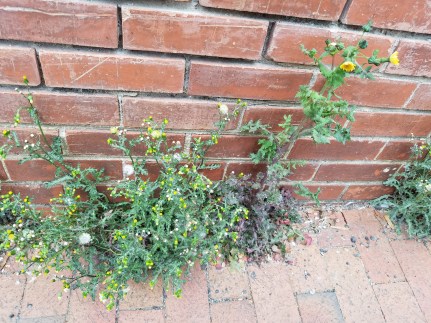
20170330_155035.jpg Wednesday afternoon, I was returning from my favorite coffee shop. I don’t think it is really comparable to some place tucked into a corner near the Champs-Elysees, even if it feels like it is, but it is a good place with good memories. I noticed these weeds. And I knew something.
They are kindred spirits. They are me.


I’ve often felt like I was squeezing life out of someplace I don’t really belong. After I had been at my agency for about three years, a former colleague from the agency told me there had been betting about how long I would stay. It seems I had rather quickly developed a reputation for not putting up with certain aspects of culture in play at the time. Sixteen years later I believe I have surpassed those expectations because of my flexibility and an ability to thrive in the spaces between hard places.

I have a thing for bricks. Brick walls, brick sidewalks, brick houses, brick outhouses, whatever the structure. There is a calming order to be found in brickwork. Order which has just enough imperfection to not be threatening in its orderliness. The varying reds combined with tuckpointed mortar is lovely. Brickwork also presents as strength and safety. Remember the third little pig? He built his house out of bricks.

There is something beautiful about these weeds. The mixture of greens, purples, and yellows is quite nice. They also have a protective prickliness about them to make one think twice about grabbing them with your bare hand to rip them out, or to eat them. They don’t comply with the traditional ideal of beauty, but they have their own. It’s a beauty born of fighting the system, of thriving in a place they are not meant to thrive, or desired to exist.

Against the orderliness of the brick work behind and below, the weeds seem wild. Extravagantly disordered. Unkempt and untamed. They transgress against the horizontal and the vertical. The weeds rise up, ignoring the lines that been set and create their own contours and their own sense of space. They break the rules. Mostly, they are ignored and unseen by the many people who walk these sidewalks.

So much of this is me. I don’t conform well against the ordered background. I stand out, when noticed at all. I have my own beauty, and my own prickliness. I try to thrive in the places that are least suited to me, and will generally do so. The lines of my life are anything but ordered, or straight, with few intersections of the perpendicular sort. The lines of my life are twisty and turny, with hidden surprises and pitfalls along at the intersections.

The weeds that grow in the spaces (spaces that are not meant to be spaces) between sidewalk and the wall live in a precarious position. They are unable to grow deep roots and can be easily pulled up and tossed to the street. They are unwanted as they challenge the status quo and what roots they have make damage by making the space between greater than it is. They slowly, so slowly, tear into the brick and reduce it to rubble, to dirt. Their beauty is not that of the rose, the tulip, or the lily, and is rarely appreciated or noticed.

If you pull them up, they come back. Persistently. As long as there is water and sunshine, their scattered seeds and the remnants of their roots allow them to be reborn. A cycle continues. And the slow rebellion of nature’s ongoing fight against orderliness continues.

Stories and heroes

In a very much heart-rending conversation chat this evening between two of us caregivers, this question I was asked:

And how do we write about this? How do we write when this story is our own and not our own?

I started to answer, but I stopped. One, I was walking laps around the top of the parking deck before leaving for home, and any reply might have been riddled with swipe text errors. Two, I didn’t want to interrupt the flow of the conversation. It was important just then to read the messages. But I want to answer it, even if just for myself, as I think it is an important question.

I’ve struggled with this in writing these posts about being caregiver. The stories are a mix of mine, of hers, of ours. I can legitimately only tell the stories from my perspective, save when I ask her to tell her side and to allow me to write that. She is not interested in that. So I write from what I know and observe. It’s a shared story, but from one side.

The more important story is probably hers, as I think is likely true in most patient-caregiver stories. By definition, caregiver is a supporting role. It’s not the leading role.

When my friend asked the question above, my thoughts went to a scene from the Lord of the Rings where Frodo is telling Sam that the great stories never really end, they just continue with new people, new heroes. And that’s the thing, right there. We are all part of one really big unfolding story with lots of side stories.

And lots of heroes.

I’ve said it before, sometimes we may need to be our own heroes. By being our own hero, we set an example for others, especially our children and others close to us. I continue to be amazed at the ability of individuals I see on a regular basis doing things I know are harder, or I suspect are harder, than what many  other people imagine. Just getting to an upright position and moving forward can be an act of courage when the day’s challenges of care (and hopefully some self-care) stretch across the horizon like deep sand. Doing it each day when it seems that the best you can do is grasp at straws of hope, or ignore any thought of hope because it is a distraction, is phenomenal effort. When those of us who’ve been there encounter a kindred spirit in the midst of such life, we experience empathy, terror, and a desire to help. The terror shows up simply because we remember.

Heroes are everywhere. Their stories need to be told. We need to tell our stories to keep in front of us why we are doing what we are doing, why we keep at it, and who we are. The others in the story can tell their story or not because it is their story. Our story is ours and is just as deserving of the telling. Because we are the center of our story, we are worthy of our story. Caregivers tend to subjugate themselves, to lose sight of the fact that they have their own story. We should not forget that we have an existence and story of our own. And we can be our own hero if we need to be, and are willing.

Telling our stories, telling my story, is part of self-care. It reinforces that I exist. And reminds me that I can be more than just a bit player.


One Success

This past weekend we moved our youngest son to Massachusetts to be with the woman with whom he has fallen in love. She has a good job, life, and her family there, and Zach felt free enough, root-less enough, to go there to a start a life with her. When he announced his pending move on Facebook he said, “After living in VA for 17 years I never felt like this was truly home for me. As hard as it may be at times to move so far from my parents I’m looking forward to this next chapter in my life with you Kristen. In just a few short days I’ll be moving to Massachusetts for a fresh start with the woman I love and an opportunity to create a place with her that I can call ‘home’.

His mother was a bit upset about this. I pointed out the number of times that we have moved, that this is the third state we have lived in, and that we have moved at least twice in each state. His time in Virginia includes college and living on his own in a couple of places. Settled is not something he has been. Thus, making the decision to move 700 miles away was not such a big deal for him.

Zach is just about everything I hoped he would be growing up, save that he’s not much of a rebel against authority. He practices a bit of rebellion every day, but it is rebellion against the mundane trivia of laziness and incompetence that he encounters. He doesn’t tolerate stupid very well either. Given these things, he is a loud, confrontational rebel against unqualified authority, which exists in great quantity today. Maybe this is really what I wanted.

He got far less attention as young child than he deserved or probably needed. He could self-manage from a young age and so we let him. His older brother consumed our time and our lives. Zach is a bit embittered by that experience and still carries a lot of the anger he developed, Melinda suffers from PTSD, and the scars I have run deep. Someday I may write about that experience, but it won’t be easy to do nor pleasant to read. Raising schizophrenic child rarely has a happy ending.  Despite the family dynamics of chaos and stress, Zach is very much a success.

zachatdinosaur

Zach, 9, at Dinosaur National Monument

The trip to Massachusetts was anything but uneventful. Just about an hour into the trip we had to flip the kayaks (13 foot long plastic sails) that were mounted on the top of Zach’s jeep. With tops facing outward, they were catching way too much wind. Shortly after lunch, Zach led us on a wrong turn that put us on a two-lane road up a snowy, icy mountain – not the ideal route for the 4,000lb U-Haul  rolling brick I was towing for him. Just hours later in Pennsylvania we came upon traffic at a dead stop on the highway. Zach took the adjacent exit and Kristen texted “Got off.” We stayed on the highway, not knowing she meant “get”  until later. It was just as well, as they had a pretty crazy route that was wicked enough for them and not suited for a car towing a rolling brick. Eventually we got rolling again, passing the two crashed semis, and then our driver-side wiper blade broke. Time lost finding a replacement, getting further behind them.

About 82 miles from his new home, his beloved Jeep broke down. He stopped, called me, we talked, he started checking spark plug wiring, and called our mechanic friend. Ten o’clock on a Friday night, temps in the low teens, and winds blowing around 40 miles an hour. He’s told he can probably limp on in if he takes it easy, listening to only five of six cylinders firing. Sometime after midnight he makes it, a little over an hour ahead of us.

Zach was stressed. He told me later, “Kristen got to see all of me that night. The entire range of who I am. From relaxed to the most intense I get.” He tends to function well under pressure, but the stress can eat at him for awhile. But he was ready. We’ve done so many road trips, we are at home on the road. Melinda I talked about our move to Oregon in ’94. We rented a U-Haul truck and auto trailer for my little pick-up and she drove her Nissan. James rode with her and Zach road with me in  “that big noisy truck.” We had adventures on that trip. Zach loved riding in that truck and it is probably why he loves trucks so much now. As he thinks about perhaps replacing his Jeep, he has noticed a used Ford F250 with a snowplow at a little dealer near his new home. “Dad, it is just about perfect. I think the backseat might be cramped, but it will be big enough for a carseat or two.” He’s thinking ahead and comfortable with the future.

The picture above is from a trip the summer before we moved to Oregon. A three thousand mile loop from Keizer, OR to Joplin, MO. We visited Crater Lake, Dinosaur National Monument,  the Cottonwood Pass,  Santa Fe, St. Louis, the Field of Dreams (Iowa), Rushmore, Crazy Horse, Devil’s Tower, Yellowstone, Grand Coulee, Multnomah Falls. And a bunch of places with unfamiliar names. It was a glorious trip for the three of us, camping in some beautiful places. Nine year-old Zach loved that trip. Camping at Devil’s Tower under a full moon was pretty cool.

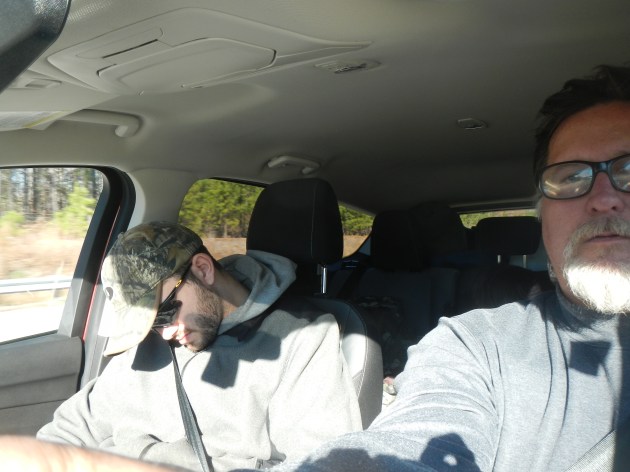
Camping. Zach and I have done a lot of that. Between Scouts and our personal trips, we have almost a year of camping, since his first camping trip at the age of two. Road trips two and from the camping sites (or fishing or hunting) where invariably Zach would spend the return passed out in the passenger seat. I have lots of pictures like the one below of him sleeping spanning eight or nine years. I included them in a photo album I made for him and Kristen at Christmas.

DSCN0483

Zach is my son, my golf partner, fishing buddy, and an all-around good guy to have around. I’m going to miss him terribly, but I am so damn happy for him. And so very proud.

Even with memories like this:

Me: A colleague in DC is telling people, including the Governor and our Secretary of Ed that I am a “National Treasure.”

Zach: (without missing a beat) “Why, because you are old as dirt and hard to find?”

Yep. I’m gonna miss him.

adequacy and its opposite

The truth is that you make me feel inadequate. All of you who read this blog and that I interact with regularly on Twitter and elsewhere. It’s a bit like graduate school all over again with my split high school experience and experience in an almost-open enrollment state college education. I spent the first two years of high school in Purcellville, VA preparing for the vocational program in printing. While I took the regular curriculum, I also took lots of shop, as in each and every semester, and at least one time, twice in a semester. Because this was a rural high school in the foothills of Blue Ridge Mountains, there was an entire vocational agriculture focused sequence in shop classes.

When my mother and stepfather divorced during my sophomore year, I made the decision to move to Missouri to live with my father and stepmother. Vo-tech was pretty much taken off the table and I was enrolled into the college prep track. Fortunately, I wasn’t actually behind in terms of classes and experiences. But I also hadn’t really been intellectually challenged and my reading list was on the non-classical side. Dad and Teresa had thoughtfully provided me a reading list, in the form of a shelf of carefully selected books. Unfortunately, I only read about half the shelf and most of what I left unread were the Western Civilization canon. This may be a good thing in that I am not overly-steeped in just one sliver of the world’s thought and philosophy.

College was no different. Entering as a physics and math double major, and adding a military science minor through ROTC,  I drifted through the English and literature courses the first year, with the required history, doing enough to get by. Usually at the last moment. In other words, quite a number of late nights spent over an electric Smith-Corona typewriter.

When I returned to college after my sabbatical in the Army, I was much more interested in the arts and humanities. And social science. Picking up the required political science and sociology courses would have life-changing had I taken sociology sooner. As it was, I was too deep into learning to paint and craft jewelry to seriously consider changing majors.

So, why do I feel inadequate? Too often I spend time googling stuff I think I should know from philosophy, learning theory, and communication. It reminds of the doctoral program and my fellow students in the public policy program talking about all these damn philosophers that I primarily knew from Monty Python‘s Philosophers Song and a bunch of silly stuff that really didn’t seem relevant to urban development, policy analysis, and all the quantitative stuff we did. It wasn’t silly, but I just didn’t have the time to add all that stuff my to reading pile while being an occasional husband and the father of two young boys with special needs.

I did notice that my fellow students didn’t really seem to know how to do much of anything outside the classroom or library. After three years in the Army and four in the Army Reserve, plus two years running a museum frame shop, I could do stuff. Not to mention all those shop classes in high school. So, I figured I would just learn to do anything and everything of interest, because as much as I liked the intellectual life, the required readings were enough and I can’t always sit still.

Besides, I could always say, “What, you can’t do this? Oh, okay. Go back to talking.” (Not really a nice person focused on building relationships.)

This was the beginning of my life’s journey into counter-dependency, with a focus on the omnipotence aspect. Leastways, it is what I am calling the beginning. It’s not the source, but probably about the time I started weaponizing competence. The Wikipedia entry is pretty horrifying to my mind, but it also represents the extreme or full manifestation:

Counterdependency is the state of refusal of attachment, the denial of personal need and dependency, and may extend to the omnipotence and refusal of dialogue found in destructive narcissism, for example. (Wikipedia)

I mean, I’m not that bad. Unfortunately, I can see who I am in both links, especially the first one with its multiple bullet points:

Then there is the inner world of a counterdependent. With a childhood that often left them to fend for themselves emotional (see causes, below) a counterdependent can have a tumultuous mind, including:

  • being oversensitive to criticism of others even as they often criticise
  • often hard on themselves, hate making mistakes
  • suffer an inner soundtrack of intense self-criticism
  • don’t relax easily
  • can experience shame if they feel needy
  • see vulnerability as weakness
  • secretly suffer feelings of loneliness and emptiness
  • might have difficulty remembering childhood

Source: http://www.harleytherapy.co.uk/counselling/what-is-counterdependency.htm#ixzz4aPpCs3G2

Yeah, a number of these ring true.  The whole concept of “vulnerability as weakness” uhmm, well, yeah, that’s the just kind of confusing, right? To be vulnerable is to be capable of being wounded and isn’t that a form of weakness? Well, I guess not, at least as far as Merriam-Webster defines weakness, but shucks, it’s the way I always did, or at least one way I did. A friend had shared this link of Brené Brown’s TED Talk on The Power of Vulnerability  and I found it quite helpful in understanding what vulnerability means and how it can be a good thing as it allows one to be open and to begin to truly connect with others. It was after listening to that talk that my writing on this blog began to change away from the obscurities of my humor to trying to make a connection with readers. (And by the way, in case it has not occurred to you yet, this post is taking a huge step into the abyss of vulnerability. It will be hard to pull the trigger and publish it.)

Back to inadequacy. I have spent much of my life camouflaging my feelings of inadequacy with super-competence across a range of activities. I have tried to learn to do anything and everything I want. Along the way I learned that there are things I am not particularly good at it, things I don’t think I will ever be good at. On the other hand, when I became an art major my father’s response was “An art major? Tod, you’ve never shown any talent or ability!”  Completely true. Did not stop me at all, nor did it keep me from being successful as an art major (“Outstanding Art Student, 1988”), and I produced some good work.

wp-1488683314591.jpg

The Wilderness, Tod Massa, 1989

Along the way I have learned plumbing, cabinetry, furniture-making, general wood frame construction, roofing, welding, electrical work, a dozen programming languages, homebrewing, soapmaking, cheesemaking, golf, flatwater and ocean kayaking, shooting (sport and otherwise), automotive work (something I am not good at, especially major automotive work), lightweight (not quite ultralight) backpacking, sewing, tailoring, hair coloring, luthering (something else I am not good at), banjo, farming, including raising small critters and poultry, and all sorts of things that pull combinations of these skills together (such as building a highly efficient fermentation chamber with heating and refrigeration). You could drop me off in the middle of nowhere and I would probably be just fine because I can even make my own tools.

It’s a bit addictive. One can start filling on the odds and ends of time with doing stuff and learning stuff and keep human engagement to a minimum. It’s kind of pleasant. But I am not supposed to say that as I need to think more positively about human engagement and relationships. It is hard to change a lifetime of thinking.

These days I am shedding. I am taking careful inventory of the stuff I have and the things I want to do and I am working to reduce those to two or three things that I will do regularly. Everything else is being sold, donated, or held to be given to Zach when he has the space.

See, I don’t feel like there is much I do really well, so I will focus a bit more on the things I continue to do. More importantly, I will focus more on building, strengthening relationships through openness and vulnerability. This will be hard work for me as it is much easier to hide behind doing things. Working with dangerous objects in my hands is a good way to avoid talking in any depth. I will screw up along the way, so please be patient and forgiving. I know that I will screw up because I have made a lifetime’s work of failing at stuff just to keep learning and keep trying, and to justify the ongoing internal self-criticism. (Wow. That just occurred to me. What a self-perpetuating cycle!)

A final thought. When I was thinking through some of these things the other day, I put on my public policy hat and wondered if anyone had thought to view relationships through the lens of Herbert Simon’s theory of “satisficing” which is to accept a non-optimal solution in favor of forgoing the cost and effort of pursuing the optimal solution. Sure enough, the Google Gods return a variety of answers on the first page from Psychology Today article and prior versions of the same that refer back to a 2002 study. The authors makes satisficing sound to be the ideal model for relationships. It’s an interesting line to pursue in another post and it recalls what a co-worker once said, “Employees are like stepchildren – they may not be the children you want, but they are the children you have at the moment.” (Fortunately, that person has not been a co-worker for many years.)

That’s the story of my inadequacy. This is being vulnerable. There’s not actually anything wrong with being able to do lots of things. The problem is when the doing gets in the way of being and gets in the way of relationships. So, I will try to do less, and be more.


expectations and playlists

Actual conversation a few years ago between me and my son. The youngest grandelf was somewhat plaintive about his struggles with his Color Nook.

“Wow, there is nothing quite so pitiful as a seven-year-old complaining that he can’t connect to the wi-fi,” I said.

“Yeah, what did I have at that age, an Etch-a-Sketch? What did you have, a stick? And some dirt to draw in?”

“Yeah, something like that.” 

Technology is like this. It creates expectations, especially when it is meant to be easy to use. We become accustomed to it and then get frustrated when it fail us. Our frustration is not just with its failure, but with the void it leaves in our lives. To a boy of seven whose life often revolves around the content delivered via high-tech tablet, the inability to connect to the network to receive more content, creates a painful emptiness.

That’s the nice thing about just having a stick and a patch of dirt – it’s pretty easy to go find another stick. Or just use your finger. Its when things are special, when they have potential to be all-consuming, that the void becomes seemingly limitless. That void is hungry and wants to be filled. It aches. It screams for attention, like a nameless thing shrieking “Feed me” endlessly into the night.

And then there’s my playlist.

The last few days I have not been listening to satellite radio in the car, but to a collection of what I *thought* was a great collection of songs for driving. Instead, especially when played in alphabetic order, it begins to sound pretty dark. Dark like a bruise full of purple, black, a little bit of green, and streaks of gold. Sad and angry music, even when it’s uptempo. Music that spans decades and a half-dozen genres that I think are generally closely related and overlapping. Break-up songs (No Souvenirs). Songs about moving on. Fighting  (Ballroom Blitz), drinking (I’m Gonna Hire a Wino), and fornicating songs (I was Made for Loving You). Love songs for the pure (If I were a Carpenter) and not-so-pure of heart (Secret), or slightly ironic (Alyson). Or just songs of pure macho assholery (That’s What You Get for Loving Me). I’ve begun to wonder if much of it is all too dark together, creating and reinforcing an inner darkness and sarcasm in what I’m told was once a sunny and cheerful disposition.

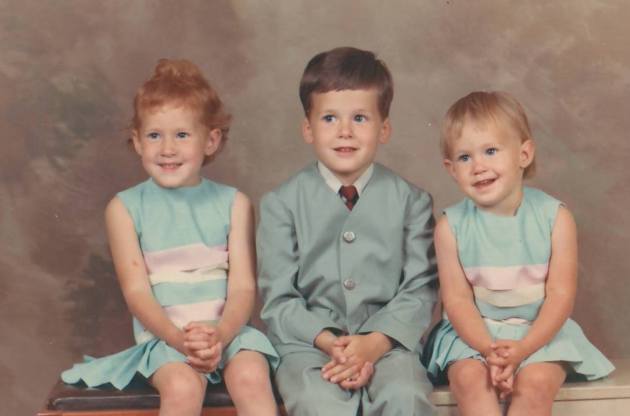
me-and-the-girls

Certainly the little boy in this picture did not have a dark and sarcastic interior. But, clearly those girls flanking him did.

But I spent some more time listening to the playlist and looking at it. While I might not be at a one-to-one to ratio of sad/angry songs to happy/peaceful songs, there is a good mix, maybe about four-to-one. Of course, it is a matter of perspective. When Zach was young, he thought Jimmy Buffett’s Come Monday was a horribly sad song but like Dylan’s Tangled Up In Blue, it always makes me feel good, as do Bob Seger’s Travelin’ Man/Beautiful Loser and Jackson Brown’s The Naked Ride Home (of course, I know a couple of true stories on that theme). Of course, some songs confuse the hell out of people, like Green Day’s Good Riddance or Rupert Holmes Escape, both of which are more familiarly known by “The Time of Your Life” and “The Pina Colada Song” respectively. Darkly cheerful and upbeat, but breaking up and cheating songs that seem like they belong together. Or darkly upbeat and triumphant like Kelly Clarkson’s Since U Been Gone and Bring on the Dancing Horses by Echo & Bunnymen.

I like the dark though. Johnny Cash’s cover of Hurt still amazes me.

So, while I was thinking I need to lighten up my music drastically, I’m now thinking it needs only tweaking and better balance. I’m not giving up any Tom Waits (Tom Traubert’s Blues), Johnny Cash (Sunday Morning Coming Down), Merle Haggard (Mama Tried),  or Steppenwolf (Snowblind Friend) and certainly not Bat out of Hell.

We’ll see  – it is full speed ahead, because I Can’t Drive 55 and if you ride with me, be prepared for We’re Not Gonna Take It to be followed by Rock Lobster and Pretty in Pink or Picture or Dead Skunk. Or Dwight Yoakam’s cover of Purple Rain.

There’s just no telling other than alphabetically, we’ll end with Ziggy Stardust and if it’s a roadtrip, Born to Run is likely to blasted at least twice.

Yeah, upon further review, I’m fine with all this. It’s good music.

Tinnitus and Morning Coffee

For seven years now, since the remnant of my left auditory nerve was destroyed through the surgical approach to remove my tumor, I have had tinnitus.

 Tinnitus is the perception of sound when no actual external noise is present. While it is commonly referred to as “ringing in the ears,” tinnitus can manifest many different perceptions of sound, including buzzing, hissing, whistling, swooshing, and clicking. In some rare cases, tinnitus patients report hearing music. Tinnitus can be both an acute (temporary) condition or a chronic (ongoing) health malady.

Source: American Tinnitus Association

I constantly “hear” a generally steady, high-pitched tone on the left side, where it is not possible to hear. The brain, my brain, is expecting input and in the absence of such creates synthetic input. The sound can be maddening. I’ve read of people being driven to suicidal ideation because of it. It can be all-encompassing if you allow it.

I have dealt with through noise and other inputs. Mainly constant music or TV as wallpaper. Combining this with some mental tricks, such as not discussing tinnitus, not naming it or admitting its presence, I can ignore it. Writing about it is somewhat painful as it is a constant acknowledgement of its presence. However, over the last several weeks I have been experimenting with quiet.

As I work to change my approach to life, something I will perhaps write about next year, I have been trying to add meditation and stillness into daily living.

It ain’t easy.

I haven’t liked being still for a long time. Even less, I haven’t liked not having input, lots and lots of input. When the Web came along, I said, “Yes, this is what I have been waiting for. This matches how I think.” When smartphones came along, it was even moreso. It was Star Trek that way it should have been. Constant streams of input, Twitter, Facebook, email, added to music and video, not only met my craving for information, but drowned out to the noise in my head. That constant whine with fuzzy overtones, and unpatterned changes in frequency, could be kept at abeyance.

But attempting to meditate, “Oh. That NOISE. That unending, unpleasant, NOISE.”

So, I put attempts at meditating aside. I’ve spent weeks now just sitting with that first cup of coffee in morning. No more talking heads on the idiot box. No obsessing over inputs from the smartphone or PC. No music. Just me, my coffee, my tinnitus, and morning sounds of traffic from the highway, and the birds. It’s finally becoming comfortable. Meditation might be more possible now (or perhaps it is actually happening). The only times  I had been comfortable with this quiet and coffee had been camping or backpacking. Each morning after a long day’s hike, just stretching and preparing for the day with a cup of coffee while the surrounding forest transitions from nightsound to daysound was always nice. It’s starting to feel that way in the house.

In the long-term this pairing is something I will have to get comfortable with, tinnitus and me. It’s not going to leave, and my hearing on the right side is degrading noticeably, so I can easily see a day where the only sounds I hear are the imaginary and synthetic sounds of a brain looking for input.


Seven years of asymmetry

So, I was inspired by this post by my talented friend and colleague, Laura (@GoogleGuacamole). It is about using selfies and avatars as a form of reflection. I’m not particularly big on selfies for a variety of reasons and deciding to do this was difficult. As I reflect on the last seven years (Monday the 13th was the seventh anniversary since 32 hours of brain surgery), I am aware of how much has changed, and how much my well-being has improved.

Picture 1.jpg

June 19, 2009

The first photo is from 2009.  Before surgery, before I realized I was going deaf on the left side. Before the grandelves and their mother and partner moved in for the second time and I still had studio space.

The next picture is February 2010, two days before surgery began. Zach and I shaved our heads together in solidarity. I didn’t actually need to shave my head because they didn’t need much real estate to work with to cut into my head. It was a really more of a statement that “I am ready for this.” I remember watching “True Grit” (the original) the night before, taking inspiration from it. Particularly the lines, “I call that bold talk for a one-eyed fat man!” “Fill your hand, you son of a bitch!” That segment of Rooster charging across a meadow ringed  with aspens was on a near-continuous loop when the US Marshall History Exhibit was on display in the museum at the Jefferson National Expansion Memorial (Gateway Arch) the summer I worked there.

hairless-tod.jpg

February 10, 2010


This next photo is four weeks post-surgery.  The entire left-side of my face was paralyzed, including the left vocal cord. Some muscle tone has returned to the left side of my face. At rest, I no longer looked like a victim of a severe stroke. When I tried to speak, it was a whole other matter. You can see the droop on the left side, that I tried hide with the mustache. My left eye was not working well either, I had bad double vision and working at the computer was only possible for short periods until an OT put tape over part of the left lens of my glasses to begin retraining my eye until the opthamologist started using an adhesive prism. It was five days later that I created, and felt, the first twitch in my cheek.It was at this point that I often scared small children when walking in the neighborhood with my taped-up sunglasses, cane, and an uncontrollable drool.

Picture 22.jpg

March 12, 2010

Now, it’s almost year post-surgery in the next photograph. I am just about to go in to schedule a fourth procedure on my left vocal fold, something a little bit more permanent when I begin to realize that my voice is returning. I look pretty normal (for me) here, but the asymmetry is clear, just not as pronounced.

Picture 46.jpg

February 2, 2011

The photo below was taken for the article in Bloomberg Businessweek about our first release of the reports on the post-completion wages of graduates. It’s notable because out of the dozens of photos taken, it naturally focuses on the right side of my face. The normal side.

avatar

December 2012

Next, a short from a fall day in Georgetown in 2013. The asymmetry is there, but usually unnoticed by most, save for the way the facial hair grows. Or if someone watches me eat as the left eye closes uncontrollably. Also, there were tough periods of hemifacial spasms across the left cheek in 2012 and 2013. They are still around, just not as painful, unless someone or something makes me laugh a lot. Sometimes smiling does in fact make my face ache.

20131016_162929

October 16, 2013

And finally, skipping ahead, because if I am bored of looking at pictures of me, I’m assuming anyone else reading this is also bored. Weight loss and the continued spasms and nerve issues have created pronounced asymmetry in the lines of my face. If I were to shave, you would see that I now have a dimple that I never had before.

avatarcoffeeshop.jpg

January 2017


Fortunately, I am old enough that looks don’t matter as much. I see this lack of symmetry in my face when I look in the mirror, and what I see is survival. Although, “survival” might be too strong a word. “Onward-ness” seems closer. I see the asymmetry and I know it is me. I know that I did not stop moving forward. The things that continue to be a problem will always be a problem (swallowing, a never-ending  cough, the need to finger sweep my cheek, no tears on the left side), but these are tiny problems in the scale of things. Moving onward is good. It is what I am all about.