Imagine a world without rankings

Imagine there’r no rankings
It’s easy if you try
No more US News
Above us just IPEDS
Imagine all the people
Living for today…

Libby Nelson at Vox has written elegantly about the US News & World Report rankings of America’s Best Colleges. She points to the fact that the rankings lead colleges to lie and they cause institutional leaders to focus on the wrong things. Finally, Libby calls for a boycott of US News surveys.

I just don’t see it happening.

I know I am middle-aged and bitter, and have occasionally been accused of a cynicism that is matched only by my tendency towards rank empiricism, but I’ve known Bob Morse a long time and I’ve known a lot of college presidents. What I don’t know is the necessary difference between a parasitic relationship and a symbiotic relationship. Especially when the potential parasite is not easily identifiable as such.

Imagine there’s no rankings
It isn’t hard to do
No reputation surveys
And no climbing walls too
Imagine all the people
Living life in peace…

More importantly, the desire to compare is taught to us as children. “See the apple, it is different from the orange.” Comparison is second nature and when there are many things to compare, we try to place them in an ordered list for simplicity.

But you know, US News didn’t exactly dream all this up. Colleges and presidents were using many of these metrics already. “Come to our college, we have a lower student to faculty ratio than other colleges.” All USNWR did was organize and systematize the metrics, and then put them into a numeric order. If they hadn’t done this, somebody else would have. Further, if USNWR America’s Best Colleges goes away tomorrow, somebody else will step in.

You may say I’m a dreamer
But I’m not the only one
I hope someday you’ll join us
And the world will be as one

Imagine no student debt
I wonder if you can
No need for PLUS or Stafford
A brotherhood of man
Imagine all the people
Sharing all the world…

Just about every college has one or more peer groups for internal rankings. In Virginia, the public institutions have formal peer groups for faculty salary recommendations and targets (60th percentile of the peer group). Sooner or later, someone would attempt to the monetize these peer groups and create rankings. The specter of a national rating simply adds fuel to this…especially as a way to validate the rankings or the ratings.

You may say I’m a dreamer
But I’m not the only one
I hope someday you’ll join us
And the world will live as one

Finally, Libby makes this excellent point:

Even if most colleges won’t disarm unilaterally, as Reed did, higher education has proved it can organize effectively for collective action when necessary. Colleges have worked together many times to defeat government proposals they don’t like. The logical conclusion is that their umbrella organizations have decided the power of a single ranking system is more fearsome and difficult to confront than that of the president and Congress combined.

Or perhaps college presidents are happy to have their cake and eat it too, denouncing the rankings in public and frantically trying to climb them in private. We’ll know in a few days, when the cycle begins again.

Public college presidents like having the rankings to use with/against state policymakers. They are just another tool they can use to claim external validation of either how wonderful they are, or how under-resourced they are. Of course, the same arguments work with governing boards, whether public or private.

I’m afraid that rankings are here to stay. After all, Imagine rose to #3 on the Billboard Hot 100 and is also ranked as one of the 365 greatest songs of the century. A Guinness survey has ranked it as the second best song of all time. And these are not all the rankings by any means – and I am pretty sure that rankings were not John Lennon’s goals.

 

If I were the type to rate colleges…

The question has arisen a few times now. “Tod, if you were at USED and absolutely had to build a ratings system college with current data, what would you do?’

It’s a tough question since I don’t believe the existing IPEDS data are up the task. So, I would attempt to to use the National Student Loan Data System and develop a result set about Title IV recipients. But that may not be possible just yet.

First, I would start with three categories, as I have written before. These would be Title IV Eligible, Title IV Eligible – Conditional, Title IV Ineligible. The federal government’s implicit authority to rate colleges based on Title IV participation and success I think is a given. Rating colleges outside of Title IV performance I think is not. However, given the lack of data specific to Title IV participants, some standard IPEDS measures will have to be used.

It seems to me that what is really at stake is Title IV eligibility. So let’s start be establishing minimum standards for participating in Title IV and assume that institutions have five years to meet these standards initially.It is neither fair nor appropriate to establish standards and apply them immediately.

Title IV Eligibility Minimum Standards – Four-year Institutions

  • First-year Retention Rate Greater than or Equal to 60%
  • Six-year Graduation Rate Greater than or Equal to 30% (All Students)
  • Six-year Graduation Rate Greater than or Equal to 35% (Students with Pell grants at Entry)
  • Six-year Graduation Rate Greater than or Equal to 35% (Students with Stafford Loans (Subsidized and Unsubsidized) at Entry) (Requires use of NSLDS or adding the required institutional disclosures to IPEDS)
  • Six-year Graduation Rate Greater than or Equal to 40% (Students with PLUS Loans at Entry) (Requires use of NSLDS)
  • Cohort Default Rate Less than 10%
  • 80% of Graduates with Federal Loans in active repayment (including Income-based options) and in-school deferments.
  • And as data become available through NSLDS, minimum 60% graduation rates for Title IV students in graduate and professional programs.

However, since the administration has made it clear that part of the desire is to increase the enrollment of Pell students at high-performing institutions, I might add a fourth category of Title IV Eligible – Unconditional for institutions that meet or exceed all the standards above and enroll a number of undergraduates receiving Pell grants at entry equaling or exceeding 25% of the traditional on-campus population. (In other words, lesser respected branch campuses or distance students that rarely, if ever, step on campus would not count.)

Title IV Eligibility Minimum Standards for Conditional Status  – Four-year Institutions


  • First-year Retention Rate Greater than or Equal to 50%
  • Six-year Graduation Rate Greater than or Equal to 20% (All Students)
  • Six-year Graduation Rate Greater than or Equal to 20% (Students with Pell grants at Entry)
  • Six-year Graduation Rate Greater than or Equal to 20% (Students with Stafford Loans (Subsidized and Unsubsidized) at Entry) (Requires use of NSLDS or adding the required institutional disclosures to IPEDS)
  • Six-year Graduation Rate Greater than or Equal to 20% (Students with PLUS Loans at Entry) (Requires use of NSLDS)
  • Cohort Default Rate Less than 15%
  • 60% of Graduates with Federal Loans in active repayment (including Income-based options) and in-school deferments.
  • And as data become available through NSLDS, minimum 60% graduation rates for Title IV students in graduate and professional programs.
  • Requires ten-year improvement plan. If unable to move into full-eligibility status after that point, loses 50% of available Title IV funds.

Title IV Ineligible – Four-year Institutions

  • Failure to meet any one of these standards constitutes an ineligible institution. Institutions failing no more than two standards would be able to appeal and be placed on a five-year remediation plan – after posting a bond equal to the Title IV funding at risk of loss for the numbers of students it would take to move into a passing score.

So, these standards are incredibly arbitrary. They would negatively affect a significant number of institutions. Further, with the addition of an “Unconditional” rating, some of the highest performing institutions in the nation (and Virginia) would not be in that highest status.

In one way though, they are not arbitrary. I have dealt with enough policymakers over the years to know how they react to graduation rates below 30% (shucks, many get outraged at rates below 50%). These are rates I feel that *I* could generally defend for about a decade. After that, I foresee necessary increases.

I have not suggested standards for community colleges. I’ll save for that another time, but they would be differently constructed.

Oh, I would also use the rating report to link each college to any state profile data and require that each college link to both federal and state reporting websites specific to that college.


In praise of the anomalies

“Hi, my name’s Tod, and I am an anomaly.”

I am not a Millennial, so I can’t really say that I am special, or that we are all special. I am from near the end of the Boomer generation and so I don’t think I ever got a trophy for just showing up. I did learn (in high school) that the easiest way to win awards, was to submit applications in categories no one else was interested in. That is the story of my multiple FFA awards.

Being an anomaly does not make me special. (My eyes do that.) I am an anomaly for a number of reasons. I want to focus on the aspect of being a failed physics/math double major, with an intervening education in military. I doubt that I am the only one with a background like this, but I suspect it is relatively rare. In any event, I think it provides a distinctive way in which to look at the world. You can get some idea of what other people are doing a studio art degree (at lease those on LinkedIn) here.

Part of the brilliance of American education is that it can create people like me for the possibility of useful, happy accidents. Yesterday, John Warner’s post at Just Visiting inspired an extensive Twitter conversation which I have Storified here. Some of the Tweets are missing, but as you will see, it was an extensive discussion about the intersection between institutional research and Big Data. It starts from Warner’s perspective of overuse of automated systems and Big Data to obscure the need to solve the tough problems of access, affordability, and human interaction to create learning (I’m seriously paraphrasing here) in the pursuit of efficiencies and education-widget results. Both John Hetts and Jeffery Alan Johnson make very thoughtful comments about what these can be, what they shouldn’t be, and how they reflect what has always been happening.

I tend to be torn on these issues. I live in a work life where I am surrounded by folks who want to spend less on education while making it better. Those folks surrounding me are themselves surrounded by folks arguing that we should spend more. I think data-based decision-making is hugely important and holds great promise for improving human outcomes. On the other hand, I think accidents and unforced pathways hold great promise for individuals and society. Certainly there is risk and cost associated with these accidents, but the rewards are potentially unlimited.

Educationally and career-wise, I am not sure I would have done anything different, save study more and take advantage of more opportunities. I hate the idea of a world where we can’t afford such accidental pathways to happen. I also hate the idea that so many students leave college with debt and no credential and no apparent lasting benefit.

So, how can we allow the one and improve the other?


Silliness

I am easily amused. Especially when observing silly games of oneupmanship.

“My discipline is better than yours. It does real stuff.”

“No, my discipline is better – we use math.”

And so on.

It reminds me of high school science classes and describing the various disciplines.

  • If it moves, its biology.
  • If it stinks, it chemistry.
  • If it doesn’t work, its physics.

It also reminds me of the discussions of astrology in both Heinlein’s “Stranger in a Strange Land” and the fifth book of Adams’ “Hitchhiker’s Guide to the Galaxy” trilogy. In both cases, the use of astrology is justified as being no more than a way to organize your thinking and perception of the world around you. I’m not sure this is all that much different from truly academic disciplines.

I guess it would be easy to ask, “Why can’t we all get along?” but then, I would have less to be amused about. I have spent enough years raising children, grandchildren, as well as 10 years as an active scout leader, to learn to enjoy observing childish behavior. You can’t really stop the behavior (other than yelling “shut up!” and separating the offenders) just work to help it dissipate over time, so you might as well learn to appreciate it at as an art form. Clearly, it is art from the naive school, but art nonetheless.

The sad thing is this. They are all wrong. The only truly meaningful discipline is art. After all, art is about learning to really see the world around you BEFORE you interpret it or describe it. Once the basics of the tools are covered (how to make a line) the lessons focus again and again on “What do you see?” “Are you sure you are what’s there and not what you think is there?” The tools (media) are then used to fill in the gaps of knowledge or interpretation….

Oops. I guess that is no different from making assumptions. “Assume a friction-free surface….” “Assume a ladder…”

Damn. I guess there are no real differences, just variations in tools and methods for grokking the universe.


What are you really paying for?

This morning I played chauffeur to the two crippled ladies in my life. My wife and my dog. My wife had foot and ankle surgery in May and today she got her cast replaced with a boot. Unfortunately, the healing process ahead is also preparation for several more surgeries so we have a long journey ahead with more pain and discomfort for her. My dog needed blood work because she is aging and needs pain relief for arthritis and bladder control help. Thus periodically we have test her kidney and liver functions.

Medical issues are big in my house.

So, when I was finally headed to the office and scanning satellite channels, I stopped on NPR for the last bit of a show from KQED about price-shopping for medical procedures, using MRIs as an example. This interests me. I have had a lot of MRIs – 14 or 15 since New Year’s Eve 2009. All but the first have been at VCU. My co-pays on these have typically run between five- and six-hundred dollars until we meet our maximum annual out-of-pocket expenses.

While I listened, I thought about procedure costs and my views on insurance. I believe in being a responsible consumer. I don’t really want the insurance company to pay for something I would not be willing to pay for out of my pocket. So, why don’t I shop around for the best MRI price?

Convenience. Quality control. Service. Peace of mind.

It is unlikely to find an MRI facility other than VCU that I can walk to and from in 10 minutes from my office. There is no place that close to home.

Most MRIs have limits of accuracy and precision within the range of one to two millimeters. Since we are now dealing with a tumor about the size and shape of a triple-thick Lima bean, the difference of a couple millimeters can be hugely important to the reader’s interpretation of the images. Whenever possible it makes a great deal of sense use the same machine.

VCU Neurosurgery is really good about scheduling everything a year in advance – on the same day. For example, I may be scheduled at 8:00 am for my 35 minute MRI and then at 9:30 upstairs to see my neurosurgeon for the results, and the next morning with my radiologist.

This last thing is really big. Many of the brain tumor survivors, or those in pretreatment status, often have to wait days or weeks to get their results. I’m done in a few hours and my doc will spend whatever time I need with me to answer my questions or discuss my case.

This is why I don’t shop around. Sometimes the lowest cost is not the best deal.

And I don’t think higher education is really any different. When a student or family makes a choice about college and how much to pay, they should really think about what they are getting for the money and how it fits within their value system. The same logic applies to legislators and institutional leaders. Think about what you are paying for and why it matters to you.

What really matters is whether the educational experience meets your needs. Of course, for it do so, because it is not a “laying on of hands,” the student must invest effort, must invest themselves, in the education experience.

And the institutions, those supporting them, must make it possible for each student to be successful.

It is a niche series of arguments and posts

This post is an edited email with a very bad pun in response to friend/colleague who asked about Nick Anderson’s WaPo piece. In Virginia, we have the institutional profiles, which I have referenced before (http://research.schev.edu/iprofile.asp) and are now used as the web pages institutions to which link to comply with new law in Virginia.

What these do not have is a score or rating or ranking. This is primarily because such is neither necessary or generally appropriate for a coordinating body to produce. While we believe in transparency to hold institutions accountability and certain narrow forms of accountability (such as the Institutional Performance Standards, which usually have some funding attached to them and are required by law), it is still our job to work to see that all institutions have the ability to succeed, while recognizing that each has unique place in Virginia’s postsecondary marketplace.

I am on record (in many places) for opposing the proposed Postsecondary Institutional Ratings System (PIRS). However, my opposition is based on very specific reasons:

1) The existing data at USED and elsewhere in the federal government is completely inadequate for the task. Virginia knows more about student success in Title IV financial aid programs than USED – and these are not our programs, nor our responsibility. I don’t think USED and the president should consider a ratings system until the data issues are addressed.

2) Ratings, as proposed,  for community colleges are completely meaningless. Students attending these institutions are rarely overwhelmed with choices about where to attend college. In fact, the community college may be their only choice, or at least their only sensible choice.

3) The ratings proposal is about undergraduate access and performance only. Not only does this mean the ratings would not actually be “Institutional” in nature, it means that, should the ratings be successfully tied to Title IV aid, undergraduate performance could prohibit access to federal loans for graduate students. As Kevin Carey pointed out last April in the Chronicle, which I have been saying for years, professional master’s programs are cash cows that support the institution and might well be considered for-profit. If Title IV access for graduate students is too be affected, let’s make sure that graduation rates and time-to-degree for graduate and professional students are part of the ratings – but these measures do not currently exist.

I think it is perfectly appropriate for USED to rate institutions based on Title IV performance (both student performance and institutional behavior, including compliance with reporting and disclosure laws). However, they have such fundamental data problems at this time, it can’t meaningfully be done. Different offices within USED define institutions differently and thus 1 in 5 institutional records between the office of Federal Student Aid and IPEDS do NOT match.

As for whether or not Virginia can create an alternative, we certainly could. I think it is totally unnecessary. Further, without legislation telling us to do it, I think it is a terribly bad idea. It is far better idea to continue to push the envelope in terms of what is known about Virginia higher education, creating such levels of data-based transparency that no one can hide. Within another year, I think we will be there. We are close now.

Ratings of financial stability/viability are perhaps another matter. What the presidents are most fearful is what happened to Virginia Intermont College. Just being put on a “caution” list, caused (I think) a 60-day delay in federal reimbursements and the institution was already leveraged to the hilt with bills past due. Presidents are quite right to fear any system that adds any additional possibility for the disruption to the money flow. (If you ever read “Dune” by Frank Herbert, you will remember the phrase “The spice must flow!” The only difference here is spice means money.)

In the end, all that really matters is how we serve students. This morning there is a report on new research that raises questions about the ongoing critique of graduation rates at minority-serving institutions. Basically, the authors found that when one controls for student educational background and institutional resources, the graduation rates are comparable to those at predominantly white institutions. While probably still a bit lower, that is explained in my research by the fact students are very much affected by institutional culture. If the norm is not to not graduate, than graduation is act of being different. Most young people tend, despite protestations to the contrary, want to fit in and if not completing is okay, then “no problem.” In fact, when you look at graduation rates of students who have successfully earned 60 credits or more in the first two years, there is very little difference between our HBCUs and our predominantly white institutions. The hard part is getting students to that point.

I really think we can accomplish everything intended for PIRS to accomplish by shining a very bright and public light on institutions and students. Which we do already in Virginia.


Additional readings:

What I said to the GAO

About the Undeclared Major as a Dead Horse

Duncan Doesn’t Understand the Opposition to PIRS

Describe a Rainbow in Seven Words

Five Stages of Education Policy

Why Ratings Seem to be Necessary to Outsiders

A response to Schuman and Warner

The Gainful Employment Rating System

The Damage of Relying Federal Data

Rating the Ratings Game

College Decision Day and PIRS

As a Matter of Fact You Do Need a Badge


Defining and Disclosing Financial Health

George Cornelius blogged this morning over at Finding My College about the desirability and need for private colleges to disclose their financial health.

No matter how you look at it, we, the U.S. taxpayers, pay dearly to support our higher ed system. Yet, when it comes to the so-called private institutions (the quasi-public colleges), there isn’t much shared with us or with prospective students about the spending and financial health (or lack thereof) of the institutions.

While I can quibble with the notion of quasi-public, it is a familiar argument. Bob Morse at US News & World Report tried making a similar argument years ago that private institutions should be subject to FOIA based on the large amounts of public money they receive. However, the money technically goes to the students, though it does seem to be a bit of a shell game. The money (student financial aid) can only be used at a qualifying provider and that provider makes the determination of eligibility and award. And controls disbursement.

The U.S. Department of Education, and any state that subsidizes quasi-public colleges, should compel the recipients of this largess to disclose conspicuously on their websites their financial statements for the past five years as well as data and information about student learning and outcomes. In other words, prospective students and their families should be given information with which to distinguish the performing institutions from the underperforming ones, and the ones with a future from the ones that are likely to find themselves in the junkyard of failed institutions before the current restructuring of higher ed has run its course.

The Department, and Congress, already require oodles of disclosures. The conspicuousness of these disclosures tends to leave much to be desired. This is also true for their usability. However, when I read George’s post this morning I was intrigued by the thought of what this might look like. In Virginia, when it comes to student-oriented data, the public and nonprofit institutions have no place to hide at the undergraduate level. We publish an awful lot of data, very detailed, with student outcomes out to 10 years. However, it does not touch the student learning issue, nor the financial stability issue.

I’ve mentioned before that there are two criteria that put a private institution on my at-risk list. A retention rate for the first to second year of less than 60% and fewer than 1500 students at an undergraduate-only, or 2000 at a predominantly undergraduate institution. A significant endowment can compensate these risks, but most institutions with these issues  have little to no endowment.

What can’t compensate is an inability to pay bills if the big checks are late. Such as those from the federal government. This is what happened to Virginia Intermont, despite the president personally loaning nearly a half-million dollars to the college. We could require some kind of disclosure as to the percentage of an institution’s total revenues represented by state and federal sources, including student financial aid.This is similar in nature to the 90/10 rule the Department has established for the for-profit institutions.

Even with five years of such numbers, that is only a minimal warning. It seems to me that a “cash-on-hand” warning trend added to this might be appropriate. Every 90 days the institution reports on its website how many days it can operate with current expenditure commitments and cash available. While this may not be directly meaningful to most families and students, it would certainly tell agencies and accreditors something important about the viability and sustainability of an institution.

I would also add a measure explains how much of tuition revenue is used to fund institutional aid, and on average, what students who have to borrow to pay for their attendance and do not receive gift aid, contribute in debt towards gift aid for other students.

Why?

This excellent article from Forbes describes many of the associated problems.

If the whole idea of jacking up a price and then selectively discounting seems a bit nefarious, Crockett takes issue: “Students on campuses pay all kinds of different price points, just like people sleeping in a hotel or flying on airplanes pay all kinds of different prices.”

Does that make it right? Or ethical for a nonprofit?

Given the distorted model in place, perhaps this kind of distorted solution has merit. So long as obtaining student loans is easy and universities continue to chase rankings by leveraging aid and beefing up campus amenities, published prices will continue to rise along with tuition discounts. Thousands of schools will continue to struggle, and enrollment consultants like Noel-Levitz will be more than happy to lend a helping hand.

Yep. So perhaps the president’s proposed rating system (#PIRS) should focus only financial stability.

By the way, speaking of #PIRS, since no one else has picked up on this, Valerie Strauss published this tidbit on her blog entry regarding 50 Virginia presidents signing on to a letter opposing PIRS:

Education Department spokeswoman Dorie Nolt issued this comment about the letter:

I noticed you wrote about the letter from the Virginia college presidents. Here is a statement from me (Dorie Nolt, no Turner necessary) on it:

“We have received the letter and look forward to responding. As a nation, we have to make college more accessible and affordable and assure that students graduate with an education of real value, which is the goal of the College Rating System. In an effort to build this system thoughtfully and wisely, we are listening actively to recommendations and concerns, which includes national listening tour of 80-plus meetings with 4,000 participants. We hear over and over — from students and families, college presidents and high school counselors, low-income students, business people and researchers – that, done right, a ratings system will push innovations and systems changes that will benefit students and we look forward to delivering a proposal that will help more Americans attain a college education.”

She also said there was more information about the development of the rating system on the Education Department website here.

“College Rating System” as opposed to “Postsecondary Institution Ratings System” – this seems like two changes to me: one rating system and only colleges and universities – not the thousands of other postsecondary institutions.


Net Price isn’t always

If one is going to write about how net price for college enrollment, it might be useful to really understand how it works. And to understand the College Board is less interested in reality and fact, than supporting its business models.

Taking into account financial aid — some of which comes from the colleges themselves, some of which comes from the government — the average tuition and fees were $12,460 at private colleges last year and $3,120 for in-state students at public four-year colleges, according to the College Board. At those prices, college is an investment with an excellent return for the vast majority of students who graduate.  from How the Government Exaggerates the Cost of College

Putting aside that these figures include tax benefits that don’t show up until the college year is almost done, there are two very practical problems with how they are presented here.

1) The author leaves out the $9500 in room and board, and thus the net price at a four-year public for most students is $12,620. Like it or not, this is a real cost for all students, whether on-campus or not.

2) More importantly, all of the grant aid the student receives (some of which comes from other students, including those have to borrow their full cost of attendance), is based on the total cost of attendance – which includes room and board. Without this consideration, their grants would be far less.

From the College Board report:

The calculations of average net price for full-time undergraduates in Figures 10 and 11, as well as the calculations in online Tables 7 and 8, are a best approximation and are based on the aggregate amounts of each type of aid reported in Trends in Student Aid 2013 and on the allocation of each type of aid across institution types and between part-time and full-time students reported in 1993, 1996, 2000, 2004, 2008, and 2012 National Postsecondary Student Aid Study (NPSAS) data. 

There is no way to use these data to allocate aid intended for tuition and mandatory fees v. non-mandatory fees and other expenses. I’m not sure what value the College Board report has, other than to make people feel good about a myth. I find it terribly misleading, much like their test scores.

The basic issue is this. Living, eating, and having a safe place to sleep are part of the costs of attending college. There is no real net price that excludes those costs, save for students that are fortunate to be able to attend a local college and live with their parents rent-free. To ignore these costs as part of net price is to ignore the realities of most students – especially those attending institutions, public and private, requiring students to live on campus at least the first year. And those students that don’t live near a four-year institution.


About this whole “paying for college” thing

I keep trying to figure out this whole idea behind paying for college. I seem to be missing something.

Most everyone agrees that higher education is a private good. Most people, although not always the same people, agree that higher education is private good.

The first question is how much of either?

But does level matter? Yep, fewer states directly subsidize graduate and professional programs. Less financial aid is available to those students than a decade ago.

Despite the fact community colleges serve a greater number of students who are less than fully prepared for college, they typically receive a fraction of the support of four-year colleges. Fortunately, there are fewer frills (like full-time faculty) at community colleges, and despite lass financial support, they cost much less to the student. (Yes, the state spends less, but since the colleges are supported to a level that matches the needs of their students, attrition is high and completion is something other than timely, and so I would argue the cost is higher. Too many opportunity costs from subsidizing students with little hope of completing given the circumstances.)

So, if we just look at a traditional four-year student at a public institution, we see something like this:

One year of residential college: $24,000 (after a $7,000 subsidy from the state).

Four years, after increases, call it $100,000 for an on-time completion.

If the student came from a relatively poor family, the federal government might have kicked in as much as $21,000 and change. The state may have added $16-20,000, with another $12,000 from institutional aid (which if it does not come from a large endowment, it probably comes from tuition dollars of other students.) So, let’s call it a four-year net price of $50,000, roughly $12,500/year.)

That is $50,000 for the student and their family to cover. Since we assumed earlier the student got a full Pell grant, we probably should assume her family was unable to contribute anything and that the entire $50,000 is in loans.

So, the student borrows $50,000 for a solid degree in English with a 3.4% interest rate overall (which is probably lower than reality). But, she gets a job right after graduation at the median wage for English majors, about $32,000.

So, let’s make a whole host of assumptions.

She enrolls under Pay As You Earn (PAYE) right away.

PAYE remains unchanged structurally and legally for the next 25 years.

The poverty level for an individual grows about 2% annually over time. (Discretionary income under PAYE is household income – 150% of the poverty level for the household based on size.)

She stays single with no dependents.

She gets a good job at the median wage (in Virginia) for BA English majors at $32,000/year.

She stays at the medium wage which increases at 4% per year  (it was 6% for the median wage of English grads of 1992-93. I can tell you more about that next week.) but I don’t see that growth continuing, but it may.

She makes no payments the first year because her income the year she was in school was less than $20,000. Her payments the first year after are about $98. At the median wage for a in BA English in a single household, she just barely exceeds the first discretionary income cap to require payments.

If all goes well in that she has an unblemished employment history and no health problems, and makes only the minimum required payments, then it looks like she will have made just about $60,000 in total payments over 25 years. The remaining value of the loan will be about $34,000 and will be forgiven.

(This is far too much like General Physics 101 – assume five billiard balls on a frictionless surface with the cue ball traveling ……)

In any event, this looks like a relatively good deal for the student. She gets what is really a very low-cost loan with an effective interest rate for 25 years of three-quarters of a percent, I think.

In the end, the federal government writes off $34k in debt that was spent. (Doesn’t this become a back-end tax on everyone? That money is no longer available for other purposes.)

Meanwhile, we have built and maintained an entire servicing industry to manage this process…or expanded the IRS to handle it as some new legislative proposals suggest. I guess this is job creation and is thus a “good thing,” but I prefer more useful jobs.

Of course, if she had gone into engineering, enrolling in PAYE probably would have been unnecessary, and even if she had, unless she expanded her household significantly right away, she would likely have paid off all her debt well before the end of 25 years.

But I am using the non-gendered median wages. Oops. Women made less in both areas, and the annual growth rates for women were a bit less. But that’s based on graduates of 20 years ago, all that pay inequity stuff is resolved now, right?

Another oops…speaking of 20, PAYE actually has forgiveness after 20 years, not 25. IBR has forgiveness of the unpaid balance after 25 years.  So, really, she gets an even better by deal paying only $39,000 with forgiveness of $46,000.

I guess this why the GAO is planning a study on all this. It seems a pretty crazy way to run a railroad. It just seems to me it would be more cost-effective and less confusing to pay for everything upfront. In the end, there There Just Ain’t No Such Thing As A Free Lunch – we are going to pay the cost one way or another.

Students and families can only be expected to pay so much, no matter how of a private benefit higher education is. Other than the fact that 18-24 year-olds have no money, I don’t understand why families are expected to pay the college expenses of adult children. We don’t require that anywhere else. Unfortunately, we have always done it that way and we have created a marketplace where the targeted consumer is uniquely unable to afford the marketed service.

It also seems to me that this is a system designed to hide the true cost of higher education. Except that is cobbled together more than designed.

The example I used, approximates maybe 8% of borrowers in Virginia in terms of a debt being around $50k without getting into the extremes. It also represents the lower-income category net price of one of our small public colleges. However, as I have written before, if current trends continue, the class of students entering now may well have an average debt of $42-47K for those borrowers that graduate. That makes this discussion more applicable.

What am I missing? What have I got wrong? It looks to me like the states are ducking their responsibilities and spreading the cost around through federal tax base….which means we all pay in the end, what we would have paid in the first place, and probably quite a bit more. I think a more rational approach is probably in our best interests.

But that requires rationality, difficult conversations, making commitments, and living to those commitments.


What I said to the GAO

Should the Federal Government Rate Colleges (and Universities)?

President Obama, Secretary Duncan, Deputy Under-Secretary Studley, and others, have called “foul” on those of us opposing the proposed ratings system since it does not exist. Their position is that our response should be constructive and supportive until there is something to criticize.

They don’t understand why many of us, the data experts, are opposed.

It’s not that a ratings system can’t be developed. It can. At issue is the quality and appropriateness of the available data. The existing data are simply inadequate for the proposed task. IPEDS was not designed for this and organizations like US News & World Report have taken IPEDS as far as it can go and added additional data for their rankings. Also at issue is the appropriateness of the federal government providing an overall rating for an institution over aspects for which it has no authority.

I think it is fully a right course of action for the Department and Administration to rate colleges as to their performance with Title IV financial aid funding and required reporting. Ratings based on graduation rates, net price, and student outcomes of students with Title IV aid would be very useful and appropriate. Placing additional value factors in ratings relevant to compliance and accuracy of required reporting under Title IV would add meaning to a system designed to determine continued eligibility for Title IV programs.

After all, if continued eligibility and amount of available aid under Title IV are the ultimate goals, aren’t these the things to measure?

This is decidedly less politically exciting than saying Institution A has a higher overall rating than Institution B, but it makes a clear relationship between what is being measured and what matters. It also has the advantage of being able to use existing student-level data on Title IV recipients in the same manner as is being done for Gainful Employment. From where I sit, PIRS is simply Gainful Employment at an institution-level as opposed to program-level.

And that is appropriate.

Using ratings to develop performance expectations to participate in the federal largesse that is Title IV would be a good thing. Regional accreditation and state approval to operate is clearly no longer adequate for gate-keeping, if, indeed, it ever was.

The difficulty is determining what those expectations should be. It is quite reasonable to subdivide institutional sectors in some manner, calculate a graduation rate quartiles or quintiles for each group of students in Title IV programs and require institutions in the bottom to submit a five-year improvement plan with annual benchmarks. Any institution failing to meet annual benchmarks two years running could then be eliminated from Title IV. Using multiple measures of success, including wage outcomes from records matched to IRS or SSA, we can reduce any tendency towards lowering standards to survive.

In an ideal world, with quote complete end quote data, a ratings system would be focused on intra-institutional improvement. In fact, this is the language that Secretary Duncan is beginning to use, as he did in a recent interview:

“Are you increasing your six-year graduation rate, or are you not?” he said. “Are you taking more Pell Grant recipients [than you used to] or are you not?” Both of those metrics, if they were to end up as part of the rating system, would hold institutions responsible for improving their performance, not for meeting some minimum standard that would require the government to compare institutions that admit very different types of students.

The problem is that simple year-to-year improvement measures tend to not be very simple to implement. We have substantial experience with this in Virginia, especially this week, as we work through institutional review of performance measures in preparation for next week’s meeting of the State Council. On any measure, annual variance should be expected. This is especially true for measures that have multiple year horizons for evaluation. It is even truer when institutions are taking action to improve performance as sometimes such actions fail.

A better approach is focus on student sub-groups within an institution. For example, is there any reason to accept that Pell-eligible students should have a lower graduation rate than students from families with incomes greater than $150,000? We generally understand why that is currently the case, but there is no reason to accept that it must be so. I would argue, vociferously, that if the Department’s goal is to improve to access and success, that this is where the focus belongs. Rate colleges on their efforts and success at ensuring all students admitted to the same institution have the same, or very similar, opportunity for success. Provide additional levers to increase the access of certain students groups to college. To do this would require IPEDS Unit Record – a national student record system – perhaps as envisioned in the Wyden-Rubio bill, The Student Right-to-Know Before You Go Act.

This means over-turning the current ban on a student record system. It also means taking a step that brings USED into a place where most of the states are. From my perspective, it is hard to accept an overall rating system of my colleges from the federal government when I have far, far more data about those colleges and choose to not to rate them. Instead we focus on improvement through transparency and goal attainment.

I think few reasonable people will disagree with the idea of rating institutions on performance within the goals and participation agreement of Title IV. It is when the federal government chooses winners and losers beyond Title IV that disagreement settles in.

We will face disagreement over what standards to put in place, if we go down this path. That is part of the rough and tumble of policy, politics, and negotiated rulemaking. You know – the fun stuff.

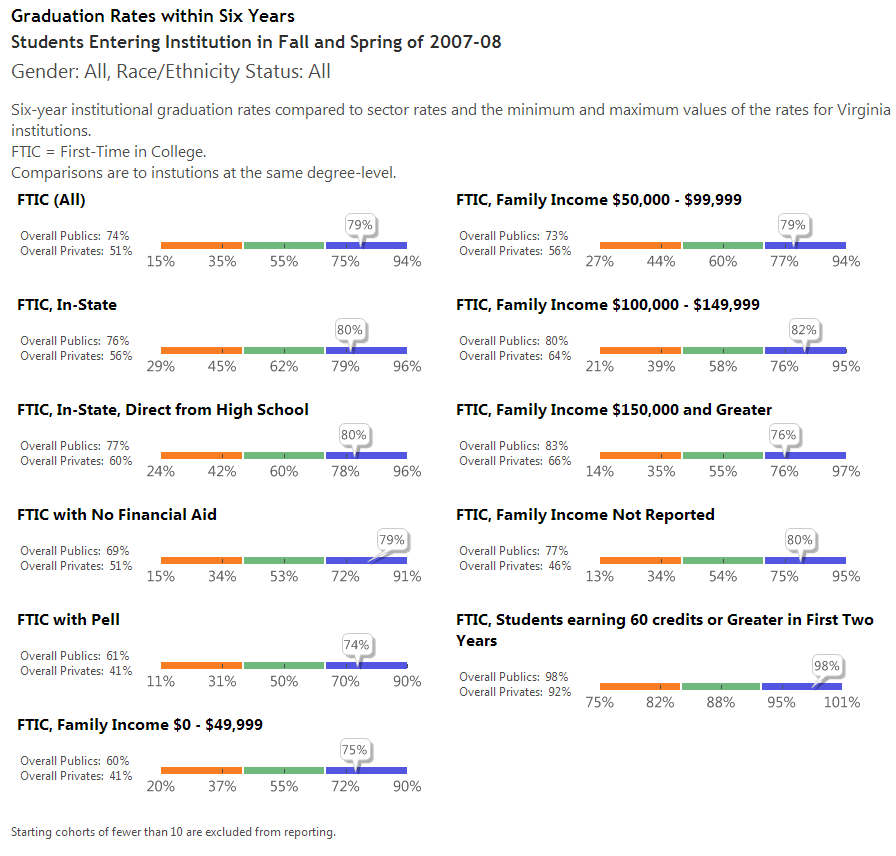
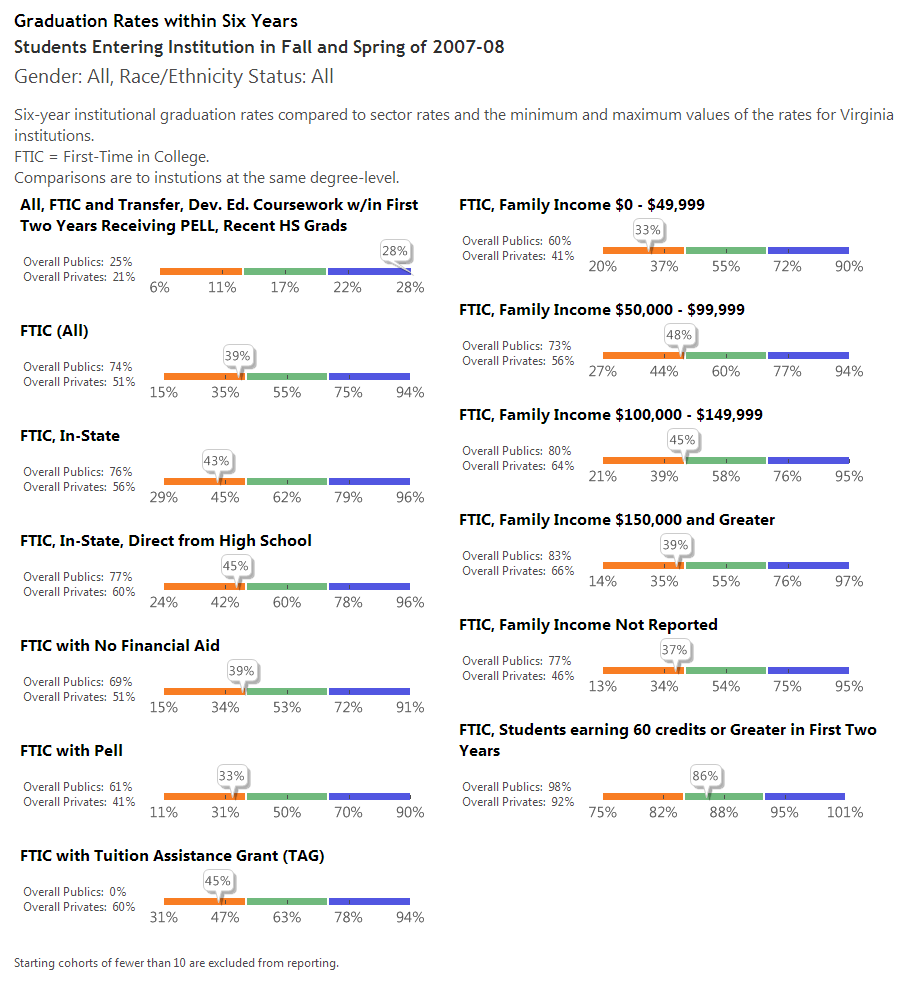
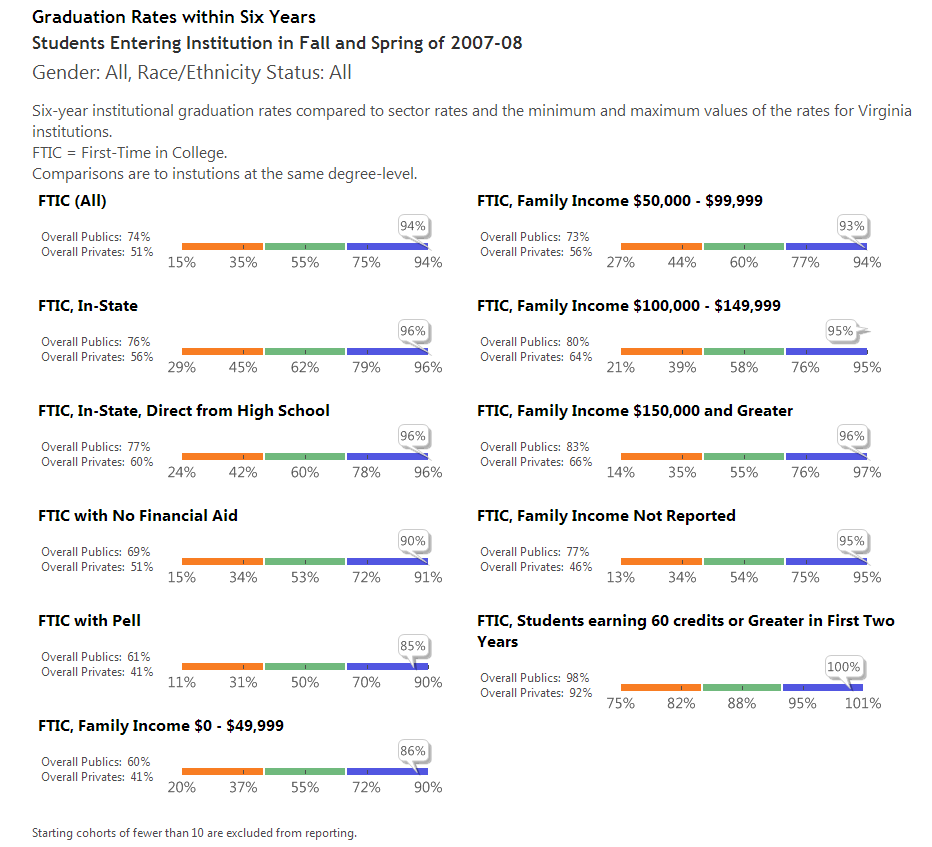
Let’s take a quick look at four very different institutions. These images come from our publicly available institution profiles at http://research.schev.edu/iprofile.asp


Germanna Community College does not have high graduation rates (note these are not IPEDS GRS rates as they include students starting in the spring as well as part-time students). All of these are toward the lower end of the range of Virginia public two-year colleges.  There are a range of differences among the subcohorts, particularly between students from the poorest and the wealthiest families.

gao1

Even at the highest performing institution on graduation rates, one of the highest in the nation, there is still a range of difference. A full 10 percentage point difference between the poorest and wealthiest students.

gao2-uva

In the last two decades, CNU has more than doubled its graduation rates through transforming the institution and its admission plans. The differences between subcohorts are much smaller, but this has come at a price of denying access to students that sought an open-enrollment institution.

gao3-cnu

Ferrum College has relatively low graduation rates and high cohort default rates. Using federal data, it does not look to be an effective institution. However, I will point out that it has the highest success rate with students requiring developmental coursework in the first two years. It apparently can serve some students well, and others better than other institutions.

gao4-fc

My point with these four examples is this. We need to drive improvements in student outcomes by focusing on differences within institutions, specifically subcohorts of students that are recipients of Title IV aid.